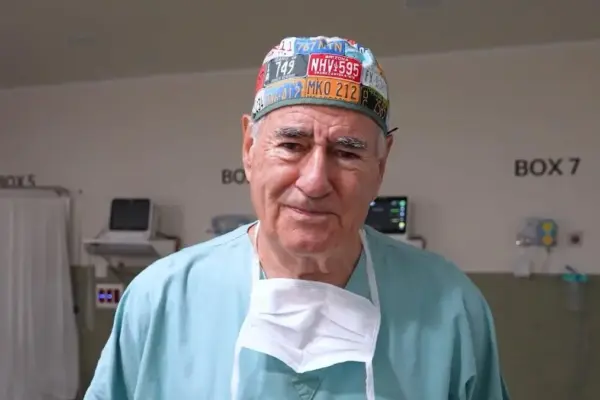
Javier de Benito, plastic surgeon, 78 years old: “If someone believes that a rhinoplasty will get them a job or make their partner come back, they need to be explained that surgery won't solve that”

Javier de Benito, plastic surgeon, 78 years old: “If someone believes that a rhinoplasty will get them a job or make their partner come back, they need to be explained that surgery won’t solve that”

There are surgeons who transform bodies and there are others who dedicate their lives to understanding the complex relationship between beauty, identity, and the way we see ourselves. Javier de Benito (Sabadell, 1948) belongs to that second category. At 78 years old, and after more than five decades in the profession, he continues to enter the operating room with the same purpose as on the first day: to help people reconcile with their image.

Read More
Ice baths: between science and posturing

Ice baths: between science and posturing

There was a time when luxury consisted of a five-star spa. Now the new symbol of well-being seems to be a three-degree bathtub. Cold plunging, immersion in cold water, has ceased to be an exclusive practice for elite athletes to jump into wellness centers, social networks, and wellness retreats. But in the face of this viral phenomenon, a question arises: are we facing a practice backed by science or the latest big wellness trend, or is it simply a moment of posturing?

Read More
Your grandmother became an adult at 13; you, at 24, still can't. Where does luxury end and need begin?

Your grandmother became an adult at 13; you, at 24, still can’t. Where does luxury end and need begin?

The new generations allocate part of their budget to mental health, sports, or education, needs that a few decades ago were not even part of everyday life. Prices in Spain have risen by 3.2% in the last year, a figure that coexists with a widespread feeling: everyday life has become more expensive in almost everything, even in what was not previously considered consumption.

Read More
The ‘fast tech’ trap: why we replace our mobile phone so often

The ‘fast tech’ trap: why we replace our mobile phone so often

How many of us still have the same smartphone today that we had during the 2022 Football World Cup? Surely few. Most of us change phones long before their useful life ends. We consume electronic products at an increasingly rapid pace and replace them prematurely. This trend is known as fast tech, fast and disposable technology, and it is causing serious damage to our environment.

Read More
The tyranny of the mobile phone, also for dating: Generation Z needs constant communication

The tyranny of the mobile phone, also for dating: Generation Z needs constant communication

Work emails, family chats, groups of friends organizing trips, birthdays, gatherings. To that hodgepodge of interactions that force one to look at the mobile screen is added, especially for young people, another tie to the digital world: keeping an actively stimulating conversation, exuding enough charisma and charm, to seduce —or show interest in— the person one wants to approach. Dating in these times, for many, represents another type of virtual slavery.

Read More
“If one day I don’t train, I feel guilty; everything tells me that if I age ‘badly’ it’s because I don’t take care of myself”: when the pressure for longevity generates guilt and anxiety

“If one day I don’t train, I feel guilty; everything tells me that if I age ‘badly’ it’s because I don’t take care of myself”: when the pressure for longevity generates guilt and anxiety

María stopped eating bread two years ago. Then she eliminated sugar, the little beer with appetizers, and practically any ultra-processed food. She started walking 12,000 steps daily, stopped using the elevator to always take the stairs, and signed up for daily strength classes. Additionally, she bought a watch that measures her sleep and every morning checks an app that calculates her “biological age.” She is 66 years old and, yet, says she has never felt so afraid of aging.

Read More
"As we age, metabolism varies and body odor changes"

“As we age, metabolism varies and body odor changes”

“I have always been a very olfactory person,” admits Laura López-Mascaraque. So much so that, as a child, her parents scolded her because before trying any food she needed to smell it. And she even used her sense of smell like a radar: “If I didn’t like someone, I didn’t want to give them a kiss,” she confesses. To that sensitivity was added a fascination surely uncommon decades ago. “While my friends wanted to be hairdressers or artists, I said I wanted to study and become a neurosurgeon.” For that reason, she decided to study the great forgotten sense: one that “was always left behind” and whose interest seemed reserved for a few fascinated by “that chemical world that surrounds us,” and who “knew how to appreciate its beauty and understand the emotions, memories, and experiences it can awaken,” she says.

Read More
Pedro Cano: “There are people who need to retire at 61 or 62 years old, but there are also many who want to keep working and now they can't always.”

Pedro Cano: “There are people who need to retire at 61 or 62 years old, but there are also many who want to keep working and now they can’t always.”

“No, the elderly are not a big expense. Longevity is an investment, these people have contributed throughout their working life and will continue to contribute from 65 onwards. And even if at 80 or 85 they have dependency, they will also continue contributing, because the services they need generate economic and social return.” This is how emphatically Pedro Cano, the first general director of the Gent Gran of the Generalitat de Catalunya, expresses the great importance of the senior group in our society.

Read More