









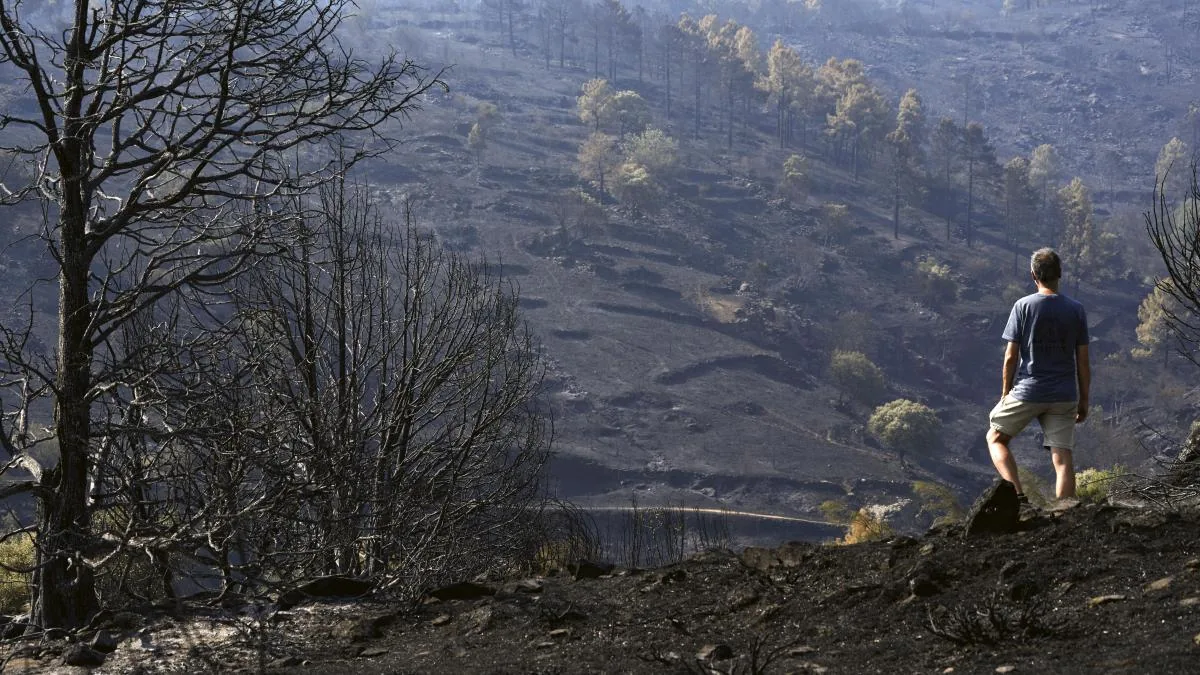
Human-caused climate change multiplied by 20 the conditions favorable for wildfires in the central peninsula this year. In other words, it made the extreme weather conditions that fueled these fires 20 times more likely than in a preindustrial world without warming. And in the case of the southwest region of France hit by the fires, climate change caused by human activities now makes disasters of this magnitude twice as likely.
Read more Ayuso is left without a penthouse
The study was carried out by the international group of scientists World Weather Attribution (WWA), which analyzes the links between climate change and extreme weather events.
In September 2025, this same team of researchers found that climate change had worsened last year’s wildfires in Spain and Portugal.
The team analyzed historical weather observations and used the Daily Severity Rating (DSR) indicator, which incorporates heat, drought, and wind conditions. The researchers examined the seven-day period with the highest index level in the central peninsula and southwest France, where the fires occurred, and compared it with simulations of a preindustrial climate.
Also read
The main conclusion of this work is that human-caused climate change has multiplied by at least 20 the probability of conditions favorable for fires like those recorded in central Spain, and by at least two in southwest France. The scientists point out that these are conservative estimates.
In both study regions, observations show strong trends of increasing probability and severity with global warming.
A world that is 1.4ºC warmer
“In the current climate, events of this intensity are expected to occur once every six years in central Spain and once every 20 years in southwest France,” says David García-García, professor in the Department of Applied Mathematics at the University of Alicante, one of the study’s authors.
“In a world 1.4ºC cooler, which is what we would have if we had not been emitting greenhouse gases, those weather conditions in Spain would be 20 times less likely; and the event would occur, instead of once every six years, once every 120 years at least, because the report shows even higher figures,” adds this professor.
Rainy winters, a danger
The report highlights that the transition from a wet winter to a dry spring is an increasingly decisive factor in wildfire risk in Western Europe.
They contribute to vegetation growth, which later dries out and becomes fuel for fires.
Above-average winter precipitation caused high soil moisture in these two European regions and favored vegetation growth. This was followed by abnormally dry and warm conditions that depleted soil moisture, especially at the surface, which is crucial for drying grasses and other fine fuels.
Read more A Supreme Court ruling causes an influx of migrants in Ceuta and forces the activation of the Army
Dryness and heat increased water stress in native vegetation, including shrubs and pines. All these conditions exacerbated the likelihood of ignition and rapid fire spread by providing more readily available fuel, the study’s conclusions state.
After the heatwaves
The weeks prior to the fires were characterized by a succession of extreme heatwaves and scarce precipitation across much of Western Europe, despite it still being relatively early in the season.
Recent studies have shown that climate change caused by human activities (burning coal, oil, and gas) increased the likelihood of these warm and dry conditions, essential for the development of extreme fire-prone weather.
Method
To assess whether climate change affected weather conditions favorable for fires in France and Spain, the researchers used historical weather observations and focused on the 7-day period of extreme risk in the most affected areas of both countries in July 2026. To understand changes in extreme wildfire risk, scientists compared this year’s fire-favorable weather conditions with the maximum conditions recorded in previous summers (June-August), within a comparable 7-day period. They then analyzed trends in the observed data and compared the current climate with simulations of a preindustrial climate. Fire-favorable weather conditions were characterized using the so-called Daily Severity Rating (DSR), an adaptation of the Canadian Fire Weather Index. This index reflects the overall impact of weather conditions on the likely wildfire risk and takes into account precipitation, evaporation, and terrain conditions, as well as daily heat, humidity, and wind. Together, it estimates the probable severity of a wildfire in case of ignition.
The fires released very large amounts of pollutants. In France, particulate matter near the city of Bordeaux exceeded the level considered “acceptable” for air quality by a factor of 20, while extremely poor conditions were felt even 400 kilometers away. This led to the release and distribution of the national strategic reserve of FFP2 masks to local pharmacies. This dangerous air pollution contributes to the accumulation of harmful conditions for a population already hard hit by repeated heatwaves since May.
Simon Stiell, Executive Secretary of the United Nations Framework Convention on Climate Change, stated:
“These mega-fires highlight how quickly extreme heat and drought, caused by climate change, can turn wildfires into devastating national disasters (…). The fact that humanity continues to burn colossal amounts of coal, oil, and gas is warming our planet. This makes these conditions more dangerous and these mega-fires more deadly and destructive. But the solutions are equally clear: all countries must accelerate the transition from fossil fuels to renewable energy and protect the population from worsening climate change effects, from wildfires to mega-storms and floods, to droughts affecting food production.”
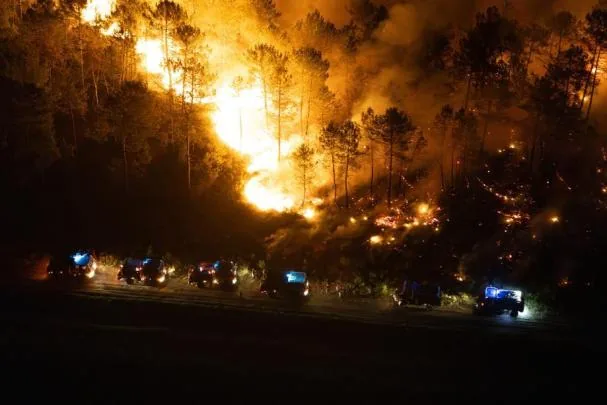
The weather conditions in the regions affected by wildfires have been the subject of numerous recent studies. In recent weeks, the WWA team has published analyses showing that both the June heatwaves and the drought currently affecting Europe were caused by anthropogenic climate change.
In September 2025, the team also found that climate change had worsened the previous year’s wildfires in Spain and Portugal. Another analysis of the 2025 fire season reached similar conclusions.
Friederike Otto, Professor of Climate Science at Imperial College London
“Another disaster caused by the same factor: burning fossil fuels”
“Our studies repeatedly show that Europe’s climate is changing faster than governments can adapt. Last year we documented the fires in the Iberian Peninsula; more recently, our research highlighted how climate change is worsening drought across the continent. Now we are witnessing another disaster caused by the same factor: burning fossil fuels.”
“Science does not care if this year follows record fires, if governments are prepared, if winter rains were sufficient, or if this happens after several heatwaves that have exhausted resources and the population. Climate change means that the right combination of weather conditions that creates a tinderbox and turns it into a catastrophe occurs much more frequently.”
Read more An 82-year-old man drowns in a private pool in La Sénia


