








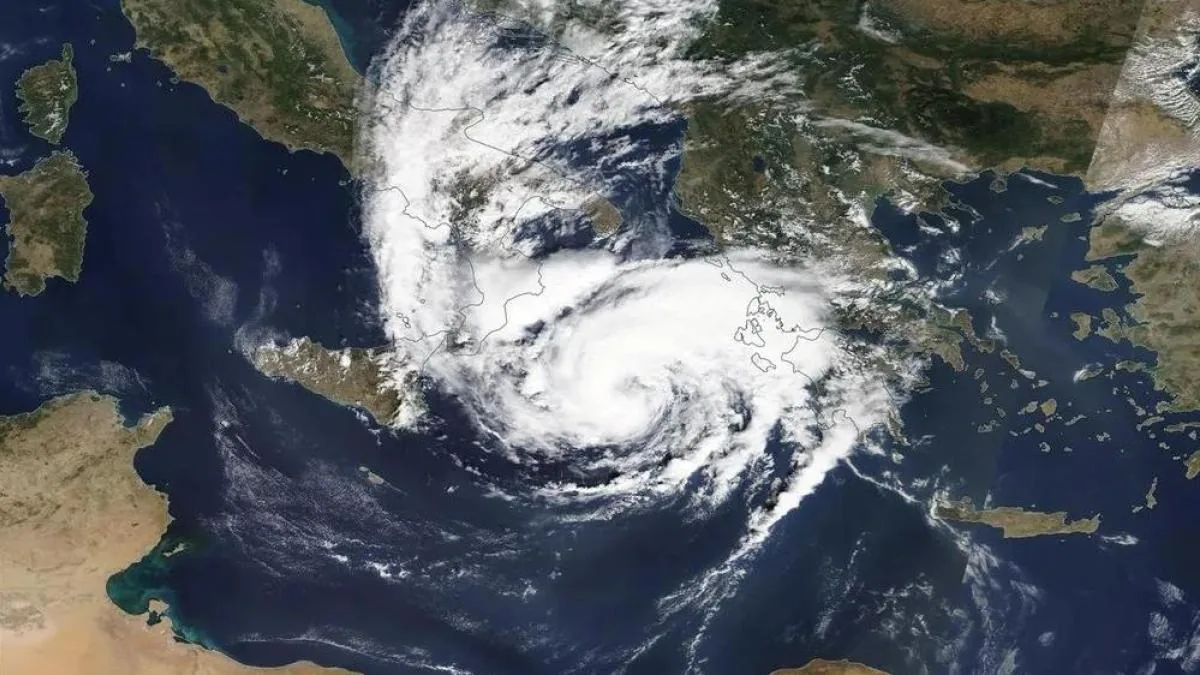
Meteorologists warn of the possible formation of a medicane —hurricane in the Mediterranean— in North Africa between Malta and Sicily. Maps show the possible creation of “a cyclone with characteristics similar to those of a hurricane that forms over the Mediterranean Sea,” warn institutions such as the Institute of Geosciences (IGeo) of the CSIC-Complutense University of Madrid (UCM).
Read more A Russian warship fires two flares at a Danish helicopter in the Baltic
The high temperatures reached by the sea this summer are one of the key ingredients for this phenomenon. After a summer that has broken all heat records to date —2026 has been the warmest in the historical series (which begins in 1961), with an average temperature of 24.5 ºC and 61 days under a heatwave—, the Mediterranean has reached heat peaks in the Balearic Islands of more than 33º C or more than 30 °C in Tarragona and Barcelona.
The Dragonera buoy, in the Balearic Islands, recorded a water temperature of 33.02º C on August 5, the highest value ever recorded in the port authority’s buoy network. But almost all the buoys in the Levant-Balearic basin of the Mediterranean broke local temperature records during the summer, according to the authority. The coastal buoys located off Tarragona and Barcelona, in northeastern Spain, recorded 30.7 °C and 30.5 °C, respectively, on August 9.
Record temperatures were also recorded at several buoys in northern Spain. On June 23, the buoy located near the town of Pasaia, in Gipuzkoa, recorded 28.4 °C. Another buoy, equipped with a temperature sensor since 2006, recorded a record of 25.27 °C on August 12.
“Although it looks like a hurricane in satellite images, it is usually smaller and less intense,” they report in a post on X from the IGeo account. “Still, it can generate strong winds, torrential rains, and very dangerous waves.”
What is a medicane?
In September 2023, three years ago, a medicane caused catastrophic flooding in Libya, leaving more than 11,500 dead and 10,000 missing. The brutality of the phenomenon devastated the city of Derna, destroying nearly 900 buildings.
Read more Moscow warns Poland that it will cease to exist “in 2 or 3 days” if it attacks Russia
The word medicane is a term adapted from the English medicane (from Mediterranean and hurricane), used generally to refer to “Mediterranean cyclones that exhibit tropical characteristics.”
According to the Aemet document Prediction of medicanes, it refers to small cyclones that develop over the sea and mainly affect maritime areas, islands, and coastal zones. This phenomenon can cause very strong winds, maritime storms, and even flooding, resulting from very intense rains.
Specialists recognize that this phenomenon is relatively new and uncommon. However, the number has grown significantly in the last two decades.
Another factor that could influence its development is the increase in water temperature, although it has not yet been determined to what extent it could influence. In any case, specialists such as the Aemet spokesperson, Rubén del Campo, clarify that it does favor these more explosive situations because in the end “it is like having more fuel.”
Read more The Government launches investments of 13 billion in airports with minimal fare increases


