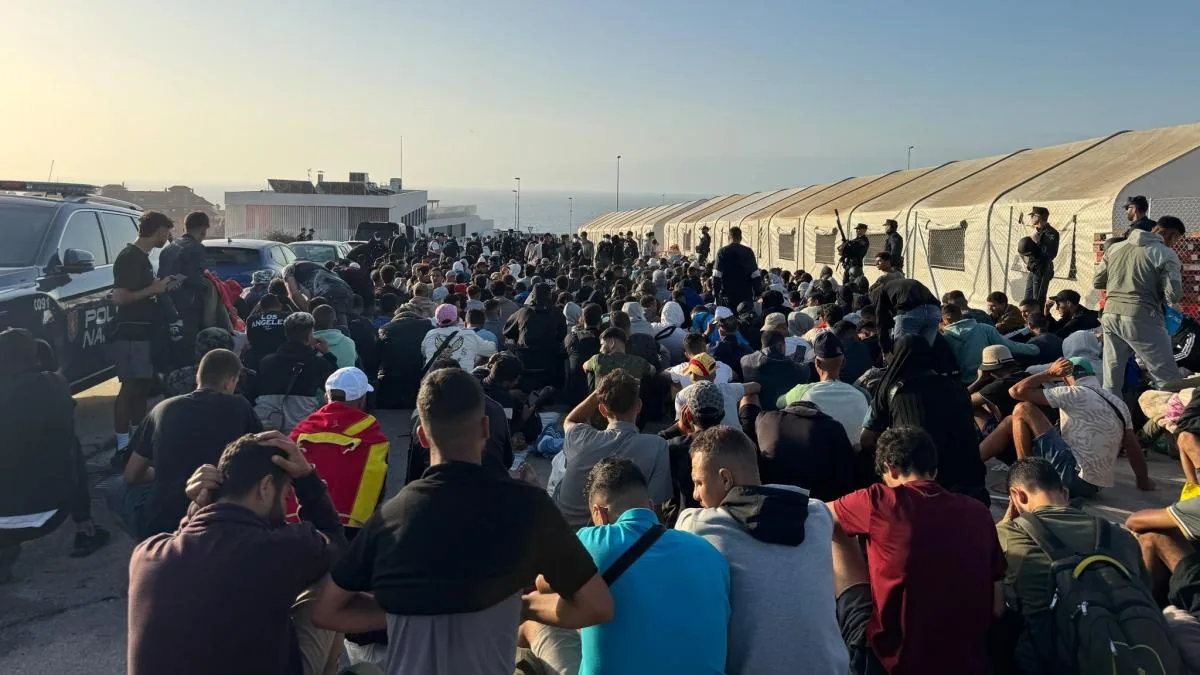









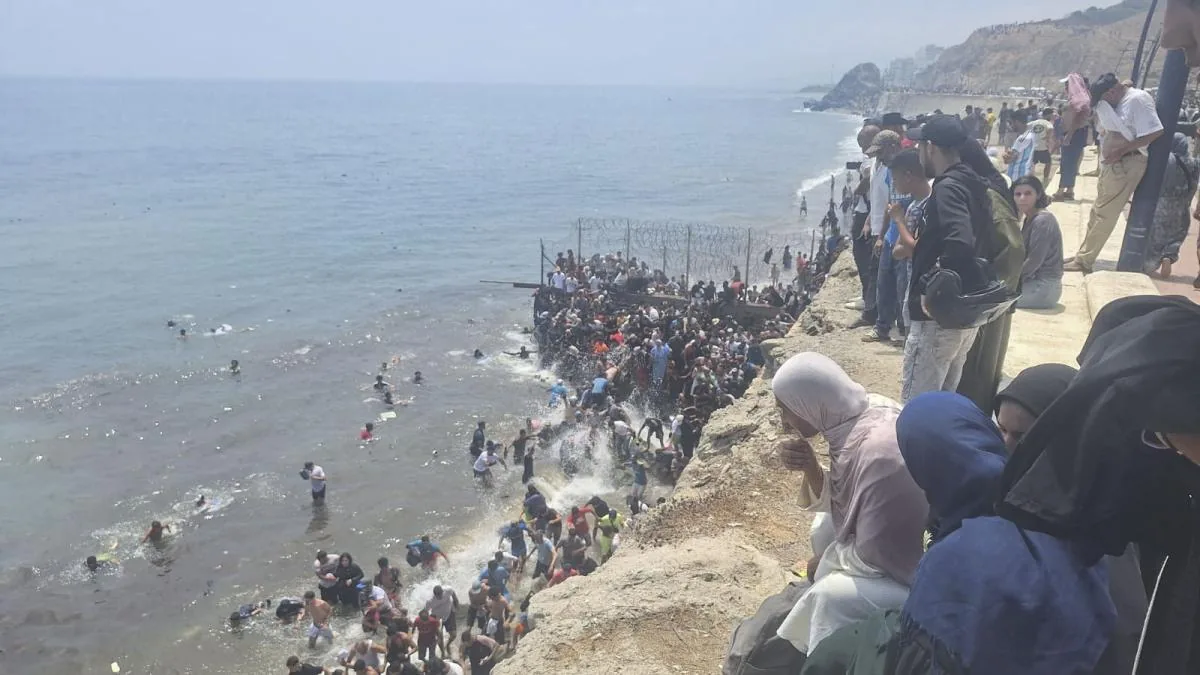
The Supreme Court ruled on July 8 that “hot returns” are not allowed for migrants intercepted at sea who attempt to enter the cities of Ceuta and Melilla by swimming. A few weeks later, the autonomous city has been experiencing a massive influx for days of thousands of migrants, mostly Moroccan, many of them swimming. The Ministry of the Interior rules out that the Alaouite authorities have ceased to carry out their surveillance functions. Yesterday, the 30th, was Throne Day in Morocco.
Read more An 82-year-old man drowns in a private pool in La Sénia
The Prime Minister, Pedro Sánchez, will travel to Ceuta today while the Italian Government is considering suspending the Schengen area in the case of Spain given the circumstances being experienced at the border with Morocco, reports Francesco Olivo.
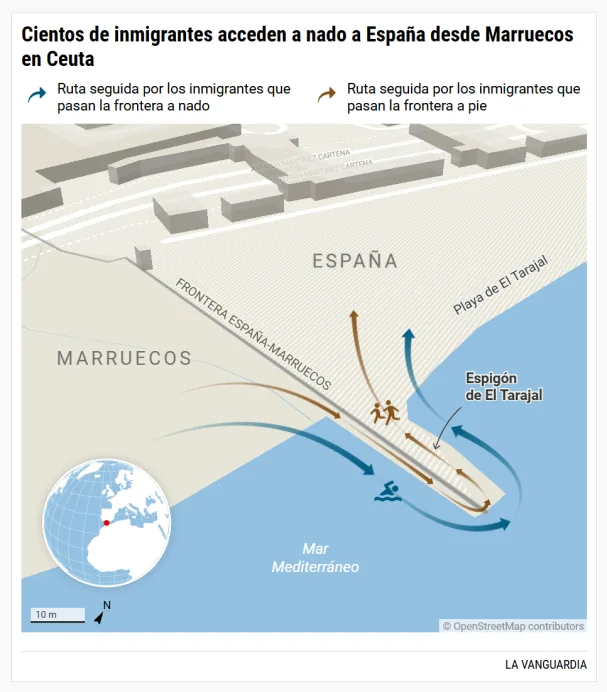
The truth is that yesterday thousands of young Moroccans arrived at the border between Castillejos, in Morocco, and Ceuta to cross the fence that separates the two cities and hundreds of them were able to do so without anyone stopping them since it was not guarded at that moment by the police. At this border crossing, at least 16 people drowned, whose bodies were recovered. In total, since the jump began, 44 have died.
Meanwhile, agents of the Moroccan auxiliary forces responsible for security on land withdrew to let the young people pass. Sources familiar with the facts argue that there has been no collusion by the Moroccan government but that this situation caught them off guard, to which, they say, remedies are already being put in place while social networks filled with messages of a new green march.
Sánchez will travel to Ceuta today while Italy considers suspending the Schengen area
Yesterday was Throne Day in Morocco and the ambassador to Spain, Karima Benyaich Millán, assured that Rabat’s cooperation in this crisis was total. “Governments are continuously in contact to resolve this situation not desired by the Kingdom of Morocco.” However, agents of the Moroccan auxiliary forces responsible for security on land withdrew to let the young people pass. Meanwhile, social networks filled with messages of a new green march.
Interior sources, however, assured that the Moroccan Government is cooperating in a “loyal and permanent” manner with Spain and collaborating “closely” to face this situation.
In this coordination effort, the authorities of both countries have committed to reviewing and implementing measures for the delivery, “as soon as possible,” of all persons who have entered Ceuta illegally. Another matter is what happens later with the appeals filed through various associations via the contentious-administrative route or the situation of the minors who have managed to enter.
Sources familiar with this situation explain that it has been detected that after the Supreme Court ruling there has been intense dissemination of information through social networks, in some cases promoted by criminal organizations that have sponsored this massive entry, causing a call effect.
Read more Border closed between Spain and Morocco in Melilla
Ministerial sources say the ruling has generated a call effect through social networks
The Administrative Litigation Chamber of the high court argues that interpreted under the Immigration Law, the return can only be executed when attempts are made to overcome the border containment elements to cross the border irregularly. However, for the magistrates, the special regime of Ceuta and Melilla only contemplates the return for those who try to do so by overcoming some physical object such as fences. According to the court, water does not constitute this containment element.
Ministerial sources trust that there may be an agreement between the two countries to proceed with the return of those who have entered illegally without major judicial obstacles.
As a result of this crisis, the president of Ceuta, Juan Jesús Vivas, described the migratory pressure situation the autonomous city has been suffering in recent days as a “national emergency.” “It must be addressed from that perspective, as a national emergency through a decisive, energetic, proportional, forceful, immediate action that is coordinated through a single command” of the Government, he said in an interview on Onda Cero. The Popular Party leader estimated that 1,500 had entered, which “means almost the equivalent of 2% of the entire population of Ceuta.”
The Ministry of the Interior warns of the impossibility of activating the declaration of national interest emergency in Ceuta after the arrival of thousands of migrants swimming in recent days, as requested by its president Juan Jesus Vivas.
Interior says it will try to return the Moroccans who entered Spain yesterday
Ministerial sources explain that the declaration of national interest emergency is part of the state civil protection regulations, which do not contemplate migratory flows nor establish special plans, basic guidelines, or specific civil protection instruments for their management.
The specific risks contemplated in the civil protection regulations that may lead to the declaration of a national interest emergency are the natural and technological risks expressly provided for in the law, that is, floods, seismic and volcanic risks, adverse meteorological phenomena, forest fires, accidents involving hazardous substances, nuclear and radiological risk, and technological risks.
Read more The number of bodies recovered from the sea in Ceuta in the last 24 hours rises to 12