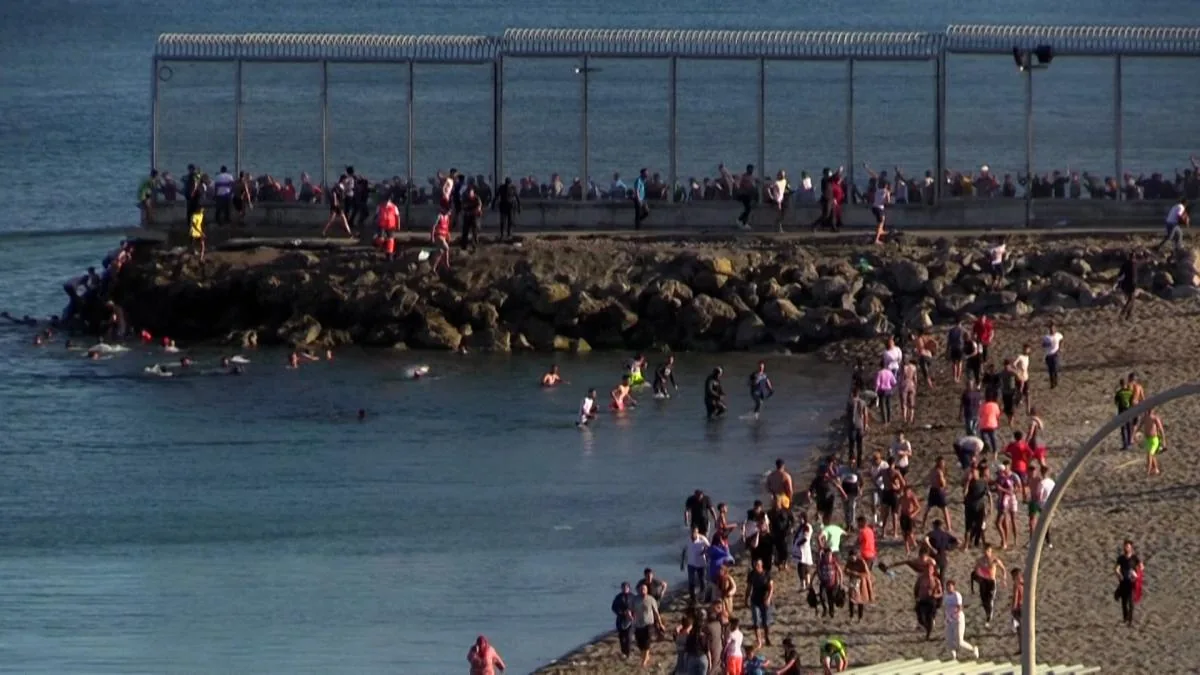
The national deputy secretary of Sectoral Coordination of the PP, Alma Ezcurra, has announced that the party will register a proposal to reform the Organic Law on Foreigners with the aim of providing legal coverage for immediate returns, known as ‘hot returns,’ of those who try to access Ceuta and Melilla irregularly and by swimming.
Read more Practical experience is more important than family connections for finding the first job
Ezcurra traveled to Palma, where she held several meetings dedicated to analyzing the migration crisis with meetings with police unions and immigrant groups. She detailed that the proposal arises as a response to the recent Supreme Court ruling, which determined that border rejection supported by Spanish regulations is only applicable when interception occurs at the physical land containment elements — the fences of the autonomous cities — expressly excluding access by sea or swimming.
“The border rejection regulation was approved in 2015, when migratory pressure was concentrated on the fence. However, today the pressure is mainly occurring by sea,” argued Ezcurra, who defended that the initiative aims to provide “legal and juridical protection” to the State Security Forces and Corps.
The PP’s initiative will focus on reforming the Tenth Additional Provision of the Foreigners Law, which regulates the special regime of Ceuta and Melilla for border rejection. Ezcurra clarified that this urgent modification will be limited exclusively to both autonomous cities and will not extend to island communities such as the Balearic Islands or the Canary Islands. The popular leader justified this differentiation due to the characteristics of the territory and the mode of entry.
The measure is limited to the two autonomous cities
In the case of swimming entries in Ceuta and Melilla, the PP considers that these are immediate border accesses that allow direct return to the country of origin as they occur at the same geographical limit. In contrast, arrivals by boat to the Balearic Islands and Canary Islands are governed by a different maritime interception legal framework, where, according to the party, priorities include strengthening resources, increasing police presence, and effectively deploying the European agency Frontex.
Read more The Biennial of Digital Arts is born to make Barcelona the international capital of the sector
The PP leadership took advantage of the meeting held in the Balearic Islands to once again criticize the migration management of Pedro Sánchez’s Government. The congressman José Vicente Mar described the Executive’s migration policy as “irresponsible” and accused the Prime Minister of generating a “massive pull effect” that has multiplied irregular arrivals on the Balearic coasts through the so-called Algerian route. He highlighted that in 2018, 700 migrants arrived on the islands, and last year it was already 7,500.
The PP asks Sánchez to return to a “State” foreign policy
For her part, Ezcurra has demanded that the central Government “comply before asking” following the recent entry into force of the European Pact on Migration and Asylum. Likewise, she denounced that Spain lacks the necessary infrastructure, police forces, and detention centers due to “two years of inaction and lack of foresight” by the Ministry of the Interior.
Regarding the announcement that Pedro Sánchez will soon travel to Algeria, she asked the president to return to a “State” foreign policy and assured that the problems with Algeria are related to the Government’s change of position regarding the Sahara “which Spaniards do not understand and which has brought some problems, among others, to the Balearic Islands.”
Read more The CIS places the PSOE again eight points ahead of the PP despite Ábalos’s conviction