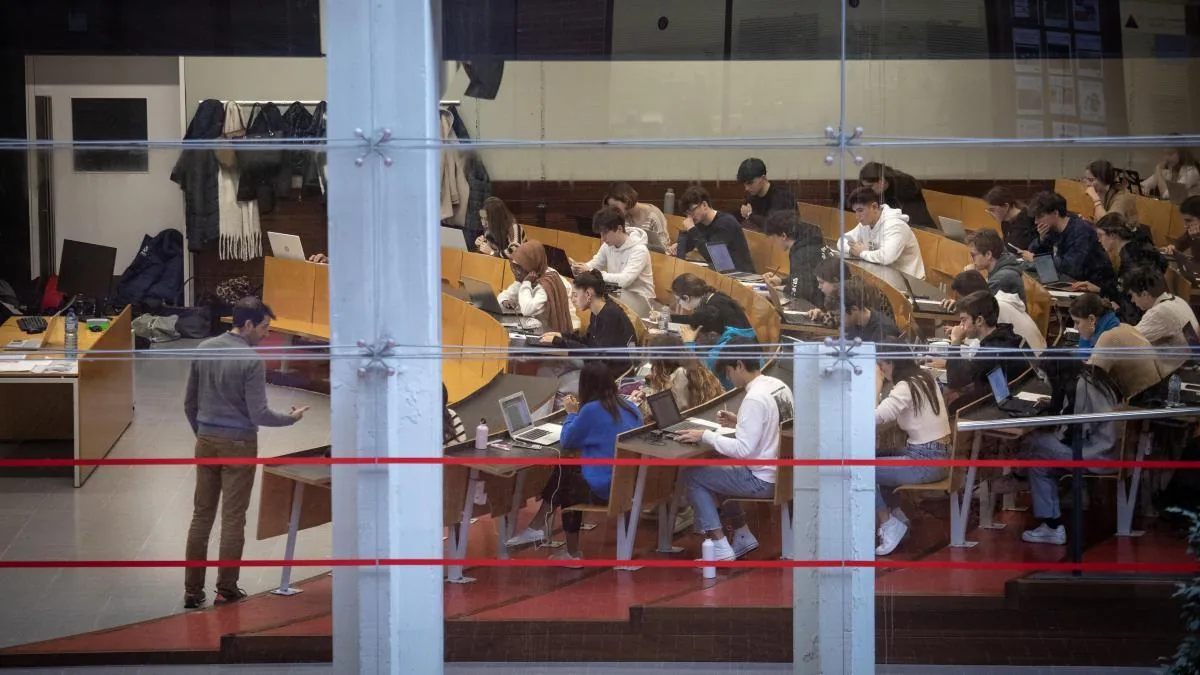
The new edition of the employment insertion study of university graduates by the quality agency AQU Catalunya is filled with interesting indicators. The Catalan agency surveyed nearly 26,000 young graduates who graduated three years ago about the conditions under which they obtained their first job, job satisfaction, and their contract and salary conditions. And it compared it with previous editions. Here are some of the conclusions of this study presented this morning by the Minister of Research and Universities, Núria Montserrat.
Read more The Biennial of Digital Arts is born to make Barcelona the international capital of the sector
Connections no longer work as they used to for finding a job; internships done during the degree and personal skills are more important, especially in technological and scientific degrees.
Double degree students find employment faster, but only in one of the studied fields.
University graduates find work quickly and earn a little more than in previous editions, but they do not live better than those from fifteen years ago because inflation erodes purchasing power. As usual, women earn less than men in comparable positions with differences of up to 480 euros in Medicine and 470 in Civil Engineering.
The pattern of taking a master’s degree after the degree is broken. Now, they enroll in the master’s while working, and one in three does it online.
Graduates give a high mark to job satisfaction. And the survey provides a fact against general perceptions: most graduates stay in Catalonia to work three years after graduating, and there are more foreigners who studied here and stay here than Catalans who go to work abroad.
Internships and contracts
For years, the unwritten formula to enter the labor market in Catalonia largely passed through the family contact network. This is how graduates explained it three years after obtaining their degree in editions prior to this study. That pattern has changed. For the first time in the history of the AQU Catalunya Employment Insertion Survey, the main gateway to a first job is the internships that students do during their degree. In fact, contacts fall to fourth place, also surpassed by personal initiative and web portals.
The Catalan agency interprets this as a reflection of an “apparently more meritocratic” insertion system, in which the skills demonstrated during the degree weigh more than the family phone book.
Young people find a job quickly, which is usually stable, and the salary is better than previous cohorts, but inflation eats away their purchasing power
However, it is not the same in all degrees. In engineering, internships are extremely relevant; in the humanities field, it is personal initiative and personal contacts that help young people find work.
AQU has interviewed about 25,971 graduates from any university academic discipline who graduated in the 2021-2022 and 2022-2023 academic years (except Medicine, which interviewed graduates from two previous years). The data persist that engineering and health degrees present more “occupational quality,” measured by low unemployment levels and high job satisfaction. And that men continue to earn more than women in the same occupations.
The study points out that young people find work earlier than in previous cohorts. Three-quarters of students are employed three months after graduation. If they graduated in June, they started working before October began. And 70% sign a permanent contract.
There are significant differences between those who studied in the scientific and technological field and those who did so in the social and humanistic field
This picture is not the same for everyone. Engineering degrees are more in demand: 85.2% of graduates are hired within three months. At the other end is Sciences, where only 62.9% find employment in this period.
There is another notable aspect. Humanities students face more difficulties from a labor perspective, as they have less employment, are more overqualified for the tasks they perform (they would not need to be university graduates), their salaries are lower, and, in general, the quality of employment is lower.
In general terms, 75% of young people work in what they studied, and 87% do tasks that require a university degree. This alignment has worsened in activities such as Art and Design, Education, and Information Technologies.
Double degrees
This edition of the study includes, for the first time, specific data on double degree graduates. Socially, the labor usefulness of double degrees is valued, a training increasingly offered by universities and very attractive to students judging by its demand level. This year, for instance, the highest cutoff score corresponded to International Relations and Law, offered by the UAB. This double training has displaced Physics and Mathematics, which had been the degree with the highest score for 14 years. But there are other double and even triple degrees to which students attribute the guarantee of solid training and a labor advantage compared to those who have taken only one degree.
Well, the study confirms that these degrees improve employability: students find jobs more aligned with what they studied than those who take a single degree. Therefore, they work as long as they ensure a job upon finishing the study. However, only one-third of double degree graduates end up performing specific functions of the two disciplines they studied. That is, the extra effort of studying two degrees at once does not always translate into a position that really takes advantage of both profiles.
Read more The CIS places the PSOE again eight points ahead of the PP despite Ábalos’s conviction
Engineering and Social Sciences are the fields where that double profile is best leveraged, with 39% and 34.5% of graduates performing functions of both degrees, respectively. Even so, the vast majority of those who have taken a double degree feel very satisfied with what they studied and say they would not have preferred to do only one.
High satisfaction
The degree of satisfaction for all respondents regarding the studies undertaken is high. 71% of respondents would repeat the same studies, a figure that has increased compared to the 2023 survey.
Among those who would not repeat, disappointment with job prospects (almost half) or the design or quality of the degree stand out (the perception of it has improved compared to previous editions). “This fact points to a recovery from the negative impact that the health crisis had on the perception of study quality.” Tourism, paradoxically the country’s main economic activity, records the lowest satisfaction level with the degree: only 47% would repeat this degree.
History, the lowest earners
Although young people find work earlier, satisfaction with salaries is not high. According to the survey, nominal salaries of graduates have increased compared to previous editions of the study, but accumulated inflation in recent years has eroded that advance. Therefore, the purchasing power of university graduates in Catalonia has not yet recovered to 2011 levels.
Differences between disciplines are notable. History graduates earn the least, with an average gross monthly salary of 1,920 euros, while graduates in Medicine and Dentistry top the list, with 3,783 euros. In general, STEM degrees – science, technology, engineering, and mathematics – pay on average about 300 euros gross monthly more than the rest.
To that gap by discipline is added another, more structural: gender. Salary differences between men and women are statistically significant in most analyzed fields and systematically favor men. In Medicine and Dentistry, the gap reaches 484 euros monthly; in Civil Engineering, 466 euros.
Master’s not mandatory
AQU has also interviewed master’s graduates and doctoral candidates. In these chapters, it is worth noting that the master’s is no longer a “mandatory” training after the degree as it has been for previous cohorts.
Only 25% of those who finish a master’s do so immediately after the degree. The rest take it years later, when they are already working. Three out of four graduates already had relevant work experience before starting it. The master’s thus seems to become a tool for professional promotion throughout working life.
Rise of distance university
Probably due to the trend of training in a master’s while working, online university is used more frequently. The non-face-to-face university already trains one in three master’s graduates. This excludes some degrees, such as sciences, due to the need for laboratories.
Taking a master’s improves salary but does not reverse the loss of purchasing power (2,850 euros gross monthly on average). These studies seem to consolidate as a training ceiling. The percentage of those who do not continue training after the master’s has risen from 31% (2020) to 44% (2026).
On the other hand, the public administration does not value a professional with a master’s the same way the private sector does. 81.4% of master’s graduates have a permanent contract in the private sector, compared to only 52.9% in the public sector.
Balancing work and studies
Four out of ten graduates combined studies with a job related to those studies. According to the survey results, that prior experience helps them, once graduated, to be employed in what they studied. However, scientific studies require greater exclusivity, according to the data, compared to humanities and social sciences. Among the latter, 38% of young people work in tasks unrelated to their specialty. In contrast, 51% of future engineers work in positions requiring technological skills.
Satisfaction with the work done is high but depends, naturally, on whether the job obtained after graduating relates to the training. In any case, average satisfaction is high.
The vast majority of graduates from Catalan universities stay in Catalonia to work. Talent drain is small, according to the survey. Moreover, the retention of foreign talent graduated in Catalonia is higher than the departure of Catalan graduates abroad.
Finally, another notable fact is the attraction of international talent. 16% of respondents came from abroad to take the master’s, and almost half stayed working in Spain afterward.