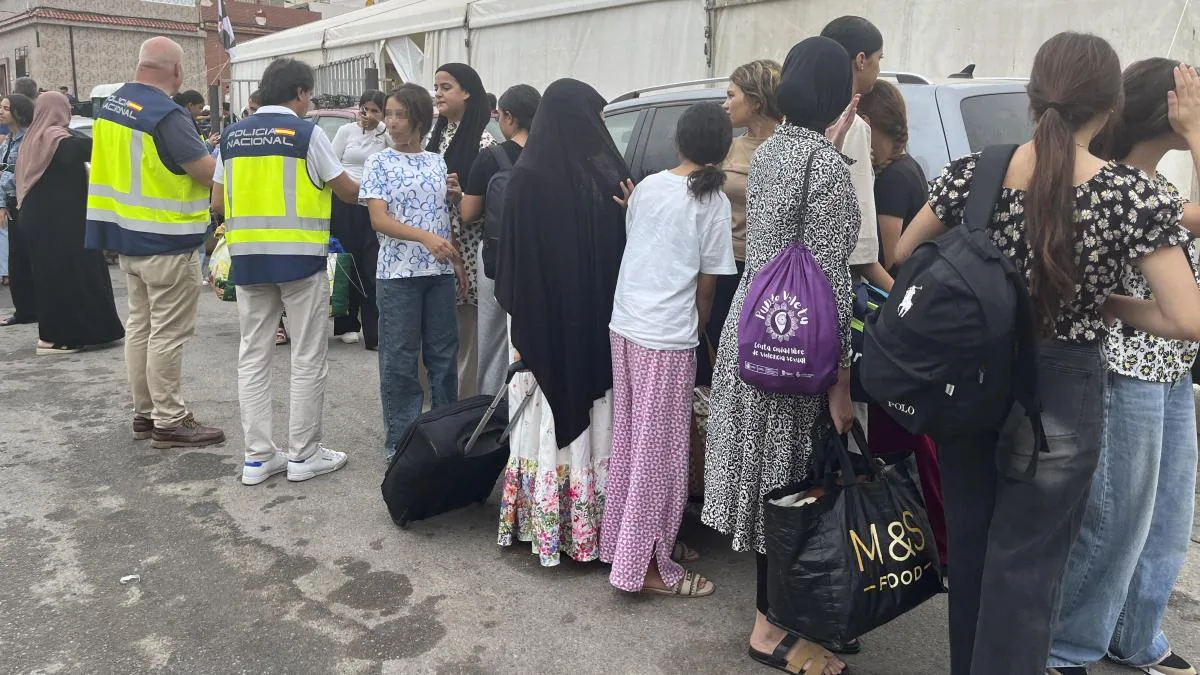
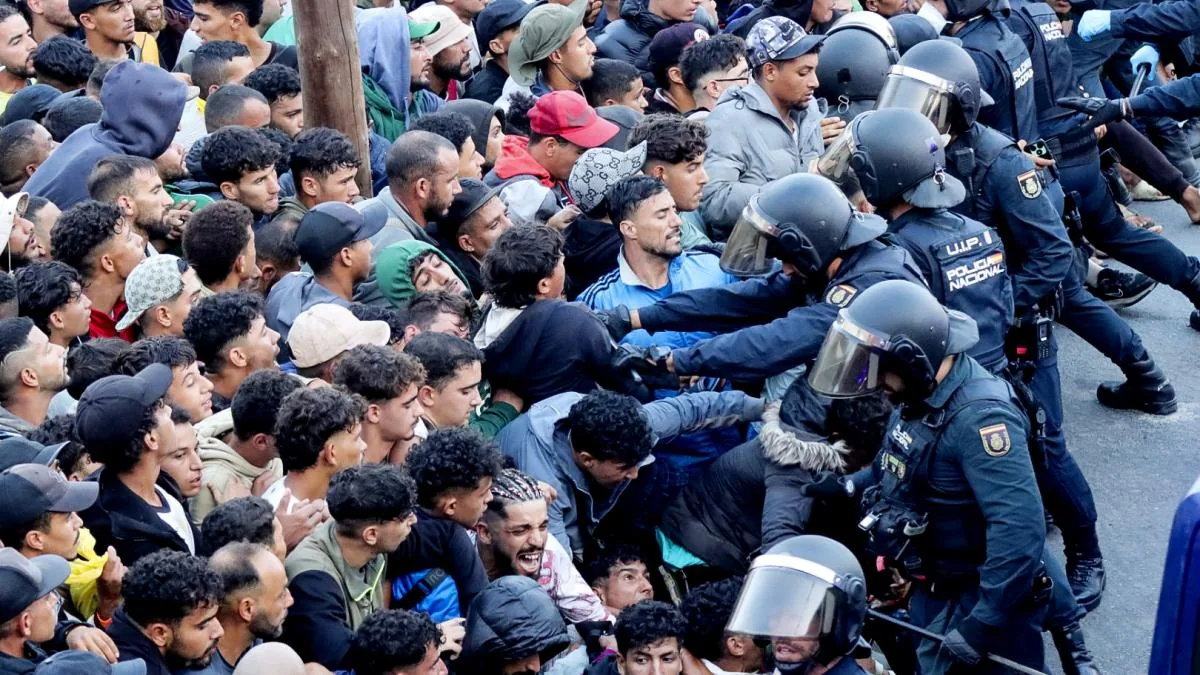
The Minister of Defense, Margarita Robles, using a report from the Defense Staff (EMAD), has attributed the arrival of more than 80,000 people in just 48 hours to Ceuta to a “self-management of individuals” who came “spontaneously” to the border attracted by messages on social networks warning of the lack of obstacles on the border perimeter. With this thesis, the Government focuses on the previous movements on social networks, which for Robles are “an essential instrument” of hybrid attacks thanks to disinformation campaigns. “Let’s not deceive ourselves. There are issues we will never know,” warned the Defense Minister about the origin of the assault, although she immediately pointed out that “interested actors” are using, or have even favored, this crisis with the “clear political purpose” of “destabilizing” Spain.
Read more The Government promotes the reform of the immigration and asylum law after the crisis in Ceuta
The Defense Minister has opened the round of extraordinary appearances of eight members of the Government to report on the actions of their ministries in response to the Ceuta crisis, triggered after the massive entry of more than 80,000 immigrants in just 48 hours. Robles moved to the Congress after attending early in the morning the National Security Council, which was convened yesterday, 25 days after the avalanche, and the Council of Ministers, where a single command was established to manage the migration crisis in the autonomous city. Before getting into the matter, the minister, as she already did from Ceuta on August 12, insisted that “it is essential that no one ever has the slightest doubt” about the Spanishness of Ceuta and Melilla, and repeated several times “so that there is no doubt” that the autonomous cities “are Spain” and “untouchable.”
Robles detailed part of the EMAD report in which it is confirmed that the crisis went through three phases, although these sometimes have blurred limits. The first, “with concentrated migration,” which begins on July 8 with the Supreme Court ruling and ends on the morning of July 30. In those days, the swimming crossing of the border by several hundred immigrants was prepared, to which thousands joined. In this phase, according to EMAD, a call effect favored “by an interested interpretation” of the Supreme Court ruling would be evident, in addition to the fact that on social networks a supposed decrease in police forces on the Moroccan side begins to spread, as a consequence of the celebration of the Throne Day. Here “great activity” was detected, especially in Facebook groups that were already created previously with the purpose of organizing crossings to Ceuta, which convey eminently practical information about routes, equipment, acquisition of neoprene suits and fins, as well as instructions for access.
In the second phase, called “massive assault” and which is set from 11:00 a.m. on July 30, several tens of thousands of people crossed the border “dominated by a sense of urgency,” since the analysis of the images shows that the vast majority were not prepared, had not planned the crossing, and took advantage of a window of opportunity. According to Robles, Facebook pages become inaccessible and are replaced by others of rapid dissemination, especially through TikTok, with information and images of people crossing the border without any obstacle, reivindicative messages about the ‘Moroccanness’ of Ceuta and Melilla, and images that would try to show inactivity of the border authorities.
Read more Defense and Interior present opposing versions regarding the warnings prior to the Ceuta crisis
The third phase, “the massive return to Morocco,” begins gradually at dusk on July 30 when a very high number of people, approximately 90% of those who entered, realize that the situation in Ceuta is hardly sustainable. The narratives on social networks in this case are of disenchantment with accusations and threats to Ceuta Muslims for not having supported them and incitements to carry out cyberattacks on Spanish organizations and proposals for sabotage against the electricity distribution system in Ceuta.
Thus, the Government places the role of social networks at the center of the triggers of the crisis. Robles has considered that lessons can be learned from this crisis that allow analyzing what happened to draw conclusions, although she warned that “there are many issues that will take time to be known, others that we may never know.” Thus, she pointed out the existence of “interested actors who have probably favored this crisis or are using it with a clear political purpose of destabilization not only of Spain but also of the European Union, in an international context, with the war in Ukraine, the situation in the Middle East, the resurgence of integrist radicalism in Africa, or the proliferation of hybrid attacks.”
This, in her opinion, “makes the reinforcement of a joint action of democratic societies in defense of our values and respect for the life and dignity of all human beings more necessary than ever,” in which the EU must continue to have an essential role. But also, the police forces, intelligence services, and judicial authorities to fight organized crime and against mafias that traffic in human beings. In addition, Spain and Morocco, as countries that share a border, must continue working together without sparing means or efforts to tackle irregular immigration.
Read more The press conference after the Council of Ministers meeting