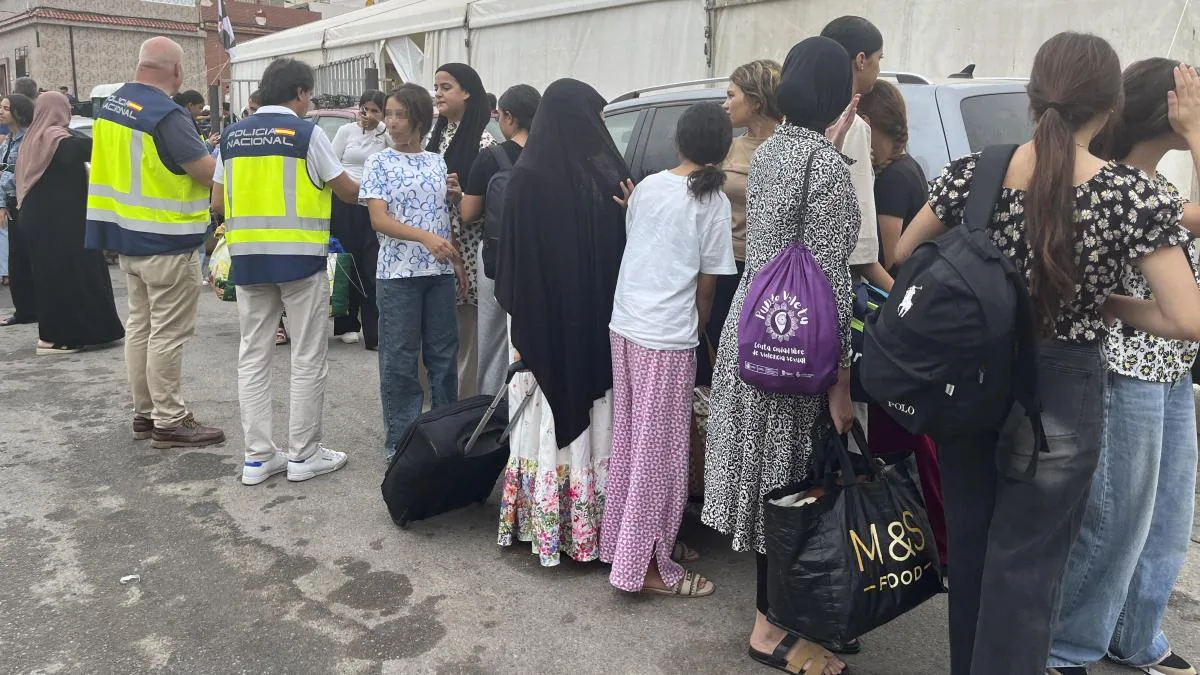
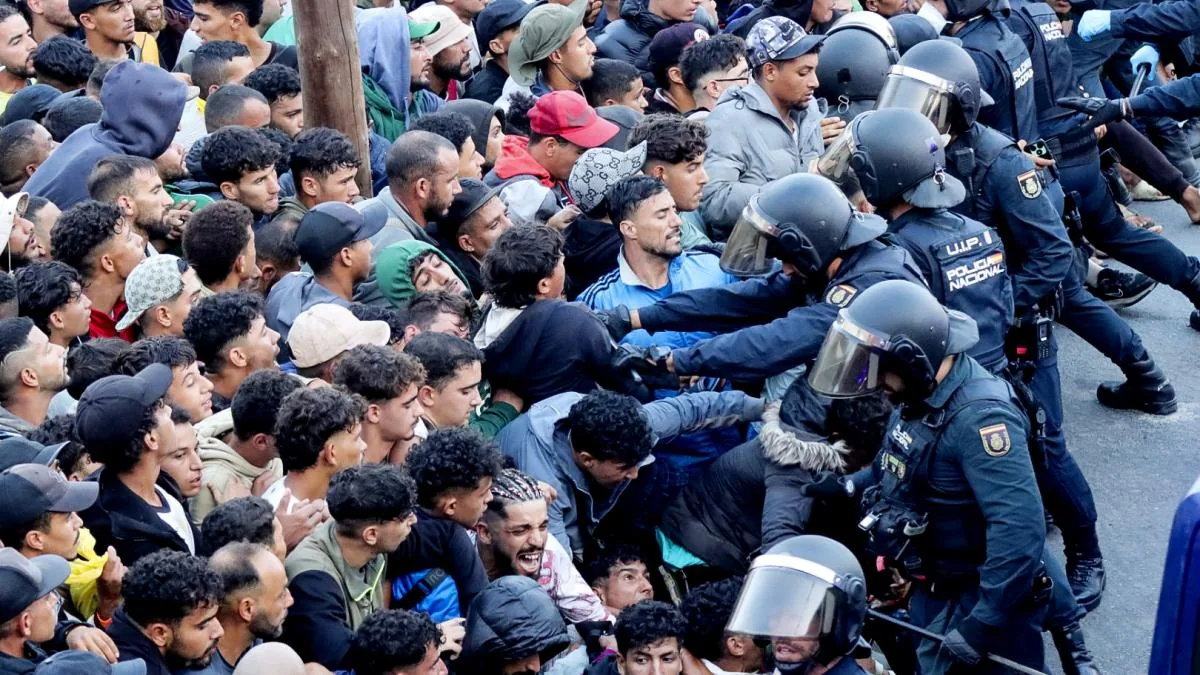
The Government has approved in its first Council of Ministers after the summer break two draft bills to reform the Spanish immigration and asylum system and adapt it to the new European Pact on Migration and Asylum. The Minister of the Interior, Fernando Grande-Marlaska, presented both initiatives at the subsequent press conference as an attempt to combine an “agile, effective and orderly” management of migratory flows with the maintenance of guarantees for migrants. The reform, he added, will also speed up the processing of international protection applications and improve “the necessary management of our borders to guarantee security in our country.”
Read more Defense and Interior present opposing versions regarding the warnings prior to the Ceuta crisis
The two regulations – a new Law regulating International Protection and a partial reform of the Immigration Law – develop in Spain the European regulatory package approved in 2024. Nine community regulations are already directly applicable, while Spain must incorporate into its legal system the European directive on reception conditions and specify some of the options left open by the community regulations. The Government itself had already included the new international protection law among its regulatory forecasts for this year.
The main novelty of the Immigration reform will be the incorporation of the so-called “triage” for foreigners who cross the external borders without having gone through the ordinary entry controls. It is a procedure prior to formal entry into Spain that will include identification, biometric data collection, a medical examination, a vulnerability assessment, and a security inspection, as well as the determination of the procedure applicable in each case.
The keys to the reform
A “triage” before entering Spain
A new border return procedure
Two ways to process asylum applications
More protection for vulnerable groups
A single law to organize the asylum system
The European Pact allows this process to last up to seven days, but the Government has decided to maintain a maximum period of 72 hours in Spain. It can only be extended by judicial decision. The declared objective by the Interior Ministry is to limit to the minimum necessary the stay of these people in the police facilities enabled to carry out the procedure.
The reform also incorporates the new border return procedure provided for by European legislation. In practice, people who arrive irregularly at the Spanish borders and do not have the right to international protection will be subject to a procedure that does not authorize their formal entry into national territory and will allow speeding up their possible return. This procedure will have a maximum period of 12 weeks. During that period, those who have applied for international protection must remain at the disposal of the Spanish authorities. In the case of those who have applied for international protection, if the request is rejected, they will receive along with the denial the corresponding notification that obliges them to leave the country.
The new asylum model also introduces different channels to examine applications. The future law will distinguish between an ordinary procedure and an accelerated one, which must be resolved within a maximum of three months, in addition to the border procedure, whose resolution may be extended up to 12 weeks. The reform also aims to organize the different steps to access the international protection procedure and specify its deadlines.
Read more The press conference after the Council of Ministers meeting
The Interior Ministry intends, with the new International Protection Law, to gather in a single regulation much of the rules that until now are scattered among different European and Spanish provisions. The objective is to provide greater clarity and legal certainty to a system that until now has relied on a scattered regulatory framework. The text will update the definitions of international protection, refugee status, and subsidiary protection and will expressly incorporate cases of persecution related to gender, gender identity or expression, and disability.
The future regulation will also strengthen the specific regulation of people with particular needs, with special attention to minors. The text contemplates the figure of the representative of minors who apply for international protection and specifies issues such as guardianship, the search for relatives, and the presumption of minority while the corresponding evaluation is carried out. It also regulates in more detail the reception conditions and the attention to the specific needs of minors, people with disabilities, pregnant women, and victims of torture, violence, or trafficking.
The Government emphasizes that the reform will maintain a “guarantee” perspective and will pay special attention to vulnerable people, minors, and family unity. Grande-Marlaska has defended that the adaptation to the European pact will not reduce the guarantees of those applying for international protection and has recalled that the Executive rejected the European regulation that contemplates return to third countries. At the same time, the minister has pointed out that the Government is working with the Hate Crimes Prosecutor’s Office to act against “far-right groups” and racist and xenophobic discourses.
The two texts were approved this Tuesday in the first round, so they still have to complete their processing before reaching Congress. The Government will seek reports from the Council of State, the General Council of the Judiciary, the Fiscal Council, and the Spanish Data Protection Agency, among other bodies, and will also send the texts to the ministries with competencies in the matter to incorporate their contributions. Therefore, it will have to be approved in a second round before being sent to the Cortes.
Grande-Marlaska has expressed confidence that the two initiatives can soon become bills and has advanced that the Government will then seek agreement with parliamentary groups. “Immigration and international protection policies are state policies,” the minister has defended, aspiring that the new framework obtains “the greatest possible political and social consensus.”
Read more Almost a month after the massive jump Ceuta will have a single authority from today