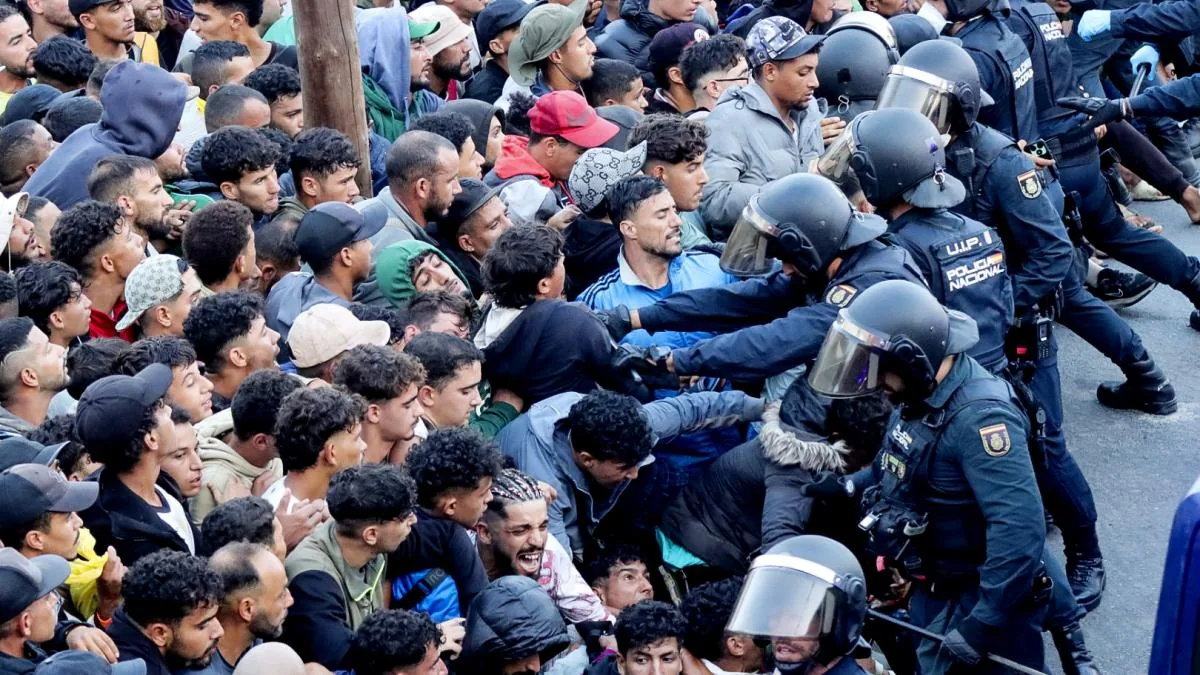
The Ceuta crisis has revealed contradictory criteria within the Government this Tuesday regarding the intelligence information available in the days prior to the massive entry of migrants on July 30 and 31. While the Minister of Defense, Margarita Robles, assured in Congress that the 25 agents of the National Intelligence Center (CNI) stationed in the autonomous city have shared and analyzed the information they had gathered with the State Security Forces and the Government Delegation, Fernando Grande-Marlaska stated at La Moncloa that “there was no report that foresaw that on July 30 what finally happened would occur.”
Read more The press conference after the Council of Ministers meeting
The discrepancy also occurred on the same day both ministers participated in the meetings of the National Security Council and the Council of Ministers, which made the lack of a common Government version on one of the central issues of crisis management even more striking. Whether the authorities had any prior alert about the possibility of a massive entry.
From Congress, the Defense Minister, on whom the CNI depends, insisted that the intelligence services have carried out the work that was “required” of them regarding irregular immigrant entries. A task that, according to her version, has been shared with the State Security Forces and Corps, dependent on the Interior Ministry, and with the Government Delegation in Ceuta.
Robles revealed that there are 25 CNI agents carrying out their mission in the autonomous city and detailed that their task consists of daily monitoring of the situation from multiple perspectives. From relations with bordering countries to the geopolitical situation on the southern flank, the actions of organized mafias and their use of networks, the increase in jihadist terrorism and, “obviously,” the development of irregular migration.
The minister lamented that the “legally imposed duty of secrecy” often acts as “a burden,” preventing the public disclosure of intelligence service actions. But she defended that this confidentiality cannot “be an obstacle” to “clearly stating” that the CNI has carried out “the work that was and is competently required.” According to her account, this work has been shared and analyzed with the State Security Forces and with the staff of the Government Delegation.
Robles also recalled that the speed of digital communications “increases the challenges and difficulties for border police and security and intelligence services to react in time to migratory attempts when these occur en masse.”
Marlaska has also maintained the position he has defended since the beginning of the crisis: that the CNI did not alert about the possibility of a massive entry. The Interior Minister assured that the Government did not have any report warning that on July 30 an entry like the one that finally took place would occur, when more than 70,000 people crossed irregularly from Morocco into Ceuta.
Read more Almost a month after the massive jump Ceuta will have a single authority from today
“There was no report that foresaw what was going to happen on June 30,” he initially stated, before insisting that “there is no report of those characteristics similar to what finally happened” in the autonomous city.
Marlaska argued that if there had been a forecast even remotely similar to that of May 2021, when around 10,000 people entered Ceuta in just two days, the matter would have been elevated “to the highest levels” to adopt the extraordinary measures necessary. “If something similar to what happened on July 30 of this year had been glimpsed,” he argued, the Government would have acted.
Despite repeated questions about the apparent contradiction with Robles, Marlaska did not want to comment on the words of the Defense Minister and limited himself to reiterating his own version. “No intelligence service from friendly countries, nor any other research or intelligence group, foresaw anything similar,” he concluded. From there, he defended that all public officials have acted “with the professionalism that is proper to them.”
Robles, for her part, and after parliamentary group spokespersons warned her of her contradiction with the Interior version, clarified that intelligence services operate “in many ways,” and sometimes there may be no written reports. According to Robles, on July 29, a day before the avalanche, CNI officials in Ceuta verbally conveyed to the Government Delegation that a call was being prepared to cross into Spain taking advantage of Morocco celebrating the Throne Day.
The divergence between both accounts leaves unresolved what specific information has been shared between intelligence services and security officials and, above all, whether the analyses made in the autonomous city allowed anticipating an episode of extraordinary dimensions. The unknown affects not only the coordination between Interior, Defense, and intelligence services but also the assessment made of the risks and how that information reached the bodies responsible for making decisions.
Read more António Costa, evacuated to a shelter in Kyiv after alarms sounded for a possible Russian attack