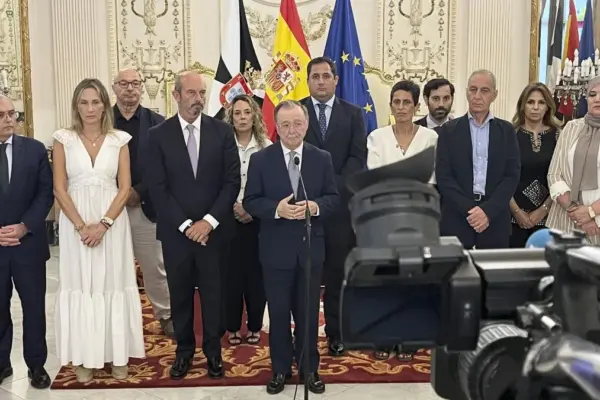










Madrid and Rabat raise vigilance in Ceuta amid calls on social media

Madrid and Rabat raise vigilance in Ceuta amid calls on social media

Two weeks after the massive entry that overflowed Ceuta, the border faces a new day under surveillance this Saturday. Morocco deployed an extraordinary device yesterday in response to calls on social networks to cross it again from Fnideq (Castillejos). Thousands of agents and military personnel, road controls, patrols in the forests, and new barriers in the sea are part of an operation aimed at preventing the entry of tens of thousands of people recorded last July 30 from happening again today.

Read Full News
The president of Ceuta urges legal changes to suspend asylum in cases of "invasion"

The president of Ceuta urges legal changes to suspend asylum in cases of “invasion”

The president of Ceuta, Juan Jesús Vivas, insisted this Friday in his request to the Government of Spain to reject and dismiss asylum applications. Thus, faced with a situation that remains of “maximum risk,” Vivas demands the “immediate” return to Morocco of all the migrants who stormed the border at the end of July and who have since remained in the autonomous city. However, this request clashes with international law, so the Ceutan leader has urged the General Courts to work on a “regulatory body” that provides an “immediate and urgent” response allowing for an “expeditious” action to return migrants when an “invasion or violation of the territorial integrity” of the State occurs.

Read Full News
Why is it so difficult to expel immigrants who arrived in Ceuta irregularly?

Why is it so difficult to expel immigrants who arrived in Ceuta irregularly?

Most arrived by swimming, although some entered on foot. Between 5,000 and 8,000 immigrants of Moroccan and sub-Saharan origin have been staying for two weeks on the beaches and streets of Ceuta. Many are minors. The Moroccan government demands the return of its children. The Spanish government assures that all will be repatriated. But the days go by and the immigrant settlements are consolidating in the autonomous city. Why is it so difficult to expel from Spanish territory the people who arrived irregularly?

Read Full News
Meloni insists on "tightening" surveillance ahead of the alleged incursion tomorrow in Ceuta

Meloni insists on “tightening” surveillance ahead of the alleged incursion tomorrow in Ceuta

The Prime Minister of Italy, Giorgia Meloni, has insisted that her country will continue “tightening” surveillance in anticipation of a supposed massive arrival of migrants to the autonomous city of Ceuta this coming Saturday and insisted that the “vast majority” of European countries share the drastic measures adopted by her Government, such as the suspension of the Schengen agreement with Spain.

Read Full News
Morocco and Spain secure the Ceuta border ahead of a new crossing call for tomorrow

Morocco and Spain secure the Ceuta border ahead of a new crossing call for tomorrow

The Moroccan authorities have activated an exceptional security operation in the north of the country to neutralize the calls widely spread on social networks, which incite a new massive entry into the autonomous city of Ceuta tomorrow, August 15, after the one led by more than 70,000 people two weeks ago. “The Ceuta border will be open on the 15th, a holiday in Spain,” some of these messages state.

Read Full News
The Government speeds up summary expulsions to clear the streets of Ceuta

The Government speeds up summary expulsions to clear the streets of Ceuta

Return is the word that best explains the new direction of the Government in Ceuta: that of the adults who still remain in the city, that of the minors when circumstances allow – since their return requires greater guarantees and a specific procedure – and, above all, that of normality. Because Moncloa’s priority is no longer so much to manage the crisis opened on July 30 and 31 as to close it.

Read Full News
The Government ignores Rabat's messages and avoids diplomatic clash over the sovereignty of Ceuta and Melilla

The Government ignores Rabat’s messages and avoids diplomatic clash over the sovereignty of Ceuta and Melilla

The messages coming from Rabat, through its Minister of Justice, Abdellatif Ouahbi, either about the possibility of breaking the bilateral extradition treaty that operates between Spain and Morocco, or questioning the Spanish sovereignty of Ceuta and Melilla, an issue he says he repeatedly raises in meetings with the Spanish Government, do not alter the position of Pedro Sánchez’s Executive, which tries to cool down any kind of clash with the neighboring country and to avoid a diplomatic confrontation, with the migratory and sovereignty crisis as a backdrop.

Read Full News