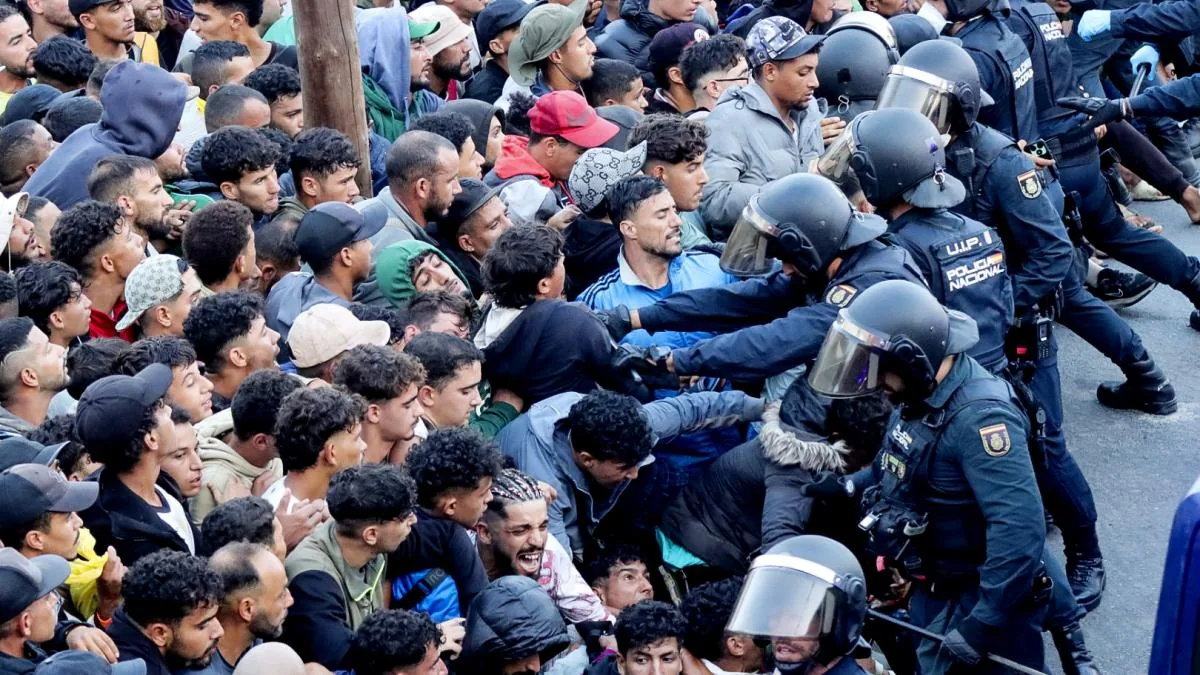
Most arrived by swimming, although some entered on foot. Between 5,000 and 8,000 immigrants of Moroccan and sub-Saharan origin have been staying for two weeks on the beaches and streets of Ceuta. Many are minors. The Moroccan government demands the return of its children. The Spanish government assures that all will be repatriated. But the days go by and the immigrant settlements consolidate in the autonomous city. Why is it so difficult to expel from Spanish territory the people who arrived irregularly?
Read more Sumar rejects the extension of Almaraz and says it violates government agreements
Spanish law, very protective, establishes a long and complex procedure to decree the expulsion of people who remain in Spanish territory after having entered illegally. In these cases, Organic Law 4/2000, of January 11, on the rights and freedoms of foreigners in Spain and their social integration (LOEX) and its implementing regulation, Royal Decree 1155/2024, in force since May 20, 2025, are applied.
According to this regulation, expulsion of people in this situation can proceed through a long procedure whose first step is identification. Thus, and according to article 23.2 of the regulation, the identity, nationality, age, circumstances of entry, whether they have documentation, whether there is a prohibition of entry, whether they have a record of expulsion/return, whether they request international protection, whether there are signs of trafficking, whether they may be minors, and any other circumstance of special vulnerability must be determined for each immigrant.

When starting this procedure, all affected have the right to free legal assistance and an interpreter if they do not speak Spanish. After being heard, the immigrant may be going through different circumstances. For example, if they claim that they are persecuted or face the risk of death in their country of origin, they can apply for asylum in Spain. This request cannot be ignored and obliges the activation of international protection guarantees. The law is more protective of immigrants who apply for asylum and come from countries considered “unsafe” such as Syria, Afghanistan, Sudan, or Ukraine. However, if the asylum request comes from a citizen of safe countries, such as Morocco, Colombia, or Egypt, the applicant will have to provide evidence that they are in danger in their place of origin.
The case of minors
Many of the immigrants who arrived in Ceuta are minors. Article 23 of the regulation provides that the return of a person cannot be executed when there are indications that they may be a minor and unaccompanied. In addition, article 35 of the LOEX regulates a specific protection regime for unaccompanied foreign minors. Thus, if any of the immigrants settled in the autonomous city claims to be 16 or 17 years old, or there are reasonable indications that they may be a minor, they cannot simply be treated as an irregular foreign adult and immediately returned. The law requires determining their age and activating, if applicable, the minor protection system.
The law also establishes special protection for victims of trafficking, who cannot be expelled from the country until their case is resolved. Possible trafficking victims have the right to be informed in writing in a language they understand and with an interpreter if necessary. In addition, they must know their rights and be aware that they can be referred to social and health services. In such cases, identification will be carried out by police personnel with specific training and qualifications, an interview will be conducted under appropriate conditions in the absence of persons belonging to the exploiters’ environment, and, when possible, legal, psychological, and assistance support will be offered. Pregnant women with medical risk and seriously ill persons are also considered specially protected groups.
Stateless persons
It may also happen that immigrants settled in Ceuta claim to be stateless. Stateless persons enjoy a special protection regime in Spain and are entitled to formally request recognition of statelessness before the Asylum and Refuge Office. Simply by submitting this request, the execution of any expulsion order is provisionally suspended. In addition, the Administration may authorize them to remain in Spain while their case is resolved. If, after the procedures, the Government formally grants the Stateless Status, the applicant acquires residence and work rights identical to those of a permanent legal resident, so they can no longer be expelled for “lack of papers” or mere irregular stay.
Who decides the return?
When an immigrant tries to enter the country irregularly and is located, return may proceed, but when they have been in Spanish territory for days, the expulsion process, which is much more complex, applies. In the case of Ceuta, it is the Government delegate who agrees on the expulsions.
Read more Regularization drives foreign employment to a record 3.5 million
However, there is a prior step established in article 58.6 of the LOEX, which determines that when the return cannot be executed within 72 hours of arrival, the judicial authority is requested to order internment in a Foreigners’ Internment Center (CIE) provided for expulsion procedures.
The immigrants who remain in Ceuta entered the autonomous city at the end of July, so the 72-hour period has been exceeded. However, there is no CIE in Ceuta. There is a CIE in Algeciras with a capacity for 500 people. Ceutans have a Temporary Immigrant Stay Center, which operates openly and is saturated. There are also not enough judges. The autonomous city has two administrative courts, which are responsible for immigration matters.
The expulsion procedure
Given the influx of people who arrived in Ceuta on July 31, most of the legal procedures established in the regulations have not been carried out. Internments, whose maximum duration is 60 days, have not been carried out, and identification processes are very slow. When these procedures advance, the Government delegation in Ceuta will be able to initiate expulsion sanction files ex officio after the due police proposal.
Precautionary measures such as passport withdrawal or the obligation to report periodically to the authorities can be taken. After the process is opened, the foreigner has a short period, between 48 hours and 15 days, to present evidence and allegations with legal assistance. The Administration has six months to issue a resolution and notify it. Expulsion orders can be appealed administratively or through contentious-administrative appeal before the courts.
If the Administration does not resolve within those six months, the file is archived, which may cause many of the affected immigrants to remain in Spanish territory. This archiving does not grant them nationality or residence permit, but it does cause the expulsion order to lapse and precautionary measures to be removed if imposed. In these cases, a new file can be opened, but the entire procedure must be repeated.
Thus, if the Government intends to expel the between 5,000 and 8,000 foreign persons who have settled in Ceuta, it will have to carry out the procedures quickly. It must also do so very scrupulously and following the legal mandates to the letter. The former government delegate in Ceuta Salvadora Mateos and the former president of the autonomous city government Mabel Deu were sentenced for malfeasance to nine years of disqualification by the Provincial Court of Cádiz for having rapidly repatriated 55 Moroccan minors in 2021 without complying with all procedural formalities.
Read more Latvia shoots down a drone in its airspace and Finland restricts access to areas of the Baltic