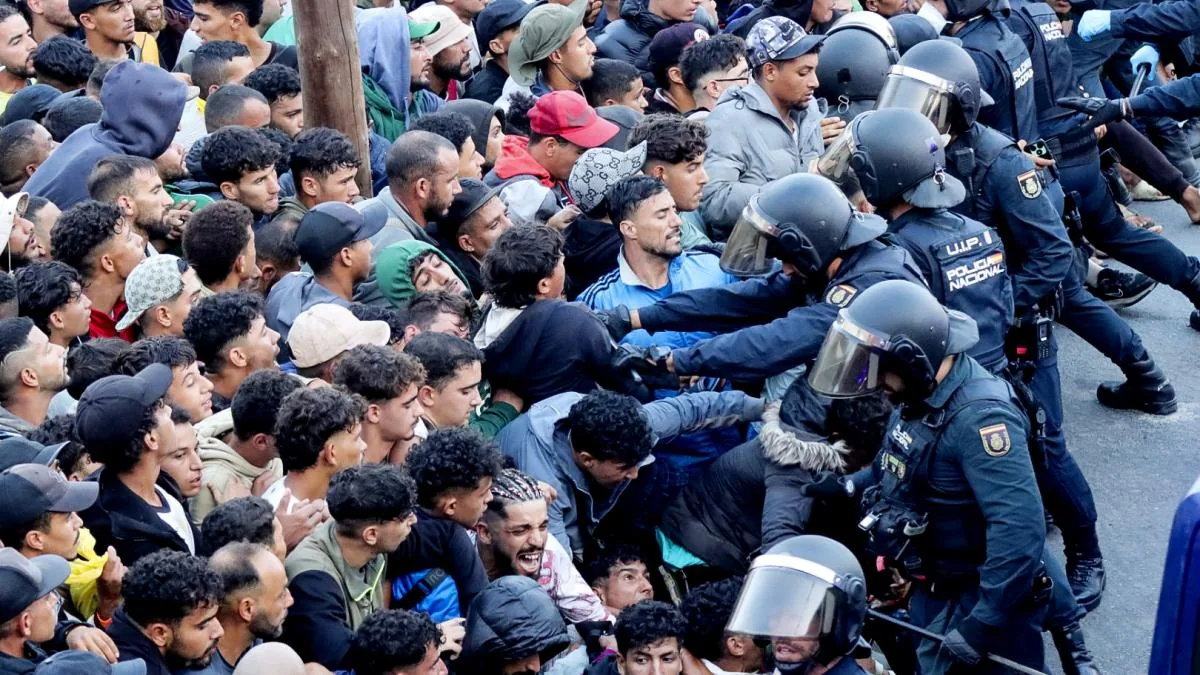
Ceuta continues to be the whirlwind that can engulf the Spanish Government. The declassification of Intelligence documents to try to prove that the Executive did not receive a clear warning about what could happen at the end of July has provided more information about the events in Ceuta, but it has not resolved the confusion about the behavior of state mechanisms on both sides of the border.
Read more The crisis claims the first resignation in Ceuta over the CNI warnings narrative
There were warnings, but these were not issued with flashing alarm lights. Everyone is right. The CNI and military intelligence detected that something could happen, they even warned the Moroccan intelligence services, but no one pressed the highest alarm signal, the signal that could immediately reach the Prime Minister’s desk. The focus is now on the Government delegation in Ceuta. Gonzalo Sanz, chief of staff of the delegate, received a warning message from a CNI agent and even had a phone conversation with him. The delegate, Miguel Ángel Pérez Triano, has maintained from day one that he did not receive any official communication from the CNI. His chief of staff has resigned for “personal” reasons and due to disagreement with the version given by his boss. It is likely that this will not be the only resignation.
The president of the autonomous city of Ceuta, Juan Jesús Vivas, 26 years in office, with a lot of experience, an old hand, as it was said before, went back on the offensive yesterday declaring that from Moncloa they told him not to call anymore after having communicated his concern in various phone conversations prior to the day of the crisis. Vivas points to the chief of staff of the Presidency of the Government. It is significant that the president-mayor of Ceuta did not emphasize that fact “-don’t call anymore-” in the early stages of the controversy. Vivas, very aligned these weeks with the leader of his party, Alberto Núñez Feijóo, knows how to navigate whirlwinds.
Has the declassification of documents served any purpose? It has provided more information, that is undeniable. Society today knows more than last week. Has the confusion decreased? No. There were warnings, yes, but they did not have the maximum alert lights on. A WhatsApp message cannot be considered a full alarm signal.
Given the documentary evidence of that reality, it is very striking that the Minister of the Interior and the Minister of Defense were unable to coordinate their versions days after a crisis with a very strong international impact. It is known that Fernando Grande-Marlaska and Margarita Robles, both former magistrates, have been at odds since day one. Someone was warned, but no one predicted the magnitude of the crisis. Minister Robles has wanted to close the controversy by admitting that the CNI did not gauge the magnitude of what was coming. Conclusion: the Transparency Operation avoids greater harm to the Government, but does not allow it to regain the political initiative.
There is also no unity of criteria in the main opposition party. Núñez Feijóo has had to call his territorial leaders to order so that they unify messages and do not spoil the Genoa score. Very harsh with Sánchez from day one, Feijóo was cautious with Morocco in the early stages of the crisis. On August 10 in an interview with the digital publication Ok Diario, the PP leader declared that his first trip as president of the Government would be to Morocco and announced the intention to maintain good relations with Rabat if expectations of a political change in Spain are confirmed. At that time, the PP was not yet talking about the ‘invasion’ of Ceuta. It would have been shocking if ten days after the “invasion,” Feijóo had shown prudence with the “invader.” On August 10, the social crisis in Ceuta had not yet erupted with all its acrimony, and Sánchez had not yet made the serious mistake of not moving during August from the summer residence of La Caleta in Lanzarote.
Since then, Feijóo has been raising the tone against Morocco to better punish the PSOE, but once again Isabel Díaz Ayuso has raised the stakes with an Attic perspective. “If I were president of the Government, I would break diplomatic relations with Morocco,” she declared to OK Diario on September 7. Alberto, top this.
Morocco issued a statement this week in which it affirms it is collaborating with Spain and rejects becoming a ping-pong ball in the harsh internal Spanish political battle. It is a statement that we can consider more critical of the PP than of the PSOE. The Populars have responded with another statement accusing Morocco of being responsible for what happened in Ceuta “by action or omission,”
Read more The Ceuta migration crisis sinks Spanish tourism to Morocco
José María Aznar comes in and out of the scene eager for a role. In August he traveled to Ceuta to claim the feat of Perejil and this week he presented in Madrid a lecture by the chargé d’affaires of Israel in Spain, Dana Elrich, in the absence of an ambassador, due to the downgrade of diplomatic relations between the two countries. The former president has wanted to open the geopolitical focus of the Ceuta issue. Aznar maintains that Spain has dangerously weakened its international alliances [referring basically to the United States and Israel], so today it is a weaker and more exposed country. Mrs. Elrich wanted to dissociate Israel from what happened in Ceuta, but she let slip a statement that is being the subject of much comment. “Not working with Israel on our defense also has a price for Spanish citizens.” After July 30 and 31 these words take on a special meaning.
Vox speaks less. The party of Santiago Abascal took a position from the first moment, accusing Pedro Sánchez of “high treason.” Vox proposes activating article 102 of the Constitution. This article, rarely mentioned, provides the possibility of accusing the president of the Government before the Second Chamber of the Supreme Court if Parliament considers that he has carried out a “criminal action.” To activate this procedure, never proposed in Spain, the accusation must have the initial support of 25% of the deputies, a percentage that Vox does not currently have, so it would need the propelling support of the PP. Subsequently, the accusation should be supported by an absolute majority of the Congress, which would require the support of Junts. Vox has set a framework: high treason. Top this, Alberto. Top this, Isabel.
Abascal’s group, however, also sends signals that may please Morocco. Last Thursday, Vox was the only party that voted against the bill to grant Spanish nationality to Sahrawis who wish to have it. The PP abstained. One of the promoters of this initiative is the Sumar deputy, Tesh Sidi, of Sahrawi origin. Moroccan authorities have received this bill with displeasure. PSOE, PP, and Vox know this since they have direct communication with Rabat.
International alliances. The President of the French Republic, Emmanuel Macron, will travel to Spain at the end of the month. It is a State visit planned months ago that will have a very special context: the aftermath of Ceuta and the paralysis of the friendship treaty between Spain and France, signed in 2023 and now stranded in the Spanish Senate. It could be an uncomfortable visit for the opposition leader, who has done everything possible to prevent the parliamentary ratification of a friendship treaty that provides for the periodic participation of ministers from both countries in the meetings of the Council of Ministers of the neighboring nation. This is a clause with a strong European flavor that is not liked at all by Marine Le Pen and Santiago Abascal. It appears, without problems, in France’s friendship treaties with Germany, Poland, and Italy.
Macron obtained validation from the National Assembly, despite the opposing vote of the Le Penists and the France Unbowed of Jean-Luc Mélenchon. In Spain, the PP went from abstention to a negative vote when it saw that Sánchez could bite the dust. When Macron arrives in Madrid on September 29 it is possible that the Constitutional Court will have already ruled on the treaty. Along with Portugal, Ireland, and Luxembourg, France was one of the four countries that on August 1 did not sign the letter critical of Spanish migration policy, signed by 22 European Union countries, a letter that has been a severe blow to Sánchez. It was promoted by Italy and Denmark with the active support of Germany.
Whirlwind. Attention to what is happening in Yemen and Saudi Arabia. In a bold coup, the Houthi guerrilla, an Iranian proxy force operating in northwest Yemen, has taken the port of Mocha in the Bab el Mandeb strait, is trying to conquer the small island of Perim, located in the center of the strait, and has bombed the Saudi East-West pipeline through which Arabia exports oil without having to pass through the Strait of Hormuz. The conquest of Perim would give them visual control of all ships crossing the Bab el Mandeb strait. They could visually select targets without radar assistance.
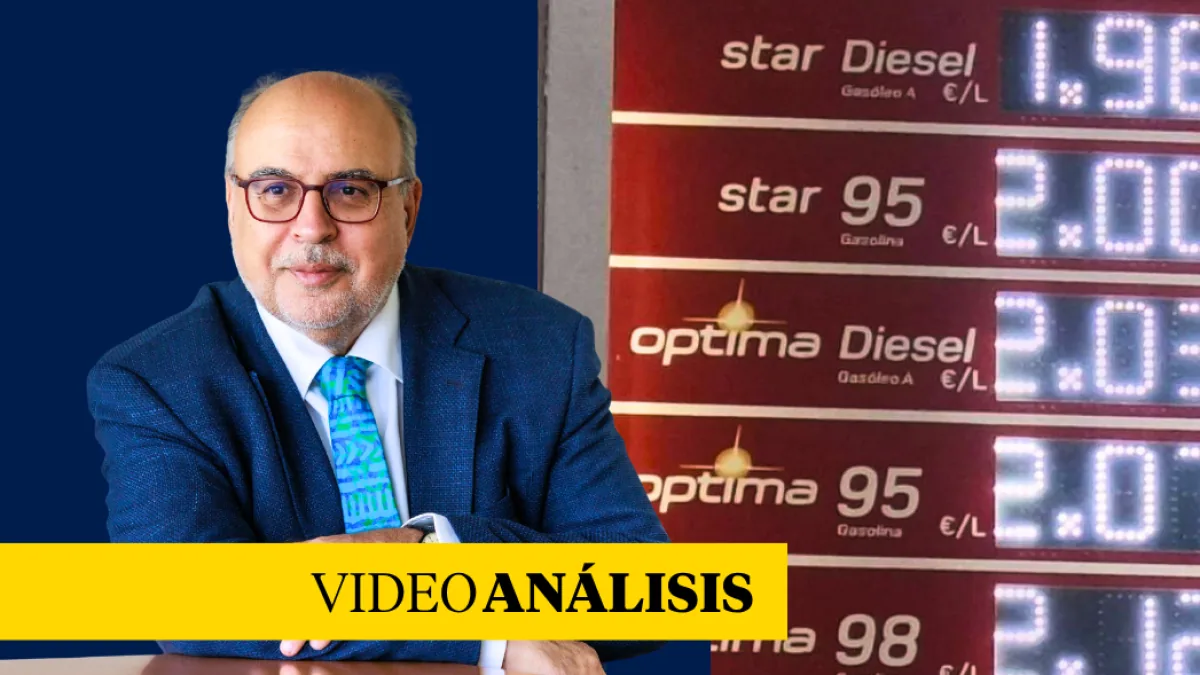
If the Houthis consolidate positions, Iran could come to control directly or indirectly Hormuz and Bab el Mandeb, vital corridors for global maritime trade and hydrocarbon transport. Saudi Arabia has suspended oil exports after the pipeline bombing. Oil and gas prices could rise even more. A sharp spike in inflation would accelerate the whirlwind.
Read more PISA against Aristotle