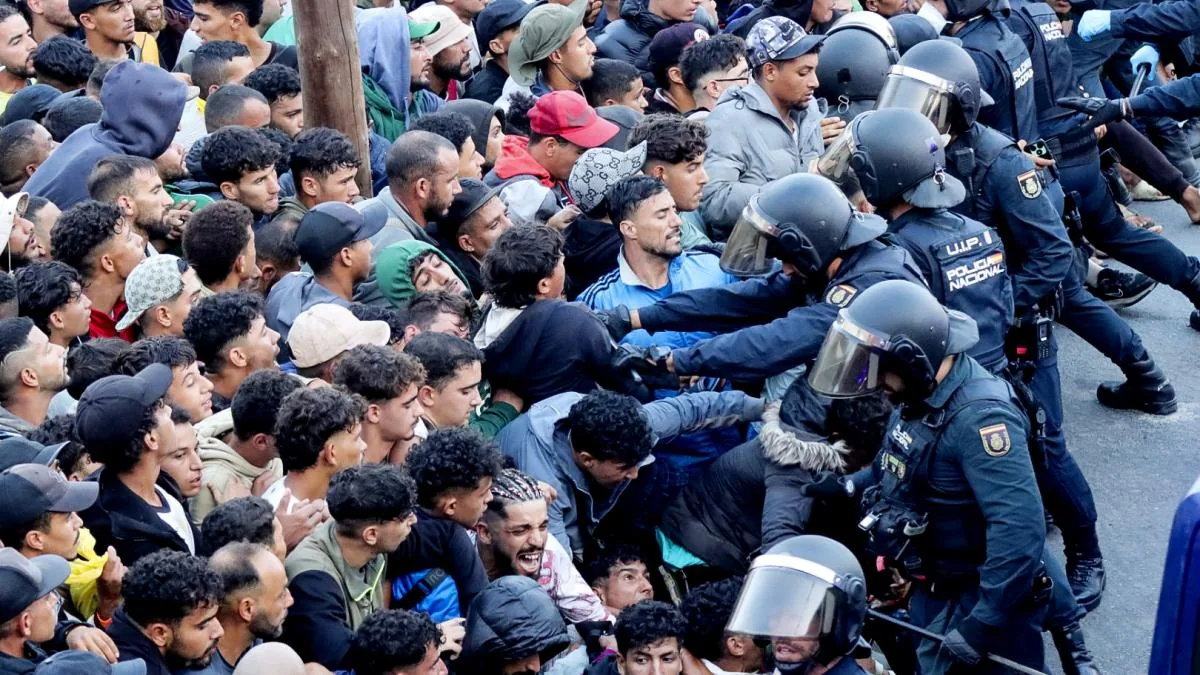
The president of Ceuta, Juan Jesús Vivas, insisted this Friday on his request to the Government of Spain to reject and dismiss asylum applications. Thus, faced with a situation that remains of “maximum risk,” Vivas demands the “immediate” return to Morocco of all the migrants who stormed the border at the end of July and have remained in the autonomous city since then. However, this request clashes with international law, so the Ceutan leader has urged the General Courts to work on a “regulatory body” that provides an “immediate and urgent” response allowing an “expeditious” action to return migrants when an “invasion or violation of the territorial integrity” of the State occurs.
Read more Ascó and Vandellòs trust in the «domino effect» to extend the life of Catalan nuclear plants
The request from the president of Ceuta came after he met with the president of the Senate, Pedro Rollán, who joined the call for the creation of this legal mechanism that enables the State to return migrants “urgently” when there is a territorial violation. In the subsequent appearance, Juan Jesús Vivas expressed “incomprehension” precisely because a State “does not have a regulatory body to face the situation that has been experienced.” “I find it difficult to understand, and if that is because there is no rule that provides a response to it, it should already exist because otherwise we would not be preparing our regulatory body for this type of contingency that is no longer hypothetical since it is the second time it has happened (the previous one took place in May 2021),” he stated.
In the opinion of the Ceutan leader, the solutions to the situation are being approached “erroneously” from the perspective of the Immigration Law. In this regard, he admitted that he shares the view of jurists that a mass return cannot be carried out abruptly or without processing a case-by-case file.
Therefore, Vivas urges to approach it from the “qualification of what really happened”: “It is not a migratory crisis; it is, in the words of President Sánchez himself, a violation of the territorial integrity of Spain. Force can be used in many ways, such as with the use of weapons, but also with a mass of people that overwhelms any capacity for containment and security. That is what happened. When the rules for states of alarm, exception, and siege were enacted, this was not contemplated, but now it has become evident that through the use of massive entry, the sovereignty of the nation can be put at risk. These facts must have a legal response, and for that, there are legislative initiatives and the General Courts,” he emphasized.
Still regarding the suspension of asylum applications, the president of Ceuta justified that the autonomous city he leads “cannot be a platform to facilitate entry to the rest of Spain and the continent.” Otherwise, he believes, it would nullify “any possibility of development and normal life” in the city. In this context, Vivas proposes to “deactivate the use of migratory pressure”: “We must try to avoid a platform for issuing and obtaining asylum, both for Moroccans—because their country is safe—and for other nationalities.” Nevertheless, the leader defended that Ceuta is a “eminently supportive” territory.
Read more Why is it so difficult to expel immigrants who arrived in Ceuta irregularly?
For his part, Rollán joined Vivas’s words and pointed out that an “immediate regulatory body with sufficient tools to restore normality” is urgent. For the president of the Senate, the feeling is that “the anomaly is becoming chronic and that normality must not be restored tomorrow, but today.” From this point of view, he asked the Government to “do everything in its power and what it cannot, also” to resolve the crisis and the General Courts to work “from now on” on a response so that “if it happens again, the response is urgent and firm.”
Throughout the press conference, the president of Ceuta described the situation in his territory as “unsustainable, disappointing, and of maximum risk” “for citizen security, coexistence, the normal functioning of public services, and national security.” Juan Jesús Vivas expressed his “powerlessness” because he believes the Government “has not been up to the dimension and proportion” of what happened in its response.
Besides insisting on the “immediate” return of all migrants who crossed the border at the end of July to Morocco, Vivas demanded a plan to “lay the foundations” and prevent this “violation” of territorial integrity from happening again. In his opinion, the pillars that this plan must have are “guaranteeing border security and that it does not depend on third parties, deactivating the use of migratory pressure to violate Spain’s territorial integrity, strengthening the State’s presence in Ceuta, supporting the productive fabric, reinforcing the city’s anchoring to the European Union, an investment plan in infrastructure and housing, and addressing the structural and chronic deficits of the city’s treasury.”
Read more Sumar rejects the extension of Almaraz and says it violates government agreements