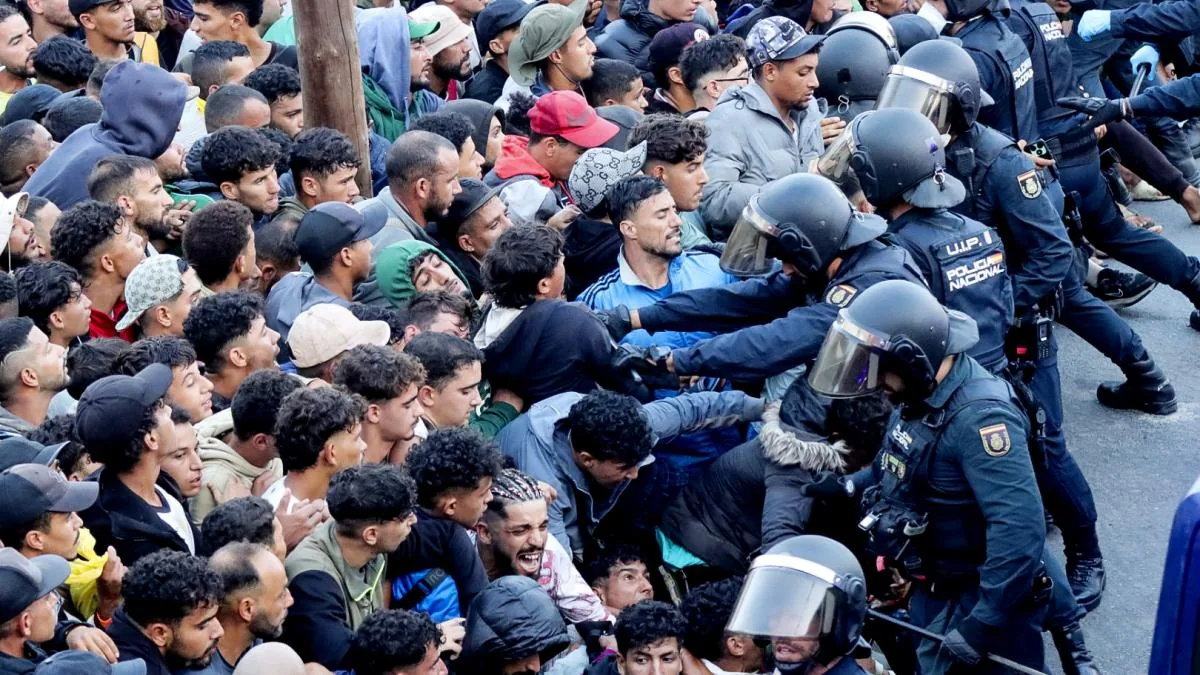
Moroccan authorities have activated an exceptional security operation in the north of the country to neutralize the mass calls spread on social networks, which incite a new massive entry into the autonomous city of Ceuta tomorrow, August 15, after the one led by more than 70,000 people two weeks ago. “The Ceuta border will be open on the 15th, a holiday in Spain,” some of these messages state.
Read more Spain: an expensive or cheap country compared to the rest of the world?
While videos from digital media in the Maghreb country show a deployment of security agents supported by the military in the border area, especially in Fnideq (Castillejos), the pro-government portal Le365 reports that the Moroccan Ministry of the Interior has raised the alert level to the maximum through an unprecedented deployment combining land control, transport surveillance, and the installation of severe physical barriers on the coast.
The most visible aspect of this operation is located on the maritime front of Fnideq, where large-scale technical work has been carried out. According to on-site verification by Le360, the defensive strategy has reinforced the land metal fence and incorporated a structure in the Mediterranean Sea itself composed of reinforced steel pillars that extend between five and ten meters from the shore. This aquatic infrastructure is completed with barbed wire frameworks and metal nets intended to physically block any attempt by migrants to swim around the border jetty, complemented by dozens of additional meters of mesh installed at the access points to the Ceuta crossing.
On land, the Auxiliary Forces, the Royal Gendarmerie, and National Security have established strict and systematic controls on the main road axes connecting Belyounech, Fajs Anjra, M’Diq, and Tetouan. Agents thoroughly inspect buses and large taxis coming from various parts of the country with the aim of identifying and intercepting suspicious individuals before they can approach the border strip. An example of these interventions mentioned by this outlet took place last Tuesday, August 11, when security services at the entrances to Tetouan intercepted two vehicles carrying irregular migrants, leading to a judicial investigation supervised by the Prosecutor’s Office to dismantle possible human trafficking networks.
At the same time, joint patrols carry out intense sweeps in the forest areas near the boundary between Castillejos and Ceuta, usual camping and refuge zones. These preventive operations have resulted in the location of dozens of migrants, mainly of sub-Saharan origin, who are being evacuated by buses to other provinces in the Moroccan interior to relieve migratory pressure in the north. The police have also arrested several individuals accused of leading the incitement to the mass assault through digital platforms.
Read more Ferran Torres, the shark who never quite captivated at Barça
Finally, the Ministry of the Interior spokesperson emphasized that the surveillance operation has a permanent and adaptable character that goes beyond the specified date, warning that the law will be applied with full rigor against anyone participating in these actions.
On the Spanish side, the reinforcement of security forces and military in Ceuta is also evident, and yesterday the Interior Ministry also installed a floating barrier in the sea in Melilla similar to the one placed in Ceuta a few days ago. In the autonomous city, 880 national police officers are deployed (270 more than on July 30) and 714 civil guards (almost 200 more). Additionally, about 2,000 have moved to support roles, and the Navy reinforced its deployment with the arrival of the frigates Santa María and Navarra, which operate in the southern bay of the city.
Furthermore, the Minister of the Interior, Fernando Grande-Marlaska, announced yesterday the additional deployment of a Police Response Unit (UPR) with 45 new national police officers to guarantee citizen security and 20 members of the Central Immigration and Borders Brigade to assist the Asylum and Refuge Office in processing all international protection applications that may be submitted. The goal is to help expedite these procedures so that once all legal requirements are met, these people can be expelled to Morocco.
In any case, Marlaska defended yesterday the cooperation and complicity “absolutely beyond any doubt” with Morocco as one of the fundamental elements to prevent a new massive entry of immigrants like the one at the end of July.
Read more The fires in Huelva and Huesca worsen with new outbreaks during the night