




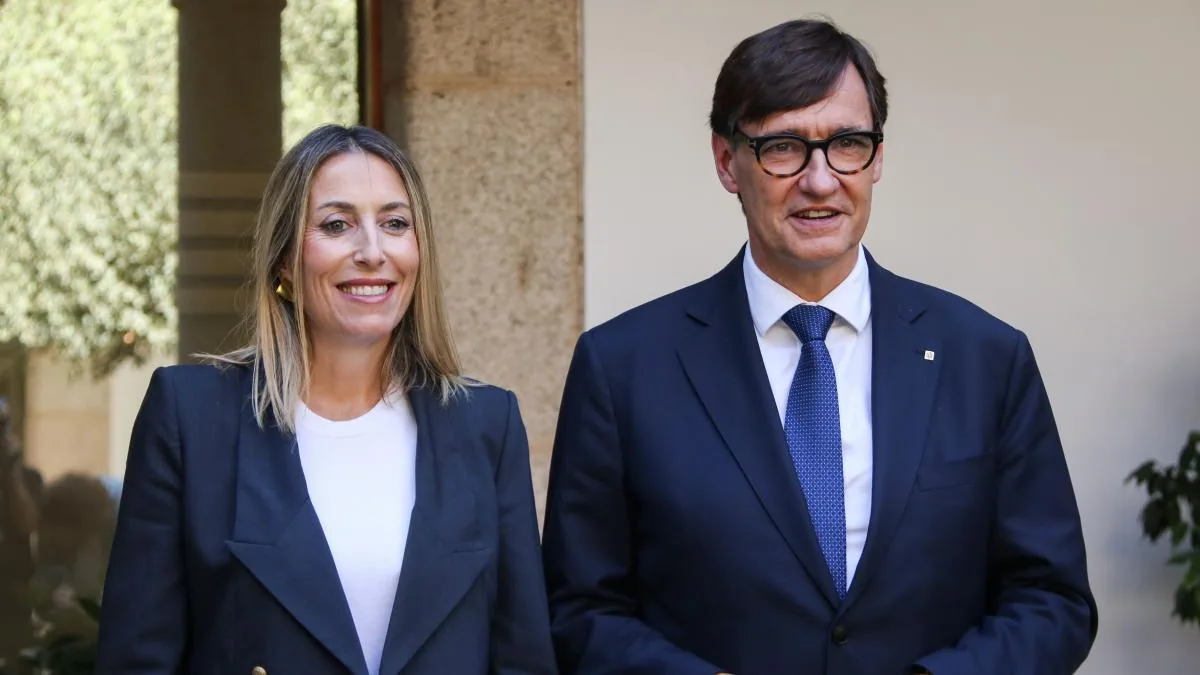
The president of the Generalitat, Salvador Illa, met this Wednesday in Mérida with the president of the Junta of Extremadura, María Guardiola, to convey Catalonia’s solidarity with the whole of Spain, especially regarding regional financing, and to claim the ties that unite both communities as a result of the migration process that took place last century, which caused more than 100,000 people from Extremadura to emigrate to Catalonia.
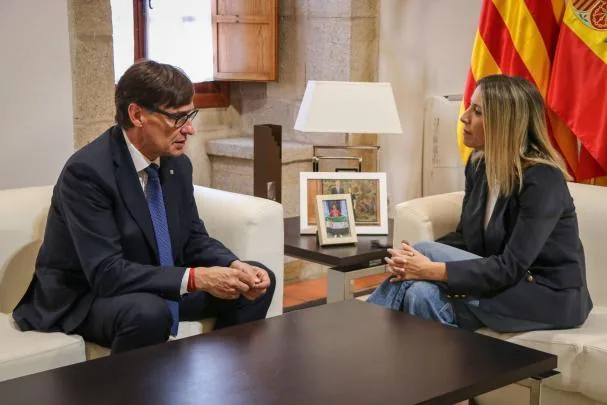
Illa and Guardiola held this closed-door meeting at the headquarters of the Extremadura government, in “a climate of cordiality and collaboration,” during which the two presidents “shared impressions about the priorities of the two autonomous communities,” according to sources from the Govern. But the meeting was marked by the current political context, characterized by the debate around financing and the Ceuta crisis, in which the transfer of immigrant minors to the Peninsula is on the table.
Before the meeting, the president traveled to the small town of La Zarza (Badajoz), with just over 3,300 inhabitants, where a sculpture stands precisely in tribute to the emigrants from Extremadura. Accompanied by the town’s mayor, the socialist Francisco José Farrona, who was born in Granollers but has lived in his hometown since he was 9 years old, and the secretary general of the Extremaduran socialists, Álvaro Sánchez Cotrina, Illa justified his visit to the region: “We wanted to bring the Diada to Extremadura to share, explain, and show an open, inclusive, and supportive Catalonia,” and “to make a call to talk to each other and not about each other, emphasizing what unites us, which is a lot, instead of focusing on what differentiates us, which is much less than we think.”
After thanking the contribution of Extremaduran migrants to the construction of present-day Catalonia (“Catalonia owes you a lot,” he said), the head of the Government explained that his purpose with this meeting with Guardiola was “to convey the links between Catalonia and Extremadura, the interest in keeping those links alive, and to underline, of course, Catalonia’s solidarity, always, with the whole of Spain.” Thus, Illa highlighted that “what we propose” regarding regional financing “harms no one,” but “benefits everyone,” although “there is always room for improvement.”
Among the arguments the president put forward to claim the benefits of this new financing model, which is close to starting its processing in the Congress of Deputies, he pointed to the additional 21 billion euros that the General State Administration would transfer to the autonomous communities, and that “are for health, education, infrastructure, social policies…”. But aware of the Extremadura government’s opposition to this model, following the path of the rest of the PP regional governments, the Catalan leader warned that “credibility would always be gained by those who criticize the model if they proposed an alternative one, which I have not seen.”
Illa also took advantage of his first day in the province of Badajoz to make a “reflection on migrations,” which “are inherent to humanity,” he assured. The president warned that “Spain is a country of migrations” and that “not long ago we had to go elsewhere, unwillingly,” so migrating “is often done out of necessity.” Under this premise, he urged not to forget this circumstance “when the tables have turned,” he said, clearly referring to the Ceuta crisis. “Let’s think about how we wanted to be received, welcomed, that we need time to integrate. What we saw being done to us, let’s practice it,” he demanded.
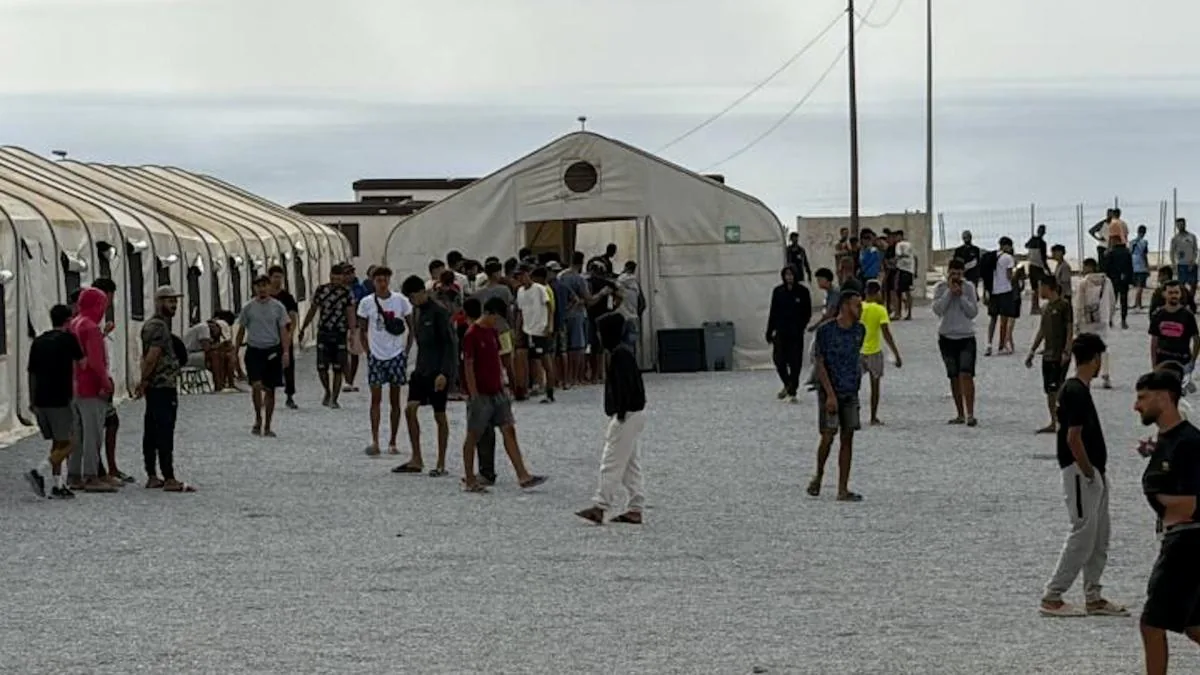
Precisely the reception of immigrant minors from Ceuta, after the assault on the border at the end of July, is another issue that directly concerns the autonomous communities. Catalonia has shown itself in favor of this temporary reception always according to the distribution established by law among the territories, and Extremadura has already received four immigrant minors from the autonomous city, who arrived before that massive assault, despite the Government agreement between PP and Vox, which precisely includes the rejection of hosting unaccompanied foreign minors.
The president also made a plea in favor of identity plurality. “When one migrates, their identity is challenged,” so “identities are not exclusive” and one can be “Catalan and Extremaduran” at the same time, he claimed. Against the “exclusive discourses” in this area, Illa defined identity as “a set of layers, like an onion, that enriches us. And if we add languages, even better.”
The education summit, next week
In Catalan terms, the president also expressed his intention to convene parties with parliamentary representation to debate education at the end of next week, once his appearance in the Parliament to account for the mess around the PISA report has taken place. That summit should serve to deepen the proposal he launched last Monday in a conference in Barcelona: the configuration of a country agreement in favor of education that helps overcome current problems. “I look forward to meeting with all the representative groups to continue working on the proposal,” he highlighted, before confirming that far-right formations (Vox and Aliança Catalana) will also be invited to that meeting, although so far they have never attended any meeting of this type. They “self-exclude,” the president noted.
El Prat airport “will be the greenest in southern Europe”
Salvador Illa also spoke from Extremadura about the future of El Prat airport, once the Government has approved the resources to prepare the future expansion. In response to criticism from Comuns, one of his investiture allies, the president said he respects “all criticism,” but reaffirmed his position in favor of the expansion, which in his view coincides with that of “the majority of Catalan society.” “It is essential to continue generating prosperity in Catalonia,” he emphasized, before guaranteeing that the airport will be “the greenest and most sustainable in southern Europe.” “We are moving forward with a project that is key for Catalonia,” he concluded.