Since in 2001 the UK Labour government decided to establish universal free entry to access the fabulous collections of its national museums (from the National Gallery to the Tate, the Victoria & Albert or the British Museum), the number of visits increased exponentially in the following decade, reaching increases of more than 250%. For a quarter of a century, this measure has not only been envied by audiences across Europe but the mere possibility of charging an entrance fee was unimaginable for the British. Until now. The economic difficulties faced by many of these museums have caused some to dare to touch what was considered untouchable and the option of easing their battered finances by charging admission has been put on the table. For now, a tourist fee is being discussed, but some voices call for a return to order. .
Read more The Ceuta crisis turns Spain into a focal point of Italian politics
But at this moment for many the solution to the museums’ funding crisis comes down to a simple mathematical operation: If the 5.8 million people who visited the British Museum last year paid 5 pounds each, a revenue of 29 million pounds would be raised. The issue is not that simple. Many who enter the permanent collections for free then decide to pay to see temporary exhibitions, which do charge admission, or buy from the shop, which contributes significantly to income. And above all, the philosophy encouraging free access is not based on economic criteria but on the will to share public goods, which therefore belong to all Britons, and to provide access to a more diverse audience, especially those for whom the ticket price is a deterrent. The debate is stalled, but not dead. The Mayor of London, Sadiq Khan, called on Tuesday for museums to remain free because “art and culture are for everyone, no matter where they are from or how much they earn” and assured that “free entry generates one billion pounds a year in tourism revenue”
Without reaching total free entry, in Madrid the major national museums have for years decided to open free time slots with spectacular results in terms of visitor numbers. At the Prado Museum, for example, the collection can be visited for free every day during the last two hours before closing and, in the evening, from 8:30 p.m. to 11:30 p.m. on the first Saturday of each month. The figures are striking: of the 3,513,402 visitors in 2025 (a record), 1,590,700 (45.28%) accessed with free entry, while only 221,202 (6.3%) benefited from reduced entry. The director of the Prado, Miguel Falomir, repeatedly says that the museum has reached its peak, that it does not need more visitors, but more diverse ones. Because despite the free entry (always for the unemployed, minors, and students up to 26 years old) the profile of the Prado visitor continues to be someone with university studies (80%) and medium/high purchasing power. It is not an economic barrier, but a social and educational one. For Falomir, Saturday nights are becoming the gateway for a predominantly national and migrant audience visiting the museum for the first time with their families.
The proportion of visitors who enter without passing through the ticket office is even higher at the Reina Sofía: 62% of the 1,601,732 who visited its main site in 2025 did so during free access hours (from 7 p.m. to 9 p.m. and Sunday from 12:30 p.m. to 2:30 p.m.) or thanks to discounts for groups (under 18, over 65, unemployed…). And at the Thyssen-Bornemisza they have also managed to get young people to start crossing their doors thanks to the Thyssen Nights, an initiative that allows free museum visits on Saturdays from 9 p.m. to 11 p.m. Almost half of the visitors are between 18 and 34 years old, while during regular hours they represent only 10%.
In contrast to the firm commitment of the major Madrid museums, in Barcelona only the Museu Picasso joined in 2024 this push for a more inclusive culture with Picasso Convida, which allows free access to the Montcada Street art gallery from Thursday to Saturday from 7 p.m. to 9 p.m. Again, young people between 20 and 39 years old and the local audience are its main users. This summer the museum also adds free entry to its exhibition Picasso Cyprus. Encounters with Mediterranean Ceramics, as it is part of the Presidency of the Council of the European Union held by Cyprus in the first half of the year and was one of the requirements to receive European funds.
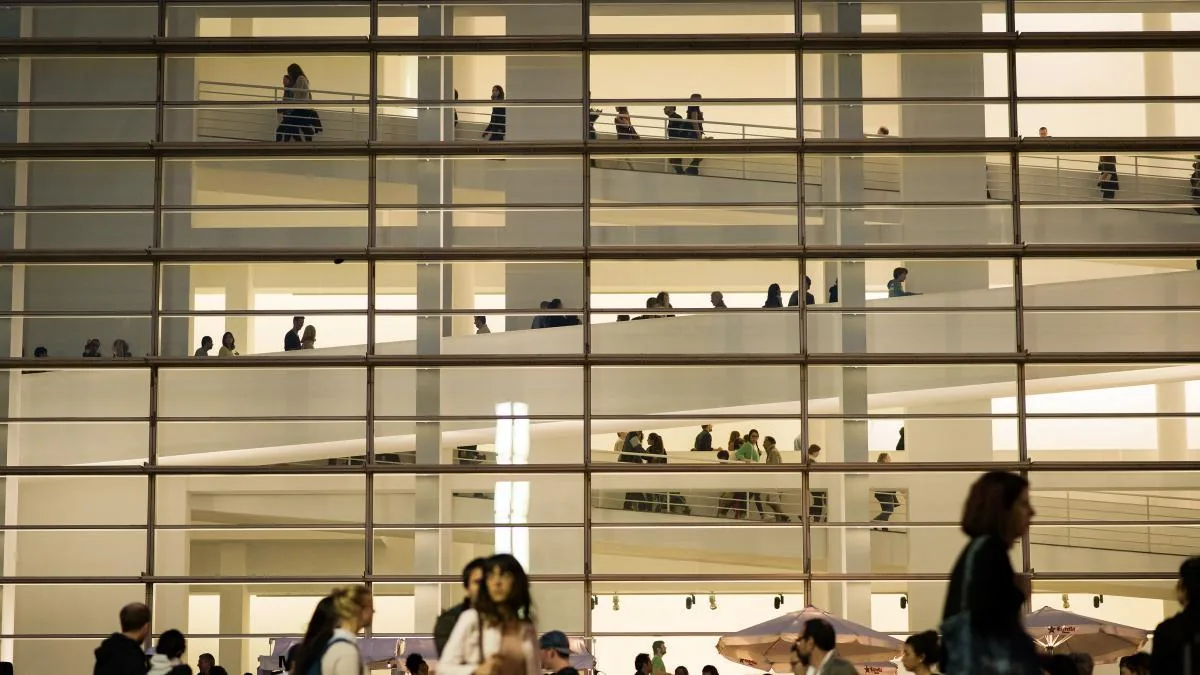
The Museu Picasso and the Macba have established free evening entry hours
“I don’t think in Barcelona the price of admission is decisive when deciding whether to go to a museum or not, because for Barcelonans they are practically free,” says the city’s Culture and Creative Industries councilor, Xavier Marcé, who estimates the average price of entry at the Macba at 1.2 euros (applying all available discounts) and 2 euros at the MNAC. “What we have to achieve is that the citizen, for whom public museums exist, can enjoy a very advantageous pricing policy and that the non-EU citizen or someone who is only in the city for two days has a more normalized rate that helps the sustainability of the centers.”
Between the departure of Elvira Dyangani Ose and the arrival of Valentín Roma as director, the Macba has implemented free access slots on Thursdays, Fridays, and Saturdays (from 6 p.m. to 8 p.m.) and joins the initiative of most city museums to open on the first Sunday of the month. The museum specifies that this is a temporary measure, which the new director will have to confirm or not. In any case, it could be a beneficial action to stop the visitor decline (the 265,000 in 2024 dropped to 200,000 in 2025 and continue falling in 2026). Although in fact, at the Macba last year only 23.4% of visitors paid full admission, 15% acquired a reduced rate, and 61.6% paid nothing at all, according to the annual survey promoted by the Barcelona City Council (see box).
Read more Ceuta, the electoral mecca of Vox
The British government’s plan to charge foreign tourists again at its national museums (17 million people, that is, 43% of the total in the 2023-2024 season) would be unfeasible in any European Union country, since since 1994 a ruling by the Luxembourg Court of Justice requires charging admission to citizens of different countries without making distinctions with other Europeans as was the case until then, when presenting an ID exempted payment in museums like the Prado, Reina Sofía, or Picasso, which until then were free for locals.
In the Netherlands, they have opted to create a pass for their citizens, the Museumkaart, which for 65 euros grants unlimited and free access to 450 museums, of which 39 are in Amsterdam. And the Louvre, which literally cannot fit another pin, has charged differentiated rates since the beginning of this year depending on whether the visitor is European (22 euros) or not (32 euros). “We could do it at the MNAC, but I find it discriminatory, because the museum’s vocation is universal and we are equally interested in someone from Peru as someone from Japan or Malaysia. Another matter is that I believe the local public, who finance this museum with their taxes, should enter for free, as if it were a library, but legally it is very complex,” says Pepe Serra, director of the Museu Nacional d’Art de Catalunya, who says he would like to follow the Prado’s policy guaranteeing that those without money can still enter every day during an afternoon slot.
“But up here, in the mountain, those we would want to help we would harm, because the effort to get here is immense. So I find it more useful to tell a retiree to come whenever they want and that they will always enter for free, than to make them come up at night. And the same happens with people with reduced mobility or families with small children. Offering them the possibility of having a few free hours but seeing how people arrive exhausted from the heat does not seem to me a real free accessibility space,” warns Serra.
“60% of people who never go to museums is not because of the price of admission. We still lack reaching that social sector”
Besides the first Sunday of the month, the MNAC has been offering free entry on Saturdays from 3 p.m. for twelve years. “They told me at first it would be a surge, but then it would go down, but no, every Saturday it is full, we are flooded with local public, which means that among those interested the price of admission is a very sensitive element. Between paying 12, 8, 7 or 6 euros and paying nothing, obviously they choose the latter. And statistically it is proven that this visitor is precisely the one who spends the most in the shop and cafeteria,” reasons the director.
“Now then – he adds – 60% of people who never go to museums is not because of the price of admission, it is not true. We still lack, us and everyone, that social sector we would like to reach.” In any case, he concludes, there should be a coordinated museum policy that, now, does not exist, and concludes that by 2029, when the museum entrance will be located lower, at the Palau Victòria Eugènia, the Prado model will be feasible and desirable.
Read more The Civil Guard must find out if the CNI warned about the massive entry into Ceuta