Spain has become one of the main axes of the Italian political debate. And the effect is also beginning to be felt at airports.
Read more Ceuta, the electoral mecca of Vox
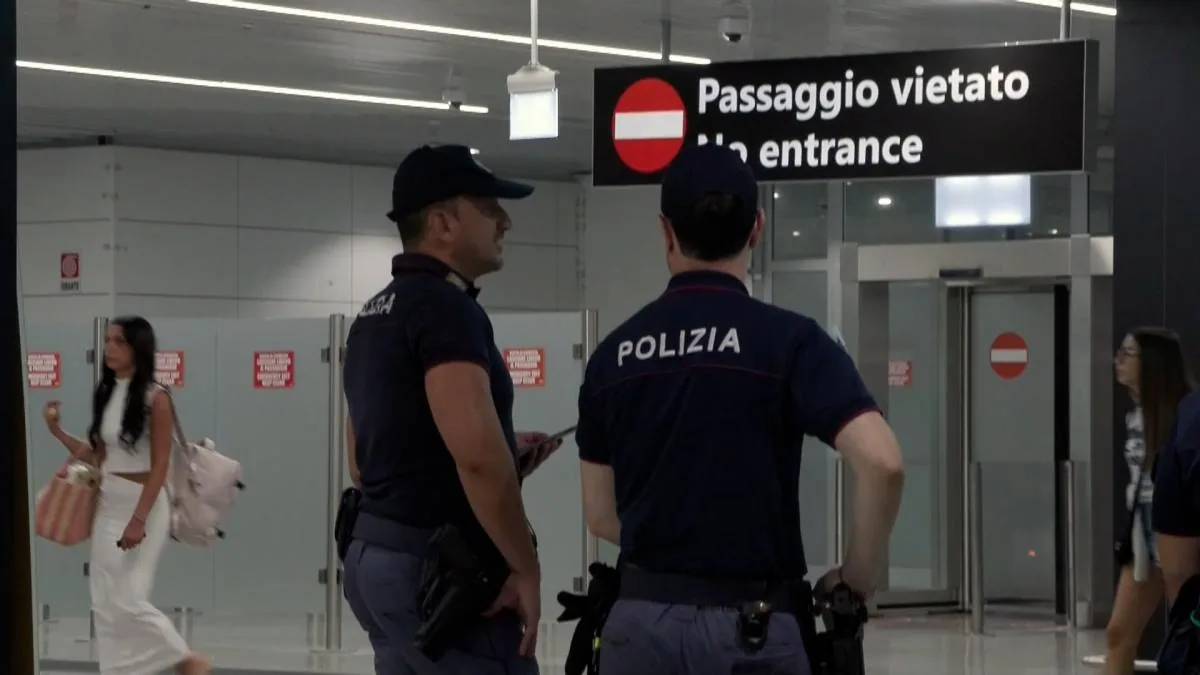
Checks on flights coming from Spain, reintroduced at Italian airports after the suspension of Schengen following the Ceuta crisis, are applied irregularly. After a discreet start, they are beginning to cause queues and protests during the busiest period of the year. The version of the Italian Ministry of the Interior — “only non-EU citizens will be checked” — has not withstood the test of facts: how to distinguish them among the crowd of passengers without first asking for documentation?
Among the travelers waiting on Tuesday night at Milan-Linate airport was also Manuel Campo Vidal, arriving from Madrid. “They asked us the same questions as at the US border. It was an unpleasant feeling. It had never happened to me when coming to a country we love so much. People were very upset.”
The Foreign Minister, Antonio Tajani, ended up admitting last Tuesday, in a television interview, that “we have not found anyone coming from Ceuta, but we have to carry out checks as we do with Slovenia.” The inconveniences and the obvious difficulty in explaining the measure with rational criteria are opening a reflection within the Government about the possibility of lifting it before the scheduled date, August 31. “Yes, we decided it when we still did not know that practically everyone would be repatriated,” admits a member of the Executive who asks to remain anonymous. For now, however, there is no turning back.
But the real scope of the crisis is political.
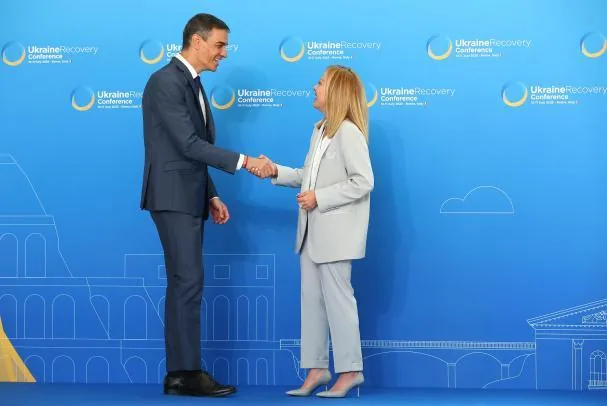
The explanation goes far beyond Ceuta. Spain has become the main political counterpoint to Giorgia Meloni’s Government. If a few years ago that role was played by Emmanuel Macron, today the adversary that the Italian right points to most frequently is Pedro Sánchez, who has become the symbol of a migratory and political model that the conservative coalition uses as a contrast.
The first to ask Meloni to appear in Parliament to explain the diplomatic rupture with Madrid was Nicola Fratoianni, leader of the Greens and Left Alliance. “Announcing the suspension of Schengen in a hurry is not only a miserable and cynical gesture, but also very embarrassing — he explains to La Vanguardia —. Perhaps the goal was another: to hit one of the European economies that grows the most thanks to progressive policies.”
Read more The Civil Guard must find out if the CNI warned about the massive entry into Ceuta
The left
Fratoianni: “The suspension of Schengen sought to hit a Spain that grows thanks to progressive policies”
Meloni did not respond to the request. The one who does defend the measure is Carlo Fidanza, head of Brothers of Italy, Meloni’s party, in the European Parliament, well acquainted with Spain, who finds precisely in the Spanish model the key to understanding. “It is clear that Ceuta is a geopolitical episode, but it happens because Sánchez is the man of open doors. He has also shown the same hypocrisy in immigration as with energy: he bought Russian gas and now, since he can no longer do so, he is knocking on Algeria’s door, with the result we all see…”. For Fidanza, suspending Schengen was, above all, “a political signal.”
The right
Fidanza: “What happened in Ceuta is also a consequence of the open-door model”
Pietro Benassi, a diplomat with a long career, was Italy’s permanent representative to the European Union, ambassador to Germany and Tunisia, and undersecretary of the Presidency of the Council during Mario Draghi’s Government. He believes Italy made a mistake by not showing solidarity with Spain and even condolences for the victims of those days, an attitude that, in his opinion, hinders a truly European response to the migratory phenomenon. “Immigration consists precisely in managing complexity, but today simplification is preferred. You will see that in a few days in Italy no one will talk about this anymore. Better, on the one hand, given how the matter has been handled, but at the same time it shows the superficiality with which the political agenda is built today.”
For Lorenzo Pregliasco, political scientist and director of the polling company YouTrend, the decision responds above all to a political need. “Immigration and security are the most sensitive nerve of this Government. One of our surveys shows that seven out of ten Italians say they do not feel safe; Moreover, Meloni now has to her right an adversary, Vannacci, who insists precisely on these issues. A flag had to be waved, and suspending Schengen was chosen.”
Comparison
Political scientist Pregliasco: “Spain is seen as a more dynamic country and is the perfect nemesis for Meloni”
Spain has all the elements to become the perfect symbol of that political battle. “It is a country that awakens closeness and sympathy — adds Pregliasco —, but at the same time also a certain envy. In Italy, the feeling of being surpassed by a more dynamic country is growing. Even Spain’s soft power is perceived very strongly; just look at sports. Added to this is that Spain is governed by the only progressive leader in Europe, whom the Italian opposition constantly holds up as an example: he is the perfect nemesis for Meloni.”
The border is no longer only at airports.