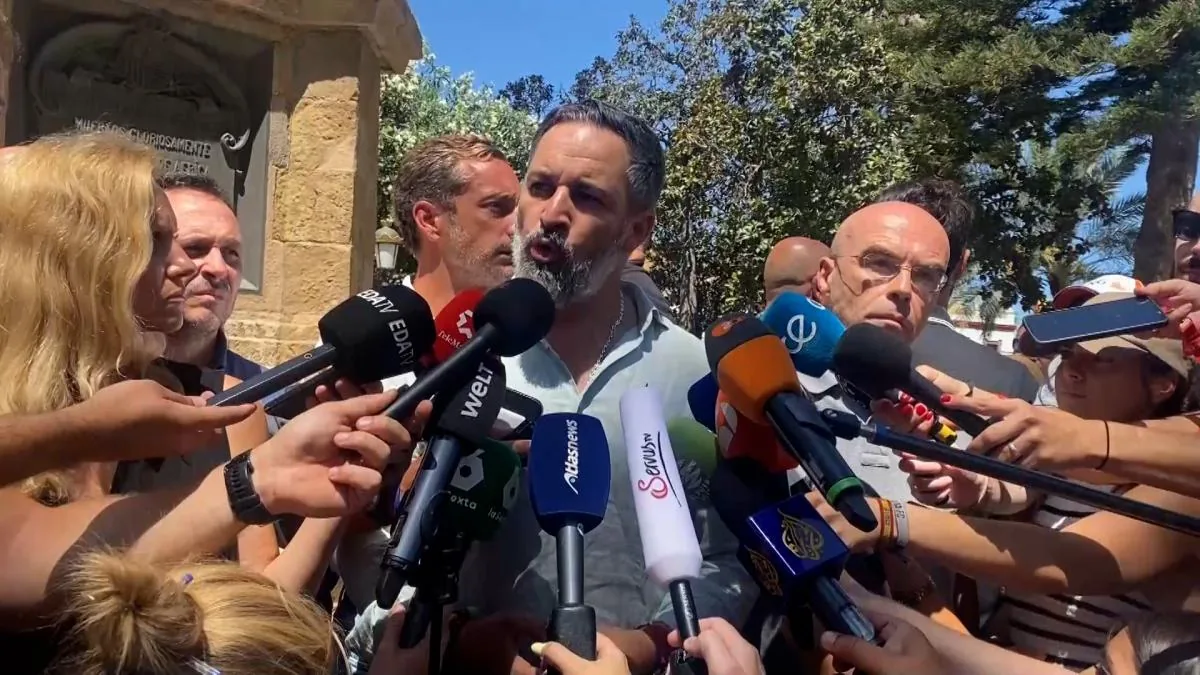
“Here I won the elections.” It had been just over three minutes since the start of his press conference in Ceuta last Sunday, and the far-right leader Santiago Abascal had already claimed twice the strength of Vox in this autonomous city, where it managed to be the leading force in the November 2019 general elections, something it has only also achieved so far in its other stronghold, Murcia. Ceuta was, moreover, in the last three calls to the Congress, those of July 2023 and April and November 2019, the constituency where Vox obtained its highest vote percentage in all of Spain.
Read more The Civil Guard must find out if the CNI warned about the massive entry into Ceuta

It is his Mecca, although it pains and annoys many Ceutans who do not feel comfortable at all with the discourse that simplifies the Spanish phenotype to a caricature, quite the opposite of what is seen in this autonomous city where all cultures and religions coexist. In fact, on the same Sunday and over these days, some events organized by far-right groups such as Núcleo Nacional or Alvise Pérez have been spontaneously rejected in the streets. Ceuta has serious problems, but the far-right’s solutions convince part of the electorate, but not the majority, for now.
Despite sympathy for ultranationalism, Núcleo Nacional activists have not been well received these days
Since the transition, these two enclaves followed similar electoral trajectories, with some differences, such as the PSOE prevailing in Ceuta throughout the eighties and not doing so afterward, while in Melilla it won in 1982 and 1993, and was close to doing so in 2008. In 2011, the PP reached its peak in both territories, with two-thirds of the votes, only to register a sharp drop in the 2015 general elections and recover in 2016.
In April 2019, the great divergence arose, but not so much because the PSOE prevailed in Ceuta and the PP in Melilla, but because Vox emerged in the first, behind the socialists and ahead of the popular party, while in the second a progressive Muslim party, born from a PSOE split, Coalition for Melilla (CpM), emerged in third place, but not far from disputing victory. These were the two usual versions in Europe of channeling territorial grievance, either through ultra parties, as with AfD in former East Germany or Chega in Portugal, in Alentejo and Algarve, or through an indigenous force.
CpM, which ended up sinking in 2023 due to the mail-in voting scandal, was only 181 votes and six tenths short of entering Congress in November 2019, just when Vox achieved that victory in Ceuta that Abascal so proudly claims. The ultras won with 35.2%, compared to 31.3% for the PSOE and 22.3% for the PP.
In Vox’s electoral geography in general and European elections, the constant is that it obtains its best results along the line from Murcia to Ceuta via Almería, three constituencies that share the high impact of immigration and also a military tradition substratum. Although, as happened in 2019, Vox again achieved its best result in the 2024 European elections in its Ceuta stronghold, a weakening was observed, both in the 2023 general and regional elections. It now seeks to reverse that trend with xenophobia as a lever in an apparently favorable context and perhaps under the aspiration to repeat the 2019 victory, although three years ago it came in third place and 15 points behind the PP in Ceuta, Vox’s electoral Mecca, its particular promised electoral land.
Read more Housing and regulatory excesses