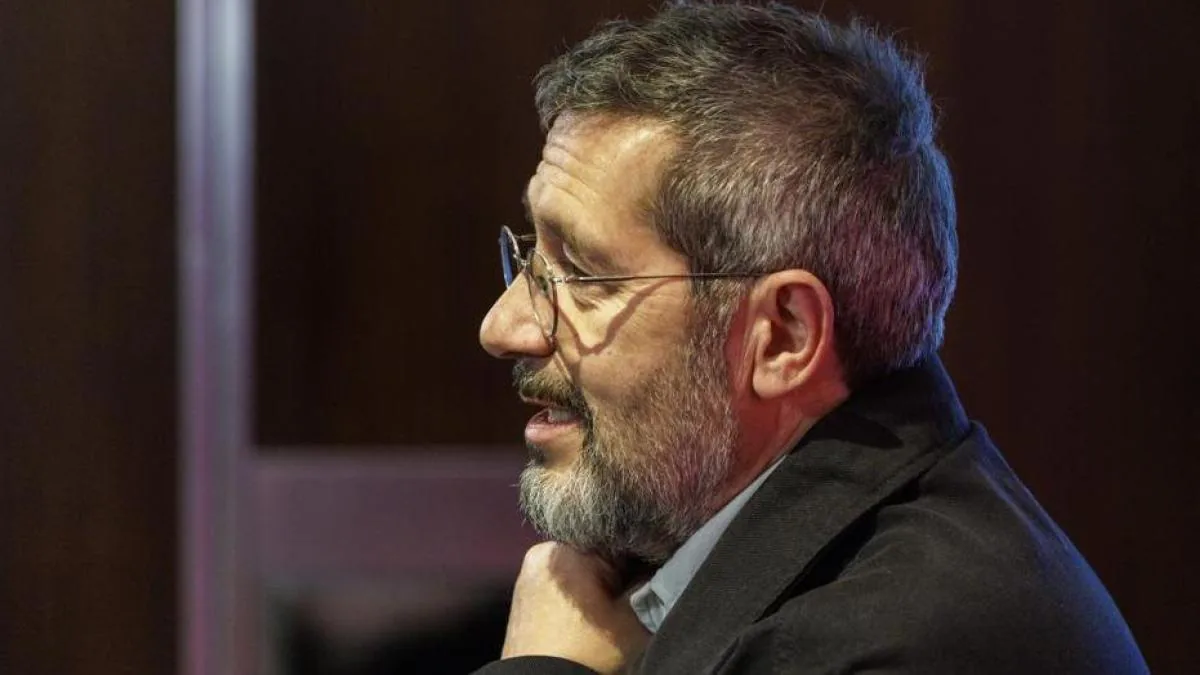
It is early in the morning. A man, neither tall nor short, approaches along a path. He is distracted by the appearance of a girl who has just crossed to retrieve her dog, which has escaped. It hasn’t been even a minute, but enough for him to notice the tattoo on the young woman’s arm. He observes people, infers their biographies with few details. He calls it “the game of life.” Also, that person, who knows, could be a possible witness to a criminal act. He will have to go back to look for her. He also usually memorizes car license plates. He can’t help it.
Read more Szczesny, a phenomenon at Barça: this is how Flick, the locker room, and the fans see him
Soon after, in his studio, he will return to his book. He has been talking with the protagonist of his next story for seven years; seven years of recordings poured into about eight hundred pages of what the author calls “the great teacher that is reality.” His hero has such depth that, this time, he himself will be the narrator. To achieve this, to get his rich orality onto paper, the author writes a paragraph, leaves it, thinks it’s not bad. But when he returns to it the next morning, it turns out it’s not, and he rewrites it. He will succeed, without a doubt. Above the flood of work, scriptwriting, and endless meetings with his team. Because the decision is made: unlike his previous books, and the cases narrated on radio and television, the narrator will be the protagonist. Period (this “period” I write, but he could well say it himself).
⁄ What remains amid so much darkness? In Carles Porta’s own words: there are bad people. Bad. Period. And then there are others who are recoverable
No one teaches us how to make decisions, laments Lolo, the boy protagonist of his novel El dia que vaig marxar / The Day I Left (Columna/Planeta, 2017). Lolo (a story he had “stuck in his head” and had to tell) is a mix of boys from his youth, including a friend’s son, and Lolo could be one of those wayward youths who star in the case files read and studied for Crims. But Carles Porta (Vila-sana, Lleida, 1963) did know how to make his decisions: while studying journalism and working weekends at the newspaper Segre. When he left the beautiful town where he studied English and answered the call of TV3. The big decision awaited him. The one that made him unique, made him forever. A writer of the lineage of the protagonist of The Pledge by Friedrich Dürrenmatt. Tenacity to the death. Swiss army knife in every story. And the promise, “or self-promise,” he clarifies, in the form of a mountain. Let’s leave him alone for a moment on his walk; we will return to him (and this I also copy from his narrative style).
“The police responded”
The offices of the True Crime Factory are transparent, so much so that when passing by you can see the panel with photos, notes, and arrows, like in the Law & Order police station. When Porta started with Crims in 2018, it was just him and the collaborators from Catalunya Radio. Today, Mireia Buenaventura arrives at the courtroom and the young security guard, a fan of the series, immediately lets her in.
Attending trials is fundamental in the training of a journalist. Trials, the opposing versions, bring notable plot twists. The case file, says Miania Llorca (one of the three girls sitting in the meeting room), is the novel of the facts. But you have to know how to interpret the reports, the new evidence that is incorporated (as we will see in the Helena Jubany case; and let’s see what happens with the double murder at the Susqueda reservoir). Anna Punsí, content coordinator, recently did this: she got in her car, went to town X, and showed up at the home of a man who appeared as a suspect in a case file she had been studying for some time. It was not easy.
Sometimes, that first thread is the beginning of something, other times the person does not want to talk. Or it’s the other way around and they come to this team to ask for help. This is the case of the three siblings in the remarkable documentary series Abandoned (Disney +). Those three well-dressed and fed little brothers, but abandoned at Estación de Francia in 1984, determined to uncover the mystery of their origins. And from that story there are still threads to pull.
There is not a moment in the conversation when they are not attentive, reminding each other of dossier details. Correcting inaccuracies. Their eyes light up, excited by possible new information. They recover unresolved matters, investigate and recreate the context. One day a police officer calls the production company because he retired with “a thorn stuck in his side”; one of the stories written by Anna Punsí that can be read in Impacte/ Impacto. They have earned the trust of victims’ families, who participate in the three episodes of The Double Murder of Bellvitge, which helped clarify a lot (a lot of yellow lies) about that double murder in 2004. There is no detail, however small, that they have not cross-checked. “We are storytellers, but we do not forget that we are journalists.” They do not exaggerate. The police did not respond forcefully. Simply “the police responded”; and then the reader, listener, viewer, will see that forcefulness. As Porta says (an admirer of Ferdinand von Shirak): the adjective expires, the facts do not.
To truly know someone
It would be impossible to count how many stories this man, neither tall nor short, who walks with his dog, has heard. Nor how many newspaper clippings he cut and pasted into his numerous notebooks kept by his mother, over the years. How many case files he read (besides reading Henning Mankell) and how many courts he fought with to be allowed to access the case file. And how many people he listened to.
Read more The ‘Hollywood hacker’: «With AI, anyone can be a hacker»
He started learning about people at 1,649 meters above sea level. Tor is the mountain he climbed for the first time in January 1997, to clarify a crime. The viewer should stop at the first report published in 30 Minuts, in the faces and attitudes of the locals. Carles Porta is a boy with a good guy face, accompanied by a cameraman who, as I am now being told (the details; the details are everything!), was a ten-kilo black Betacam on his shoulder, with which he pointed at the locals. But up there things are not as people think. No. No. Porta slows down when it’s time to stop at something: “You arrive there, say hello. But they don’t say hello back, no, no! First they look at you, examine you, and then decide, first, if they will answer you. Then, maybe they say hello. But they won’t say anything else.”
Not a word more, until they are sure if that restless young man is a stranger, a passerby, a tourist. As Palanca — one of the two main characters of Tor, “a guy who studied at the Marist school in Lleida, who had all the studies you want and decided to be a savage, one more horse” — will tell him, to truly know someone “you have to have eaten a sack of salt.” Young Carles Porta realized he had to return alone to Tor and its crime. Without a camera. And he returned again, and never stopped returning. That’s how he came to understand Palanca, came to understand so many others who appear in his report. The number of copies sold of that work, in which the editorial work of Isabel Martí and Josep María Espinàs deserves nothing but gratitude — “Isabel taught me everything, punctuation, musicality, the order of sentences” — went from 15,000 first copies at Christmas 2005 to a print run of 25,000 for Sant Jordi. And the work – with devoted admirers like Joan de Sagarra and Llàtzer Moix in this newspaper – has not stopped selling.
Light in the darkness
What remains amid so much darkness? In Carles Porta’s words: there are bad people. Bad. Period. And others who are recoverable. They listen to everyone, strive to be neutral. They blend in with their human material. They are almost imperceptible witnesses, unnoticed. To then give the matter a Copernican turn; and then they point to the listener, the reader, the viewer. How does Anna Punsí do it, when she reflects the testimony of a mother whose little girl has been murdered? Her book is called The Love That Always Remains (Columna). Could that be the clue, amid so much pain?
In his office, Porta has a portrait of himself, drawn by a “party involved” in a famous case. Different forms of friendship, circumstantial but true; the allies the hero meets along his solitary journey.
And what about the promise? Will Tor never end? Is he capable of giving it a final point? Has he reached the definitive edition? With those questions this meeting ends. As it should be. Without adjectives (I would say charming type, with a background of good manners and affection from home, sensitive and tending to formidable; but Porta will veto them all). That said, he showers praise on his team.
—————————-
Carles Porta Impacte. Les cares del mal / Impacto. The Faces of Evil La Campana / Reservoir Books, Translated into Spanish: Ana Ciurans Ferrnándiz, 320/304 pages, 21.90 euros
—————————-
Carles Porta Tor, tretze cases i tres morts / Tor, thirteen houses and three dead, Definitive edition, La Campana / Reservoir Books Translated into Spanish: Xavier Theros, 408 pages, 22.90 euros
Read more ‘TerminAItor day’: remember this date