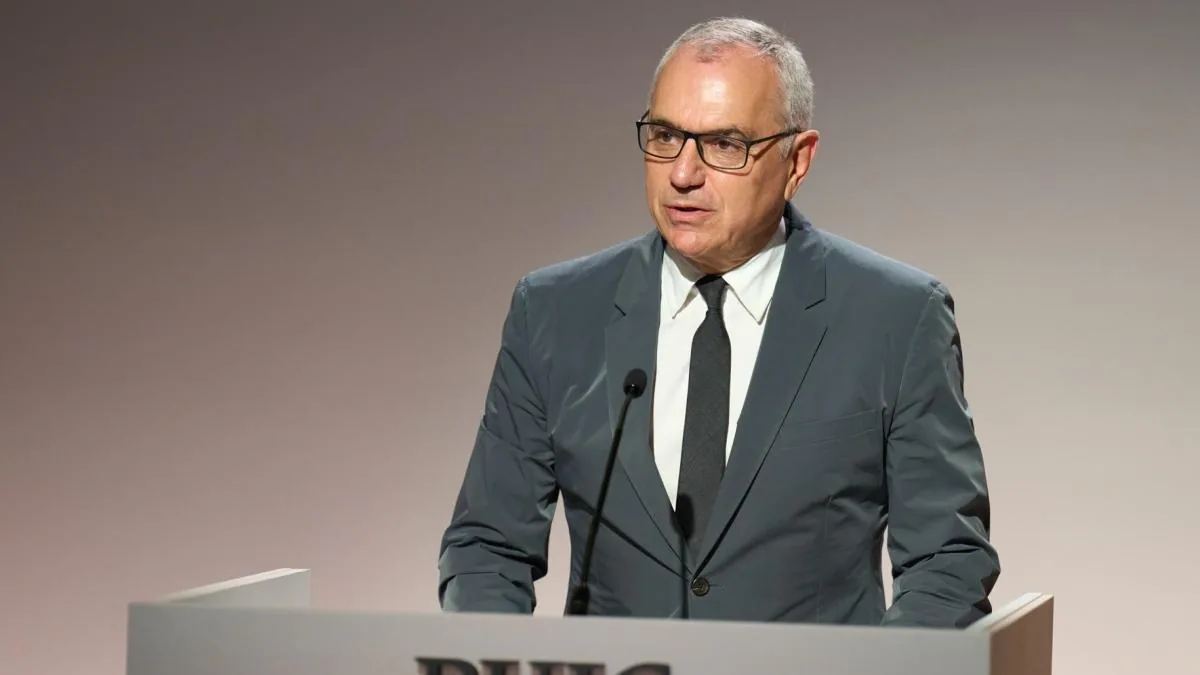









Will Rinehart (Springfield, Illinois, 1985) is a senior researcher at the think tank American Enterprise Institute specializing in the impact of artificial intelligence (AI) on the business world and the labor market. This week he is in Barcelona for the Forward summit held by the employers’ association Foment del Treball. In a meeting with La Vanguardia , Rinehart takes the opportunity to analyze the industry landscape in light of recent announcements advocating for slowing down technological advances.
Read more The race between the U.S. and China for AI halts any attempt at control
Dario Amodei, CEO of Anthropic, Sam Altman of OpenAI, and Elon Musk of xAI have raised alarms with a message acknowledging that AI has gone too far. Is the industry facing a new era of more controlled technological progress?
Yes, it is possible. This idea of taking a pause has existed for quite some time but had never been stated so forcefully. Still, it is very early to know exactly what this pause will consist of. Initially, it could involve legal issues.
Which ones?
A violation of U.S. antitrust law. Collaborating with competing companies generally constitutes a breach of free competition. Therefore, if the main AI companies coordinate to slow down the development of technology, that would generally be considered a monopolistic practice.
So what real chances does the industry have to carry out this slowdown of advances?
Companies would have to go to court to determine whether this pact is legal or not. Probably, the companies would win because the general interest would prevail over the principle of free competition. Moreover, there are already some agreements within the Federal Trade Commission and the Department of Justice that open the door to collaboration among competitors. In any case, companies should have legal certainty that they can apply this pact without problems.
Would more regulation of artificial intelligence be the solution?
That is what the major industry groups are asking for, to a greater or lesser extent, but they do not agree among themselves. Anthropic is the company demanding stricter regulation. We will see what role Congress and the states play. The Trump Administration does not have a very clear position.
Are there economic reasons behind the decision to slow down technological advances?
I don’t think so. This announcement has a background of corporate policy and responsibility. In light of recent cyberattacks like the one suffered by Hugging Face, the major groups have realized that controls are insufficient. That is why they want to subject technological advances to more testing before their market launch.
Read more The Spanish university student murdered in Mexico is the fourth victim on that campus
Do you think there is a fear of the Chinese AI industry?
It is complicated. In part, the Chinese industry takes advantage of U.S. technology, so this slowdown could also harm the Asian giant. Anyway, it is still very early to know how this decision will materialize. As Amodei has said, progress will continue to be fast if frontier models are slowed down.
About OpenAI’s IPO: “More things happen behind the scenes; OpenAI grows less than Anthropic”
So, was the decision to halt OpenAI’s IPO a good idea?
I wonder. I have the feeling that things are happening behind the scenes, beyond the reasons of controls and security. Economically, OpenAI’s growth rate is lower than Anthropic’s.
Beyond the recent uproar, what effects is AI having on the U.S. economy?
Less than expected. The impact on jobs has not been significant, far from it. Three years ago, Dario Amodei and Sam Altman predicted that by the end of 2027 AI would cut between 25 and 30% of the country’s workforce, but this is not going to happen by any means. Adoption is much slower.
But there have been numerous layoffs justified by the implementation of artificial intelligence, at least in tech companies.
It is difficult to determine whether this is related to AI or if the workforce was larger than it should have been. Many companies oversized their staff after the coronavirus pandemic. However, youth unemployment is starting to be affected. Among people aged 22 to 25, in jobs exposed to AI – such as programming or customer service – employment is 19% below what it would be if it had followed the pace of job creation less exposed to this technology.
So is it not true that AI will eliminate jobs?
The disruption will be much slower than the industry has predicted. There will be employment disruptions but they will not be massive as Silicon Valley has declared. If you look at AI adoption rates, it happens in software companies, but in other sectors like finance, medicine, or education, the arrival of AI is much slower.
Read more The wonderful country of Illa