






Artificial intelligence (AI) is becoming one of the major battlefronts in the geostrategic and technological arenas between two of the great superpowers. The United States and China clash over AI development on several fronts. While Donald Trump opposes any brake on AI development, China is also unwilling to let anyone control its companies in this field.
Read more The Spanish university student murdered in Mexico is the fourth victim on that campus
There are some coinciding facts in time starting from the trigger last week, caused by the announcement of a young Anthropic researcher, Jacob Coxon, who explained that he was leaving this company convinced that, on the current path, AI could end the human species before this decade ends.
That viral statement triggered reactions that included Dario Amodei himself, CEO of Anthropic, who was later supported by one of his main rivals, OpenAI CEO Sam Altman. Both showed support for pausing the development of cutting-edge artificial intelligence models – the most advanced – to verify that they meet a series of safety requirements.
When Anthropic and OpenAI talk about regulation, they are not only talking about themselves. They expect control to reach competitors over whom they have very little oversight: Chinese AI companies.
The Chinese company DeepSeek, which at the beginning of 2025 caused a sharp drop in Nvidia’s stock by demonstrating that their expensive specialized chips were not needed to train AI models, has just launched its DeepSeek v4.1 Flash version, which competes head-to-head with the leading models of American companies at prices that can be up to 70 times lower.
The Chinese model DeepSeek v4.1 Flash competes with leading US AI and is much cheaper
On the American side, they accuse their Chinese rivals of using a technique called distillation, whereby a new model in development asks multiple questions to a superior one already in operation and ends up acquiring many of its capabilities.
Anthropic explained last week in its report on the misuse of its AI Claude that Moonshot, the company developing the Chinese Kimi model family, secretly forwarded its clients’ requests to Claude instead of processing them directly. Then it passed the responses off as its own.
That competition between Chinese and American companies is not only manifested in the AI’s ability to solve issues. The lower usage price of AI from Chinese companies could be a torpedo to the massive investments in data centers planned in the United States for the coming years.
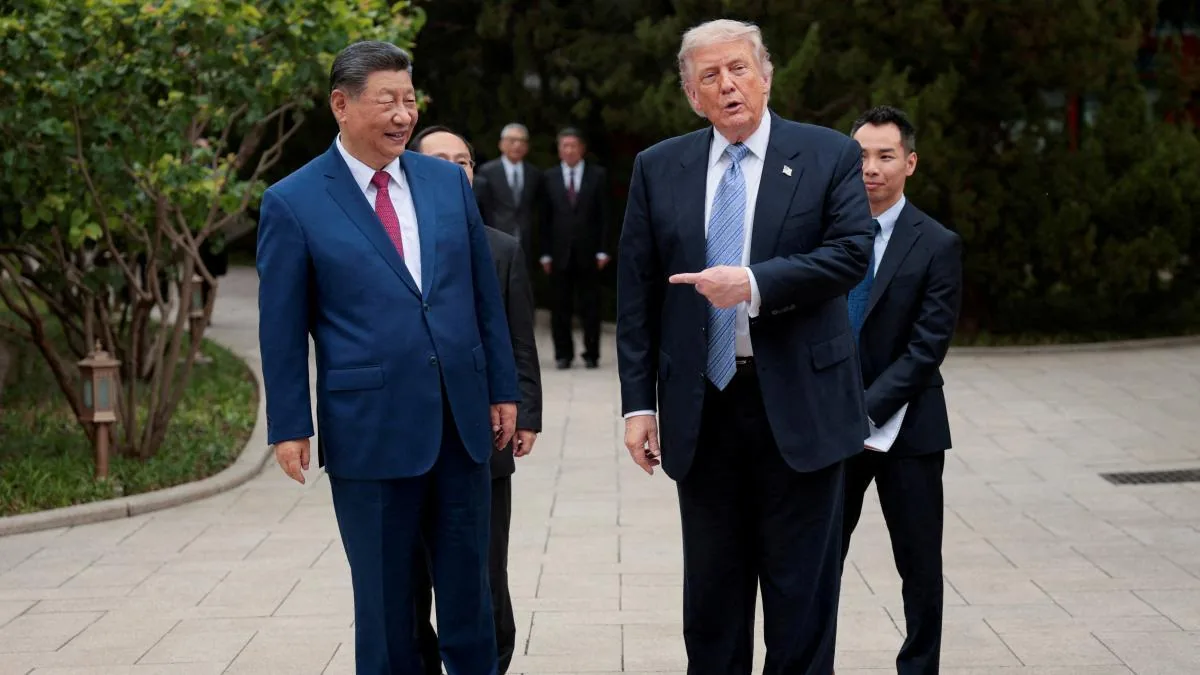
The White House’s reaction to the regulatory proposals from OpenAI and Anthropic came yesterday. Donald Trump, at 80 years old, gives the impression that he cares little or nothing about what kind of world he will leave to his grandchildren. So yesterday he responded to those warning of the danger by spreading from his social network that he himself constitutes a “sufficient protective barrier” against uncontrolled AI
and stated that any attempt to limit this technology is part of a “sick conspiracy.”
Read more The wonderful country of Illa
“The only control or protective barrier AI needs is a strong and intelligent president (with a high IQ!), and the United States has more than enough,” Trump posted on his platform. The president specifically stated that his administration has already prevented the AI company Anthropic from “doing bad things, or potentially bad things, and we will continue to do so,” and attacked its CEO, Dario Amodei, because he is someone who “now pretends to be a perfect little angel.”
A Trump advisor points out that OpenAI and Anthropic would be responsible for a harmful cyberattack
Before the president’s statements, one of the strongest responses to OpenAI and Anthropic came from one of their close collaborators, David Sacks, chairman of the US Government’s Science and Technology Advisory Council, who reproached the role played by Amodei and Altman as responsible parties.
“By any reasonable metric – market share, revenue growth, model capacity – you two have a duopoly in frontier intelligence.” So he asked them that if the models they have in development “are scary enough that you think you should go slower,” they have his support. “But stop pretending you need someone else’s permission,” he added.
“Above all – warned Sacks – stop pretending that the motivation to go slower is purely altruistic. You face massive responsibilities if your products enable a truly harmful cyberattack. The market already punishes models that behave in unpredictable or unauthorized ways.” The harsh statement demanded that tech companies stop “pretending that antitrust law has to be suspended so they can form a cartel.”
The narrative of the American tech companies was rejected by Chinese Minister of State Security Chen Yixin, who pointed out in an article in the official magazine China Cyberspace that the abusive use of AI by adversaries could “directly threaten China’s political, institutional, and ideological security.”
Chen expressed concern that “hostile forces” undertake “public opinion wars” and “cognitive warfare” through AI-generated images, videos, and texts, as well as the use of social networks to spread harmful information and foster social divisions.
A Chinese spokesperson defends an AI “open, inclusive, accessible to all, and oriented towards good”
Chinese Foreign Ministry spokesperson Guo Jiakun stated that his country opposes the spread of threat narratives or fostering confrontation, as it will only hinder the governance process of artificial intelligence. In contrast to Trump’s stance, Jiakun defended jointly promoting an AI that is “open, inclusive, accessible to all, and oriented towards good.”
Sam Altman said yesterday that “we could lose control of the future to AI” and that “if an extraordinarily powerful AI is used by a person or company to impose their worldview on everyone else, the results could be extremely dystopian.”