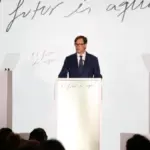



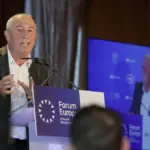


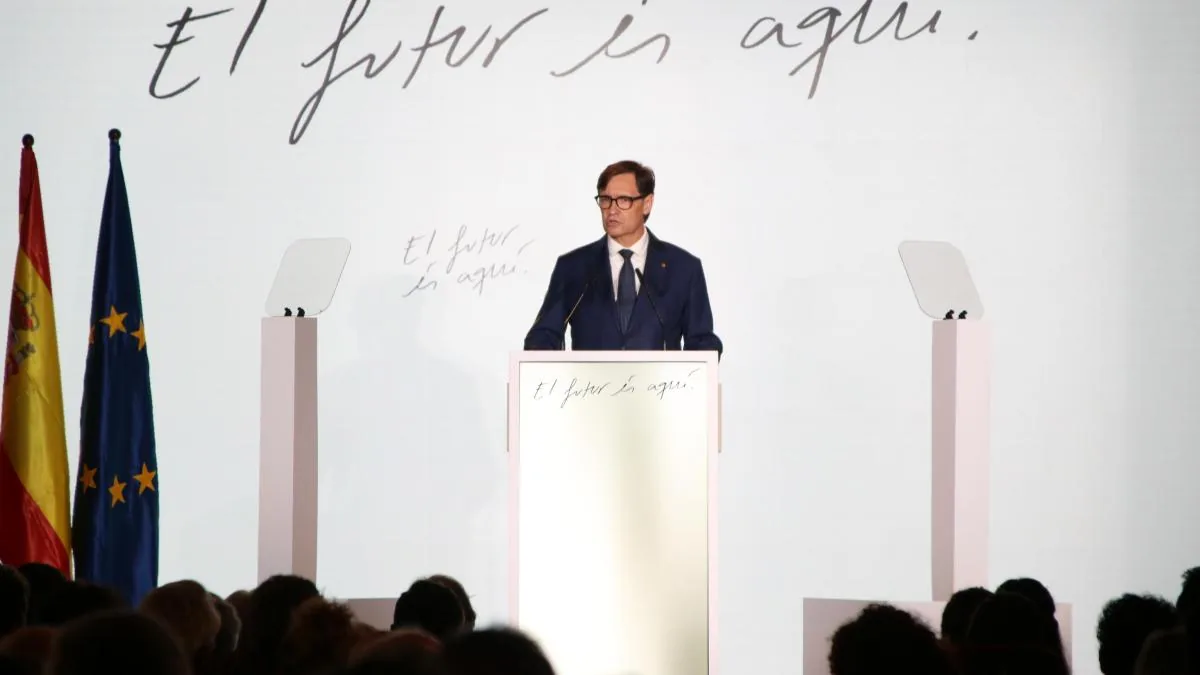
One month before the Catalan elections that brought him to power, then PSC candidate Salvador Illa presented his plans for when he took the reins of the Govern at a crowded conference. There he promised to lead the “third great transformation of Catalonia” through good management, to recover excellence in public services and leave behind “a lost decade” in the ideological battle of the procés. Yesterday, the president repeated that conference with a track record of two years of management that few approve of, but which he strove to present as successful. At the same time, he warned of those times when Catalonia was presented as the “project of a part” and of “a world heading towards a worrying dehumanization” in which “extremely divisive and confrontational politics” predominates.
Read more AI alerts shake technology-dependent markets
Illa renewed the vows of that first conference in which the management of public services was the protagonist. Two years later, with him at the head of the Generalitat and a Govern in which he wanted to incorporate various political sensitivities, the president said he felt “satisfied with the path we are making” and for having achieved that Catalonia is “more united.” “Today Catalonia is once again a collective project for all Catalans” and, “if someone thinks that is little, let them remember: they don’t need to go too far back to see that when the seams of our coexistence have torn, Catalonia has headed for the precipice.”
The president’s optimism was evident in his conviction of having opened “a new horizon of stability that has allowed the return home of important companies.” “We have left behind a decade of paralysis,” he concluded, before citing two examples that in his opinion make the difference: the approval of the “most ambitious budget in the history of the Generalitat” (€49,162 million), which he has proposed to execute “down to the last euro,” and the opportunity to achieve “the best financing system ever reached before by Catalonia.”
Illa also mentioned other achievements, such as Barcelona airport, the expansion of the ports of Barcelona and Tarragona, the extension of metro line L9, the Rodalies works, among others. But to keep moving forward, he urged society to “raise the bar of our collective demand and excellence.” This is where he fully addressed the threat posed by the rise of extremisms.
“Are we willing to make the same mistakes that our grandparents’ generation made? Will Europe again remain indifferent to the rise of new extremisms? (…) “My heart bleeds,” expressed the former chancellor Angela Merkel, moved. “Do we believe ourselves immune to hatred when in our country there are political parties that bluff and identify with Nazi symbols?” questioned the president. To combat these threats, the head of the Govern prescribed “unity and hope,” and “recover the moral ambition of the project called Humanity.”
Although for Illa the path traveled by the Govern “is positive, going in the right, correct direction,” he presented challenges in areas such as climate change, technology, demographics, and especially education, especially after the disaster of the PISA report results. In this last area, the president warned that his government is making “an unprecedented effort,” a “historic” budgetary effort to improve teaching and learning conditions, but aware that the issue is not resolved and that the educational community demands more measures, he presented concrete proposals.
First, he announced that he will soon start a round of meetings with political forces with parliamentary representation. He will also ask the Consell d’Educació de Catalunya to be the instrument for this debate, due to the knowledge and pluralism it represents, and thirdly, he committed that “the debate will include, now yes, reaching 6% public investment, as established by the education law approved by the Parliament in 2009,” a long-demanded claim of the educational community. “We must bring Catalan education to excellence,” he proclaimed.
Also in the educational field, Illa announced a plan to air-condition educational centers. The plan will act on the 2,530 public centers in Catalonia with a mobilization of up to €2.5 billion until the 2030-2031 school year. The goal is that in five years all publicly owned centers will be air-conditioned. For now, 100 centers have been planned, which will be addressed from 2027 and have been prioritized according to climatic and architectural criteria.
In technological matters, Illa announced that also this Tuesday the Govern will approve a plan to “anticipate, govern and take advantage of the impact of AI on the labor market.” In this way, the Catalan Executive will create the first Catalan observatory of AI and the labor market and will create a registry of algorithmic systems to know where, how and for what this technology is used. The president guaranteed that he will safeguard labor rights “so that no algorithmic decision acts without human supervision.” In this area, “Catalonia opens a path that I am convinced other countries will follow,” he predicted.
In demographic matters, the head of the Govern did not make a concrete announcement, but he praised the humanist policy he boasts in contrast to the “racism and xenophobia” he warns of in certain political parties, also with representation in Catalonia. Illa warned that “there is nothing more opposed to the feeling and doing of Catalans than xenophobia and racism,” and that “hatred generates no solution, does not build public housing, does not improve neighborhoods, does not build schools nor open businesses.” On the contrary, “there is a vast majority of Catalans born here or coming from outside who, quietly but steadily, are weaving stronger and more solid human bonds” and he emphasized that “Catalonia needs everyone, without distinction of origins, but with a will to incorporate and with a shared identification in construction, inclusive, of project, of future,” he conditioned.
Attendance
Representatives from the economic world and civil society
At the conference of president Salvador Illa, 840 people attended yesterday, including former presidents of the Generalitat Pere Aragonès and José Montilla. There were also representatives of the parliamentary groups of Junts, ERC and the commons, Mònica Sales, Josep Maria Jové and Jéssica Albiach, respectively, as well as the mayor of Barcelona, Jaume Collboni, and other institutional representatives. The rectors of Catalan universities and social agents also attended: Josep Sánchez Llibre, president of Foment; Antoni Cañete, president of Pimec; Camil Ros, general secretary of UGT Catalunya; Belén López, general secretary of CCOO Catalunya; and the president of the Cambra, Josep Santacreu. Also attending was Carlos Godó, executive president of the Godó Group. From the business sector there was a strong representation, with Maurici Lucena, president of Aena; Ángel Simón, president of Indra; Borja Ochoa, president of Telefónica; Sergi Loughney, from the La Caixa Foundation; Rosa Tous, president of the Catalan Family Business Association; Enric Brazís, director of Endesa in Catalonia; Emiliano López Achurra, president of Petronor; Salvador Alemany, president of the Board of the Liceu Foundation; and lawyer Miquel Roca.
Read more Pregnant woman arrested in Barajas with 69 cocaine pellets hidden in her body