









They are eight dolia or small containers that the Romans used to store products. They have just appeared on Hostal d’en Sol street, next to the historic headquarters of the Post Office on Via Laietana in Barcelona. The nearest ship is today – thanks to Google Maps – 310 meters away. Two millennia ago, when the Roman city was just founded, the sea must have been closer. Because those dolia very likely served to store products ready to be shipped to the empire; the Roman one, of course. And because right behind is the wall that the city’s founders built to protect themselves.
Read more Paula Echevarría cries over the death of her father alongside her mother and her daughter Daniella
The dolia are underground in the current city, “but at levels not as low as one might expect,” reports Laia Macià, an archaeologist from the municipal services, who is working on this still ongoing investigation and trying to take advantage of the opportunity of the Via Laietana reform and its surroundings to see what we have in the puff pastry of underground history.
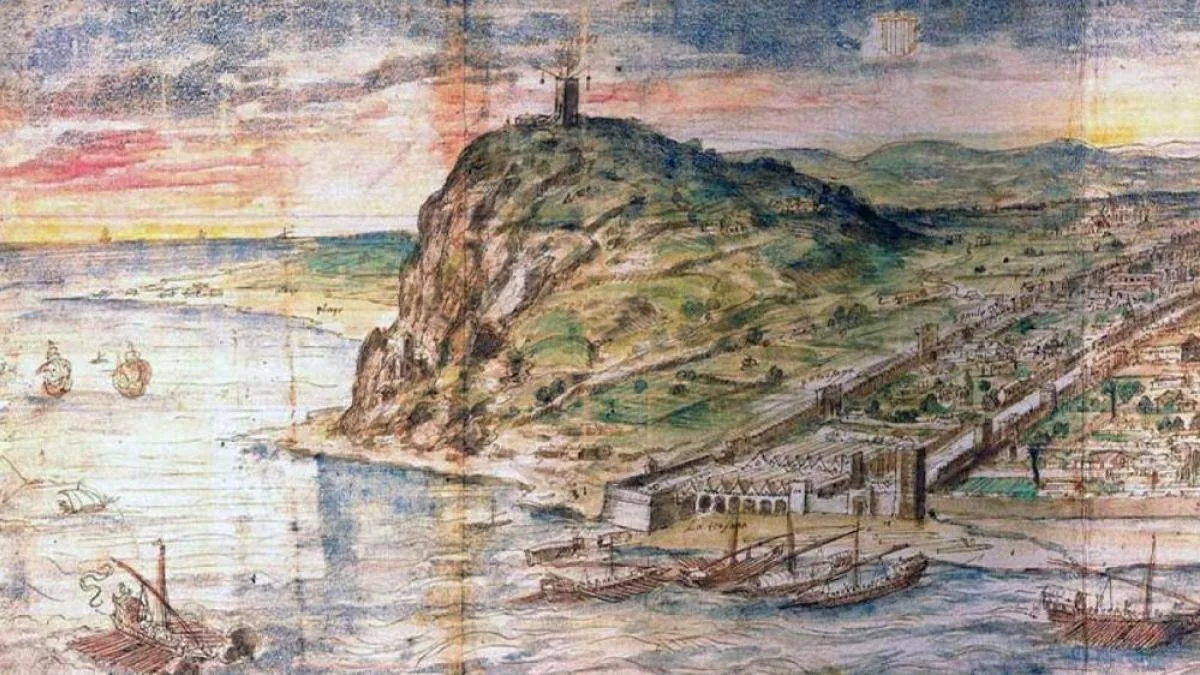
In an area not far away, certain structures appeared a few years ago that were assumed to be from an old Roman port, which is one of the great mysteries of early Barcelona: Was there a Roman port? How big was it? What capacity did it have? Where was it? Is there anything left of it down there?
A recent excavation has brought to light remains of eight dolia or small containers in a large building in an area that must have been very close to the sea
The dolia, adds Macià, “are linked to a very large building that has successive uses over time, with a major renovation that we place in the 3rd century AD. At that time the dolia were covered.” The structure of the now discovered building has a construction facing “that is not found in poor houses, it required a certain level of expenditure,” and stucco remains have also appeared that could suggest a more or less luxurious decoration. The size of the building, with a wall at least twelve meters long, its location between the wall and the sea, and the embellished interior “could indicate that we are facing a public building, which could be related to the port, if we start to speculate, but it is not proven,” Macià slows down.
“We think it is an important find, but we cannot state it categorically. I am very cautious. I cannot make a categorical statement,” emphasizes the municipal archaeologist.
Half a dozen archaeologists consulted agree in stating that Barcino certainly had an important port, and that it was a key place in the city. Barcino’s economy, based on wine, depended on a maritime connection, so it could not have lacked one. “We don’t know where, but it was super important,” stresses Carme Miró, director for years of the Pla Barcino.
“Regarding the port of Barcino – explains Daniel Alcubierre, archaeologist at the Museu d’Història de Barcelona – we do not have a structure as such, apart from some very partial fragments, but what we do have is evidence that Barcino received goods from all over the Mediterranean, such as oil, grain, and preserved fish or luxury products, such as ivory, tableware, or Greek marble, and that Barcino wine amphorae have been found in Great Britain and Germany, so we do not have precise evidence of where goods enter and exit, but we do know that this happened for several centuries.”
All experts agree that Barcino had a lot of maritime trade, but they disagree on whether ships docked at a pier or on the beach sand
“In the Magoria area, not far from the mouth of the Llobregat, huge Iberian-era silos appeared, prior to the appearance of Barcino, which indicates that there was surely an important port there in that pre-Roman time,” adds the researcher.
As in other cities of the empire, on either side of the sea gate, or the Regomir (the street of the same name still exists), there were baths, possibly for men and women; next to them was a horreum, a large warehouse for port use.
Read more Historic Italian defender Franco Baresi dies at 66 years old
In a 2011 article, archaeologist Ramon Járrega established what we know (and what we can infer) about the port of Barcino, which must have had “greater importance than we generally attribute to it.” The concentration of amphora factories in the outer area that today would correspond to the Born, which suggests a nearby boarding area, the “probable establishment of a portorium to control and tax the goods traffic” and the also probable installation of a military contingent for surveillance in the “praefectura orae maritimae laeetanae” indicate that Barcino had a stable port, with docking and wintering capacity, Járrega argues.
The subsequent evolution “is unknown to us, but the high volume of imported ceramics documented during late antiquity allows us to deduce that it remained in use. Medieval documentation suggests the non-existence or little importance of the port in the Early Middle Ages, so we believe that towards the end of Antiquity it must have been blocked by the alluviums of the torrents.”
Archaeology professor Isabel Rodà added in 2017 in another study that “Barcino was born facing the sea” and that “its port area had a primary function.” The city was born as “a small administrative center to control the territory between the Besós (Baetulo) and the Llobregat (Rubricatum), already widely exploited for its mining wealth in the Gavà area and viticulture in the late Republican period that gave rise to the proliferation of very productive villas and an active maritime trade that also included the Llobregat river route,” she argues.
Archaeologist Mikel Soberón, responsible for the excavation of a (medieval) ship that appeared near Barceloneta, believes that local historiography overuses the idea of “port” because “the word ‘port’ has glamour.”
There is a saying that the four best ports of the Mediterranean [in antiquity] are Cartagena, Maó, July, and August”
Mikel Soberón
Archaeologist
“We all love Barcelona and its history, but we do no favors if we magnify it, like snobbish parents who believe their children are the best.” Soberón emphasizes that the sea level was about 50 centimeters below the current level, which completely redraws the coastline. “It is undeniable that in Barcino there was maritime trade (of relative importance) channeled through some space that according to the evidence was a simple beach. Although it may be surprising, many coastal cities operated until the industrial era as ports without any significant artificial structure or special natural conditions, Barcelona or Valencia would be a good example (there is a saying that the four best ports of the Mediterranean are Cartagena, Maó, July, and August).”
“As far as we know, there is no evidence of port structures in Barcino. Hypothesizing their presence is mere supposition and has no foundation. The coastal strip, very close to the current one if we remove the layout of the ring road and the works of the contemporary port, would have been an open beach. In a slave-based system like the Roman one, the effort that working in such a port could represent was done by slaves, that’s what they were for. Surely it did not have large docks because it did not need them either.”
Ferran Puig, archaeologist and former director of the Servei d’Arqueologia de Barcelona, emphasizes that the coast two thousand years ago must have been very different from today: “We do not know what the coastline was like.” Barcino is built on the slight Tàber hill, barely eleven meters above sea level, and is surrounded by a wall one kilometer long, which separates it from two streams, on either side, which in their contact with the sea create lagoons that were perhaps navigable or at least suitable as docking areas; moreover, they would be protected by Montjuïc, which created a small bay. These lagoons would be called from the Middle Ages Merdançà and Cagalell, because sedimentation isolated them from the sea but not from the city’s sewers.
The lagoons, in any case, generated in Roman times another very important industry: with reed, esparto, and boga, ropes were made, a fundamental tool for tying horses, and for making bows and fishing tools. Also, of course, for hoisting sails or tying boats to their ports. Including Barcino’s.