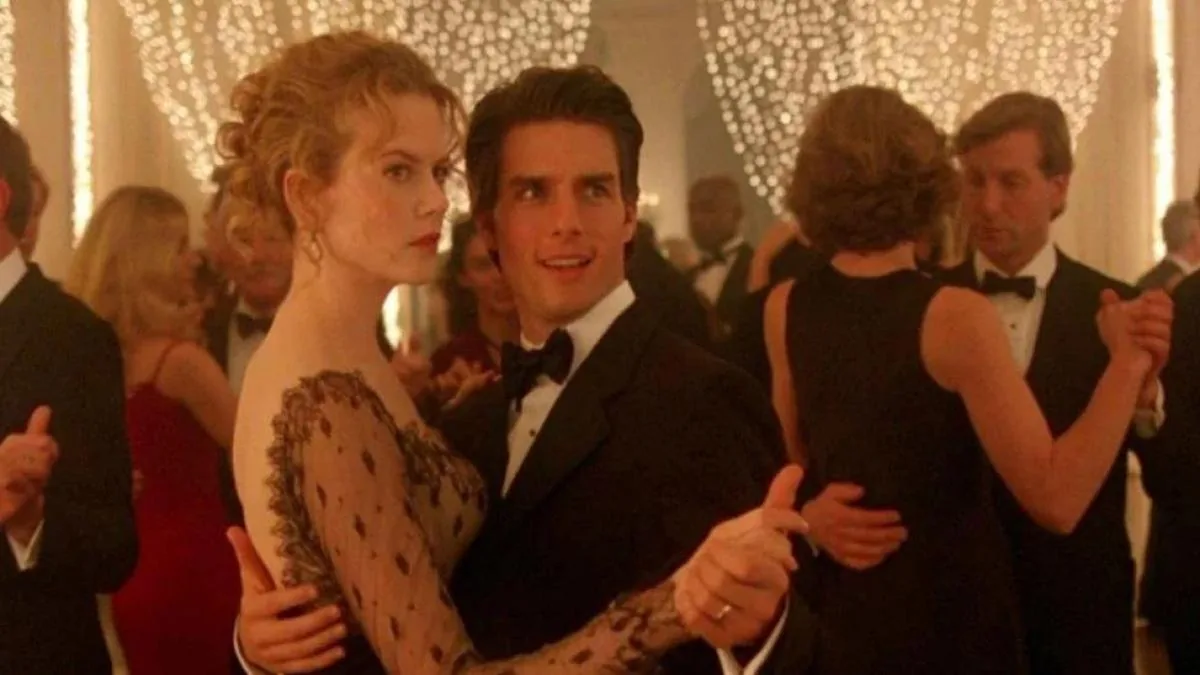
On March 7, 1999, just four days after delivering the final cut of Eyes Wide Shut, Stanley Kubrick died in his sleep of a myocardial infarction. His sudden death, the decade that had passed since his previous film ( Full Metal Jacket, 1987) and the morbid fascination that Hollywood’s fashionable couple, Tom Cruise and Nicole Kidman, starred in the posthumous film, imbued the premiere with a certain testamentary aura that exponentially raised expectations. Critics and audiences disagreed. A stroke of genius? A blunder? Or was the message simply not understood? Be that as it may, the film has aged remarkably well, features some memorable scenes, and, above all, contains not one but two succulent parties, two distorting mirrors of the same elite.
Read more Health redefines nutrition: Danone’s recipe to anticipate and lead new trends
The first is hosted by millionaire Victor Ziegler (Sydney Pollack) in his New York mansion, a pre-Christmas party attended by the married couple, doctor Bill Harford (Cruise) and his wife Alice (Kidman). Long dresses, tuxedos, oysters, and champagne galore. The Australian-born actress nails the scene where, quite tipsy, she flirts while slow dancing with a Hungarian aristocrat who talks to her about The Art of Love, by Ovid, and poses the big question that runs through the film: “Don’t you think that one of the charms of marriage is that it makes deception a necessity for both parties?” Meanwhile, Dr. Cruise is also flirting with a couple of models until the owner of the house requires his services: to revive one of the guests, who was over the top and on cocaine, with whom the host was having sex in one of the mansion’s bathrooms until she collapsed.
The group sex sequence does not convey eroticism, but rather suffocation and unease
What a night. Back home, the spouses engage in a tricky conversation that escalates into an argument when the wife, with the complicity of a marijuana cigarette, confesses to a past adultery, a fantasy for which, even without consummating it, she would have been willing to abandon her comfortable bourgeois life, including the couple’s beautiful daughter. The shadows of the dance and the conversation immerse them, “magically and painfully, in the deceptive glow of lost opportunities.”
In the novel that inspired Kubrick, Dr. Fridolin’s wife (Albertine) does not require cannabis support to reveal her infidelity. It is Traumnovelle (1925), translated as Dream Story (Acantilado / Quaderns Crema), by the writer and physician Arthur Schnitzler, a representative of that magnificent generation of Jewish intellectuals –Stefan Zweig, Joseph Roth, Sigmund Freud– who shone in the imperial twilight of Austria until the rise of Nazism. Director Kubrick and his co-screenwriter, Frederic Raphael, remained faithful to the original story except for a few, perhaps unnecessary, liberties, and the successful decision to move the action from interwar Vienna to contemporary New York.
From here, the plot becomes convoluted: nothing is as it seems. The concatenation of events unfolds under the veil of a dreamlike atmosphere already announced in the title: Eyes Wide Shut; that is, Eyes Wide Shut or, even, Eyes Closed Wide Open, a paradox that suggests that it is precisely in the depths of the subconscious, the territory of dreams, where the most authentic desires are hidden. In fact, the author of the novel, Schnitzler, maintained an intense correspondence with the father of psychoanalysis. From that logic of moral dream, after discovering marital infidelity, the doctor becomes obsessed with revenge that, in a way, will eventually take shape in the celebrated orgy. The second party, so to speak.
Read more Javier Bardem steals the show at Shakira’s concert in New York
A password allows the protagonist doctor to sneak into a majestic residence –Somerton, in the fiction–, an isolated mansion in a forest on the Long Island coast. Inside, an extravagant ceremony is taking place, with airs of a pagan mass or a Masonic ritual, presided over by a figure crouched in red velvets. The supposed priest, with a scepter in one hand and a smoking censer in the other, stands in the center of a circle of kneeling women who will eventually display their naked bodies before the attendees, all incognito, with cloaks, hoods, and Venetian masks.
Read also
One of the enigmatic vestals, masked and naked, chooses Dr. Cruise from among the gathered and guides him through the rooms of the mansion, where guests copulate, in pairs or in groups, or contemplate the various carnal tableaux (no sex between gentlemen, by the way). The sequence has immense visual power, but far from conveying eroticism, it submerges the viewer in a suffocating unease, reinforced by the music of the British Jocelyn Pook, a melody titled Masked Ball for which she drew inspiration from a Transylvanian funeral chant.
It is assumed that the party attendees are members of a secret society, a shielded minority of billionaires, bored of having everything at their fingertips, eager to invent new formulas of pleasure. And that is why recent parallels have been drawn between the film and the Epstein case, due to the uncomfortably relevant intuition that desire, money, and secrecy can turn transgression into privilege and moral impunity into spectacle.
Read more Living inside Gaudí