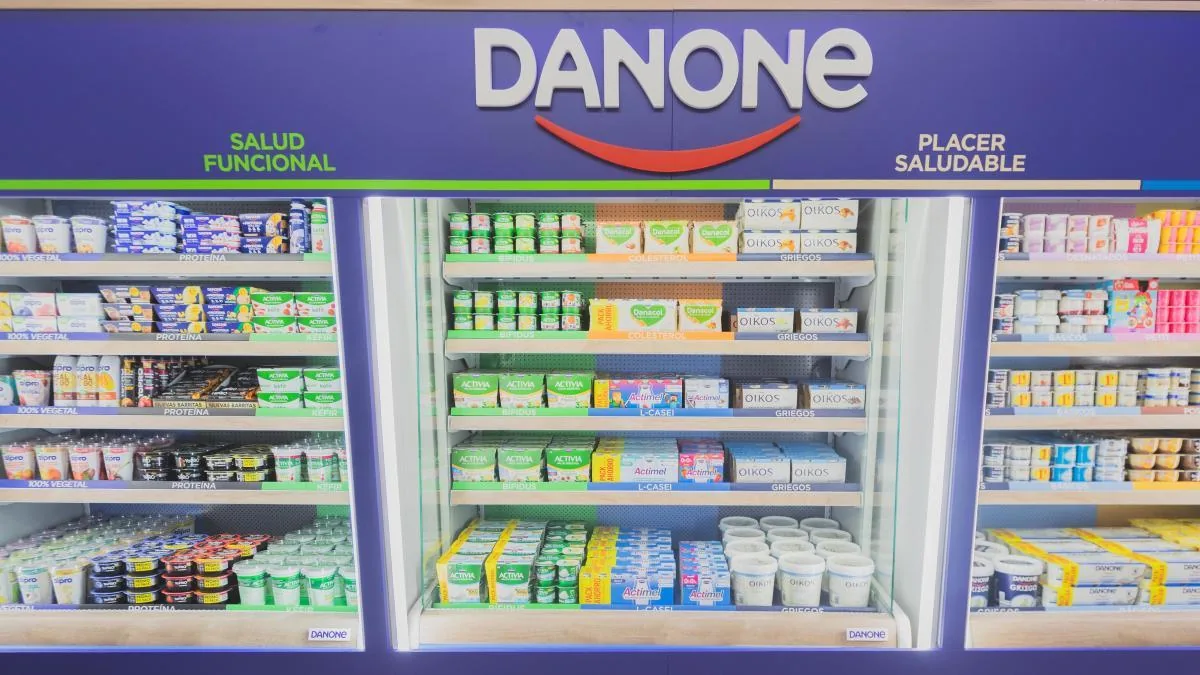
Health has become one of the main factors that condition what we eat and what products we choose when we are in front of the shelf. According to a NIQ study on eating habits and trends in Spain, 68% of Spaniards claim to be proactive in improving their well-being, actively seeking products that provide specific health benefits.
Read more Javier Bardem steals the show at Shakira’s concert in New York
Today, this transformation is evident, and most food companies are beginning to focus their innovations in this direction. However, there are others, like Danone, that identified this evolution early several years ago and decided to focus their growth on categories aligned with new consumer needs, when many of them were still nascent. Examples include plant-based alternatives, protein, Greek yogurt, cholesterol-lowering products, and kefir. Today, these categories have consolidated as market leaders and reflect the company’s ability to anticipate and accelerate consumption trends.
The proof that this commitment is bearing fruit is in a compelling fact: 95% of Danone’s current growth in Spain comes, among others, from these categories that just five years ago had a very limited presence or did not even exist within the business, and which today have become key segments for consumers. Detecting a trend is key. Turning it into a consolidated category is something very few can do, and in this, Danone has carved out a leading niche within the sector.

The company, born in Barcelona, has made innovation one of its main levers of superiority and a strategic commitment to drive future growth. In Spain, Danone invests 13 million euros annually in R&D to develop products that respond to changing consumer needs, incorporating new nutritional benefits, formats, and flavors adapted to their consumption habits. This innovation capability not only allows for the launch of relevant proposals to the market but also energizes categories, attracts new consumers, and contributes to their long-term development and consolidation.
The case of kefir is one of the most representative examples. Few know that since the company’s origin in 1919, Danone already distributed yogurts and kefir in pharmacies, its first point of sale for those who needed to take care of their intestinal health. The commitment to kefir has been maintained over the years due to its nutritional profile and versatility, although until relatively recently it was a largely unknown food to the general public. However, today, kefir has consolidated as one of the fastest-growing categories in the market, and Danone’s Activia has become one of its main references.
Furthermore, Activia Kefir is the only kefir in Spain that has AENOR certification, which accredits the presence of yeasts in its fermentation process, an essential element to guarantee the authenticity of kefir. This seal is especially relevant considering that, according to a study by the Universitat Rovira i Virgili, up to 80% of products marketed as kefir might not contain yeasts.
A century-old vision that continues to set the course
Danone’s commitment to health is not a recent response to market demands. It is part of its origin.
More than a century ago, Isaac Carasso began making yogurts convinced that food could contribute to improving people’s health. That same conviction continues to guide the company’s evolution today and is reflected in decisions ranging from product reformulation to the promotion of new categories.
Currently, 90% of its options are healthy daily consumption products, nearly half of its portfolio contains no added sugars, and Danone was the first company to align its entire children’s portfolio with the recommendations of the World Health Organization.
At a time when health is redefining food, Danone continues to demonstrate a differential ability to identify where consumption is evolving, drive new categories, and consolidate itself as a key player in the evolution of the food sector.
Another prominent case is that of protein. When YoPRO arrived on the Spanish market, high-protein dairy products were still a niche offering. Today they constitute a fully consolidated and democratized category, which has expanded its appeal beyond the most athletic consumers to reach a much wider audience. This evolution is supported by a solid research capability, with five patents developed at its Tres Cantos Science Hub related to high-protein dairy products.
Read more Living inside Gaudí
Finally, plant-based alternatives represent another example of this anticipation capability. Alpro was one of the first brands to identify the potential of plant-based food and today leads the category in both Spain and Europe. Its proposal combines flavor and innovation with a nutritionally complete formula, fortified with five essential nutrients.
Three different categories that illustrate the same way of operating: identifying emerging needs, investing in science and innovation to accelerate their development, and contributing to building high-value categories for consumer health that end up transforming the market.
Three key centers
Behind this capacity for anticipation is a commitment to constantly listen to consumer demands, a commitment to evolve and adapt, and, above all, years of research and a global network of scientists to make this growth possible.
Spain plays a strategic role within Danone’s global network thanks to three key centers: the Aldaia Innovation Hub; the Isaac Carasso R&D Center in Barcelona; and the Tres Cantos Science Hub, where research and production coexist in the same space to accelerate the arrival of innovation.
Spain plays a strategic role within Danone’s global network thanks to three centers where research and production coexist
Innovations such as YoPRO and Danone Skyr have emerged from these centers, resulting from registered patents. The basis of this work includes more than 4,000 bacterial strains—1,900 exclusive to the company—, more than 180 scientific studies, and an agreement with the CSIC to advance in areas such as microbiota, fermented foods, diabetes, and longevity.
This scientific capability not only drives innovation in daily consumer products but also allows Danone to generate knowledge in key areas for health and nutrition. Its highest expression is found in Nutricia, the company’s Specialized Nutrition division, focused on solutions for people with specific nutritional needs.
Read more The most exclusive houses in Mallorca, owned by artists and creatives, from Sybilla to James Costos