




“If we consider that Barcino was a city, let’s say, cool, we must consider that Barcino must have had an amphitheater.”
Read more At the summit of Mount Uishèra…, with the permission of the guard dog
“I don’t think it was a stable amphitheater, because there was one in Bétulo, very close, and here possibly one was built of wood, there was good oak, because we have no trace of it.”
The first opinion is from Laia Macià, a specialist in the Roman period at the Servei d’Arqueologia de Barcelona; the second, from Carme Miró, who was responsible for the Pla Barcino, of the municipal Servei d’Arqueologia.
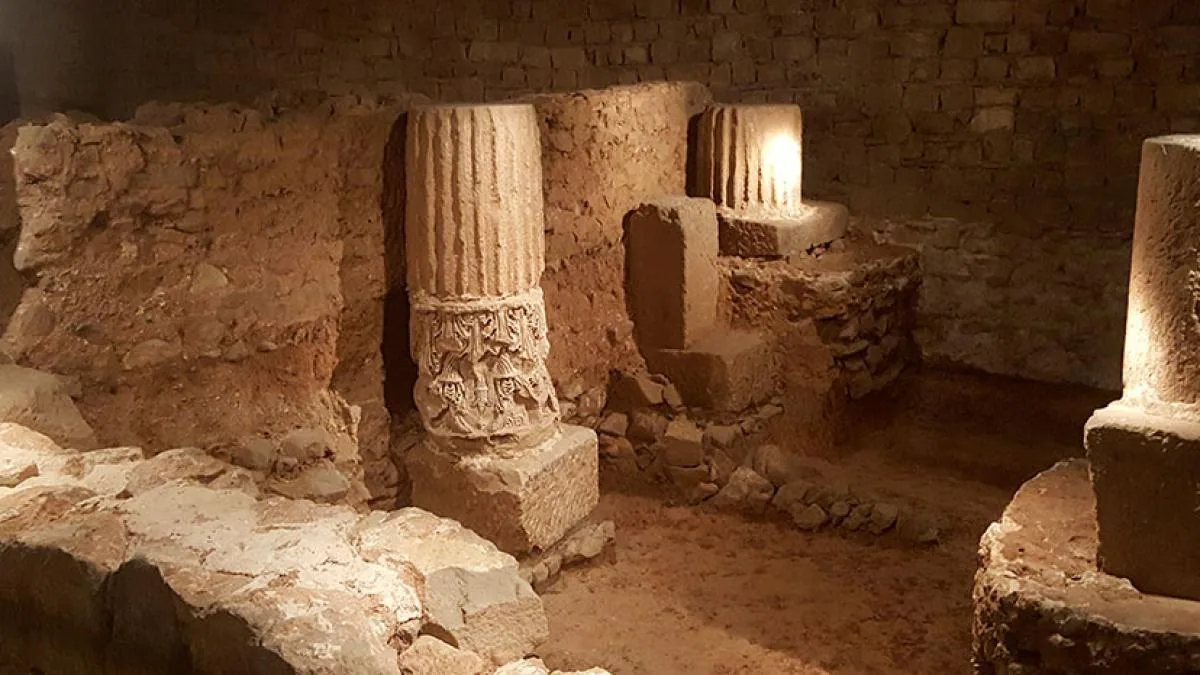
Did Barcino have an amphitheater? It is another of the great mysteries that endure from the city’s founding period, more than two thousand years ago.
In the 19th century an inscription was found mentioning the accountant of the gladiator school
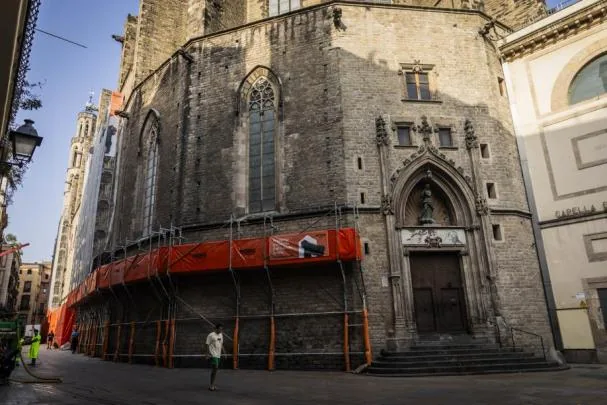
The theory that has generated the most debate places a possible location of Barcino’s amphitheater in the area now occupied by Santa María del Mar.
It was an area close to the sea (the nearest water point today is 365 meters away, in a straight line), possibly on sandy ground, fed by the sedimentation of the streams descending from Collserola.
Jordina Sales Carbonell, professor of history and archaeology at the University of Barcelona, published a study in 2011 that is at least suggestive.
In research on the preceding church of Santa Maria del Mar, she noticed that “during the late Antiquity it was very common to install churches inside disused Roman spectacle buildings and possibly in Barcelona a similar case occurred. While investigating a Visigothic church (by the way, where Saint Eulàlia was worshiped), signs began to appear indicating the possible presence of an amphitheater in Santa Maria del Mar,” she explains by email.
It is very likely, I would almost say certain, that Barcino had an amphitheater. It had the legal status of a colony and was a foundation from the Augustan period to settle Italic veterans”
Jordina Sales-Carbonell
Archaeologist
“It is very likely, I would almost say certain – she adds – that Barcino had an amphitheater. It had the legal status of a colony and was a foundation from the Augustan period to settle Italic veterans, which makes it a strong candidate to host an amphitheater, given the well-known fondness that discharged legionaries had for building amphitheaters there: ‘little Romes’. In case there are still doubts, remember that in the 19th century a funerary inscription (now unfortunately lost) was found near the Palacio Condal of a certain Dión, who according to the inscription held the position of accountant of the Ludus (the gladiator school) of Hispania and the Gauls; and since the text does not indicate otherwise, it is highly probable that this Ludus was in Barcino. Therefore, it is not only that there was an amphitheater, but that there was even a gladiator school!”
Sales investigated all the evidence that could support this idea. First, Santa María del Mar had been called Beatae Mariae de les Arenes, that is, “of the sands” (documented in 1104), as happened in other cities of the Roman Empire – such as Metz, Besançon, Nîmes, Ancona or Padua – where medieval churches built over the remains of an amphitheater were called this; in her study, Sales emphasizes that “the ancient coastline seems to have been far enough from the place so that the toponym ‘of the sands’ should no longer be considered a literal reference to beach sands.”
Second, excavations carried out between 1940 and 1967 revealed a strange layer of leveled sands that could correspond to the original floor of the circus arena.
Third, the street layout around the church draws a radial and curved arrangement – visible in a building with an anomalously curved façade on Sombrerers street – similar to cities like Lecce, Córdoba, Florence or Lucca; the author proposed an ellipse of about 117 × 93 meters.
Read more Paying with a card has a reward: ‘cashback’ returns part of the payments to our account
Fourth, the current Argenteria street would connect the northeast gate of the Roman city with the amphitheater, and the layout would coincide with that of the Roman urbanization.
Fifth, no high-imperial period necropolis was found in the place, indicating that the place was not funerary in Roman times and could have been occupied by another structure before becoming a cemetery.
And finally, the Born promenade (at the edge of the church) is remembered as the place where medieval and modern knightly tournaments were held; it is not direct proof, the study admitted, but it could indicate that the area had a recreational use from ancient times.
I think [an amphitheater] is practically a “mandatory” monument for a city of colonial status. It would be very good to try to locate it”
Ramon Járrega
Archaeologist at the Institut Català d’Arqueologia Clàssica
“I think there was one,” argues archaeologist Ramon Járrega, because there is a funerary inscription of a businessman of the ludus gallicus et hispanicus, which is significant. I think a suitable location would have been the area of the church of Pi, although there is a hypothesis that places it here but gives it dimensions that are too large. In any case, along with the theater, I think it is practically a “mandatory” monument for a city of colonial status. It would be very good to try to locate it, but so far I have not seen interest in doing so. Geophysical surveys could be done to document underground structures,” he proposes.
“The amphitheater theory is nonsense. In the Santa María del Mar hypothesis there is a fundamental error, because this church was never called ‘de les arenes’, the first mention is from the 10th century, and it is called Santa Maria in Litori Maris. Also, ‘arenas’ does not indicate an amphitheater: in Tarraco, the church built over the amphitheater was called Santa María del Miracle, and it comes from ‘admirable’, it is the etymological evolution. But not from ‘the sands’,” claims Eduard Riu-Barrera, archaeologist of the Servei de Patrimoni i Arquitectura de la Generalitat.
The amphitheater theory is nonsense. In the Santa María del Mar hypothesis there is a fundamental error, because this church was never called ‘de les arenes’”
Eduard Riu-Barrera
Archaeologist
“And an amphitheater is an immense structure that would have left some powerful structure, and here we have not found a single trace. At that time it was not a secondary city, but I would say tertiary.”
Two years after Sales’ study, another by Luis Conde Moragues (an engineer who studied archaeology after retiring) appeared, applying the same argument to conclude that the amphitheater could actually have been in the Santa María del Pi area. Sales sees that location as “unlikely” because it would be “practically attached to the Roman wall.”
“The Pi hypothesis came out a year after my Santa Maria del Mar hypothesis appeared, and the author (without citing the Santa Maria del Mar proposal at all) simply took my arguments and applied them forcibly to his proposal.” For the UB professor, it is “the typical case of (bad) reaction” to a hypothesis, which instead of “calmly debating and adding, tends to react and subtract. Instead of cooperating, we compete. It is sad, but I suppose our emotional evolution is not as fast as would be required for ‘good science’.”
Regarding the possibility that it was in the Pi square… the Via Augusta passed through there! How could they build it in the middle?” “Another nonsense”
Isabel Rodà
Professor of Archaeology at the Universitat Autònoma
Isabel Rodà, professor of archaeology at the Universitat Autònoma de Barcelona, dismisses both the Pi option and that of Santa María del Mar: “We have had the invention of amphitheaters. If it was called Santa Maria de les Arenes it was because there was beach sand, not because there was a circus arena. It is geologically proven that a structure like an amphitheater could not be founded there,” she maintains. “Regarding the possibility that it was in the Pi square… the Via Augusta passed through there! How could they build it in the middle? Another nonsense,” she concludes. In a similar vein, Riu-Barrera opines that “Barcelona’s archaeology has had some inventions in recent years that will be very difficult to counter.”
Laia Macià, in any case, applies to all hypotheses the maxim of Saint Thomas: “If I don’t see it, I don’t believe it.”
Read more The Shakespeare’s Globe Theatre in London brings flamenco to its stage for the first time