



Signing up for a writing course and submitting texts written with artificial intelligence is, to say the least, paradoxical. But it happens. These are rare cases and just one more example of how ChatGpts and similar tools are permeating classrooms at all levels: school, university, and also those of future writers. Who will be behind the future best sellers? This question has been asked for at least two years by the faculties of the vast majority of writing schools worldwide.
Read more Will Rinehart: “A pact to curb AI could violate antitrust law”
The debate is on the table and there is no single answer, although the majority agree that creativity must come from a human mind. Therefore, some directly prohibit anything that does not comply with this mantra, to the point that one could risk expulsion, as happens at Bennington College in Vermont, whose writing program, highly regarded among American poets and authors, explicitly asks students and professors not to use any generative AI tools, not even in creative assignments; or the Columbia Fiction Foundry in New York, which specifies that any text, no matter how short, written with AI “will be treated as an issue equivalent to plagiarism.”
“When a student uses AI, it is usually because they are embarrassed to fall behind in class,” notes Pérez
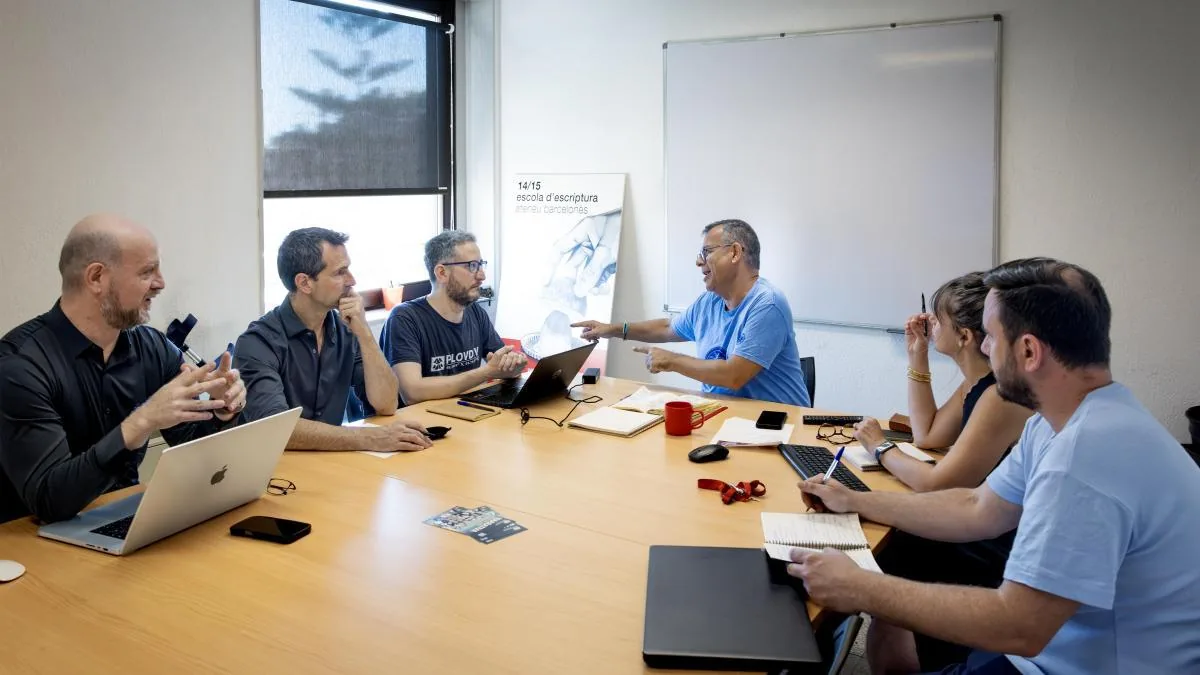
Spanish schools are having these same conversations today. Pau Pérez, director of the Escola d’Escriptura de l’Ateneu Barcelonès, meets in the days before classes start with some of the teachers and members of the coordination team, and the topic is probably the most repeated. Will it change classroom dynamics? “It’s not a question of the future, it’s already happening,” admits the tutor, who jokingly calls this new technology ‘yaya.’ “The times a student uses it is usually because they are embarrassed to fall behind their classmates in terms of submissions; but that is where we must raise awareness that it is better to go slower than to have a machine write the text for you. The opposite, in fact, is absurd. The creative process must be exclusively human.”
For now, Pérez is convinced that “it is easy to detect when someone cheats, starting with punctuation marks, since we live in a country where this is a pending subject, and it cannot be that suddenly someone who did not master this perfectly produces a perfect text.” This can lead to a new trend, increasingly widespread on social media, which is to write badly on purpose to avoid being mistaken for AI. “How can I prove that I wrote my own text without being accused otherwise? By writing strangely,” suggests Laura Brooke Robson, author of Love is an algorythm , in an article in Writer’s Digest , where she explains that in her novels she avoids “insipid metaphors,” as well as long dashes and lists of three elements, both very common structures in AI-generated texts.
“I’ve started reading like a detective. I don’t want to, but I doubt if what I read was written with AI”
“I’ve started reading like a detective. I don’t want to. I want to sit on my park bench and fully immerse myself in the book I’m reading, but lately I doubt if what I read was written by AI. Every few months, I check Claude and ChatGPT to see how their narrative skills are progressing. They are improving. I don’t like to say it, but it’s true,” Brooke confesses.
Javier Sagarna, director of the Escuela de Escritores in Madrid, sometimes has the same feeling, who years ago would have found it very difficult to imagine that much of the sector, including readers, would become a kind of writing police, although, like Pérez, he insists that it is “an awareness-raising job in which we should not point fingers, but learn. Including the teaching staff, whom we have also asked to refrain from using these intelligences in their corrections. It is important because otherwise we will end up with homogeneous texts, very similar in structure, following the same patterns, when precisely one of the riches of literature is diversity.”
Read more The race between the U.S. and China for AI halts any attempt at control
It should be said that there are centers that do believe it is possible to develop a unique voice despite artificial intelligences. The University of Maryland even published in 2025 Studio for Literary Technology , specifically for writers and professors to work with language models and generative narrative. Or, in Barcelona, Jorge Carrión, co-director of the Master’s in Literary Creation at Universitat Pompeu Fabra, explains that “we introduced writing with AI four years ago as a creative option, in the context of contemporary art, in Alícia Kopf’s class, a pioneer in the use of bots, and in my class, based on my experience with GPT-2 and GPT-3 in the project Los campos electromagnéticos. Theories and practices of artificial writing (Caja Negra), written hand in hand with AI.” He adds: “AI is an excellent tool for research and editing.”
The Laboratori de Lletres also includes a subject on AI in its Master’s in Literary Creation. The Association for Writing Across the Curriculum itself, which promotes writing teaching in all contexts for teachers, professors, researchers, and directors of literary centers worldwide, states that “AI is forcing a rethink of what writing means” and defends writing as “a human activity of research, judgment, and reflection.”
Frankfurt will put AI in the spotlight
The Frankfurt Book Fair, the largest in the world, will extensively debate artificial intelligence from October 7 to 11. There are dozens of talks and activities revolving around these new technologies, ranging from training to legal issues in the book world. The main conversation in all of them is, in fact, to rethink what it means to be a writer in these times, what value human intervention has, and how literary education can change. On this last point, writing schools have much to say although, in most cases, they are still rethinking their own perspective and their professionals are in continuous training. Aware of this, the fair has been trying for at least three years to help attendees with this education, and the offer is increasingly larger, as is the interest in conducting all kinds of workshops. Jeanette Winterson left a question open last year: “If a text written by a machine moves the reader, what exactly are we teaching when we teach writing?”
As with everything, it will take some time to see if Chatgpt, Gemini, and others substantially change the training of writers. For now, Pau Pérez concludes, “we are at a very good enrollment moment, so it is clear that people prefer to train and learn techniques with a human and not on their own with a robot, which will only flatter and encourage, but will not make a good correction to learn from.” Along these lines, the question Mia Couto asks in his new novel, The River of Blindness (Alfaguara) is striking: what would happen if the West forgot how to write? And one step further: what happens if those who believe they dominate the world lose precisely the tool with which they believe they understand it?
In a way, obviously exaggerating a bit, this is also what writing schools reflect on: does our existence make sense? In a recent TED talk, Margaret Atwood made her position clear: “If what you want is to be a writer, why would you want a machine to do your job? Artificial intelligence can imitate, but the writer must have a voice. The easier it is to replicate style, the more important it becomes to build a voice that is not simply a style.”
Read more The Spanish university student murdered in Mexico is the fourth victim on that campus