A few days ago, Cecilia (a fictitious name) was attacked by her partner. As on other occasions, he became nervous and hit her in the eye and mouth, causing a bruise on the right side of her face. After assaulting her, the man forcibly took her away – to ensure no one saw her injuries – and threatened to kill her and bury her in a hole. It was not the first time Cecilia felt her life was in danger, so she gathered courage and requested a protection order at the police station, which was granted hours later at the City of Justice in Barcelona. While the woman waits for her gender violence complaint to be resolved, the aggressor is prohibited from approaching her within a thousand meters and from communicating by any means.
Read more The Supreme Court ruling allows returns from Ceuta
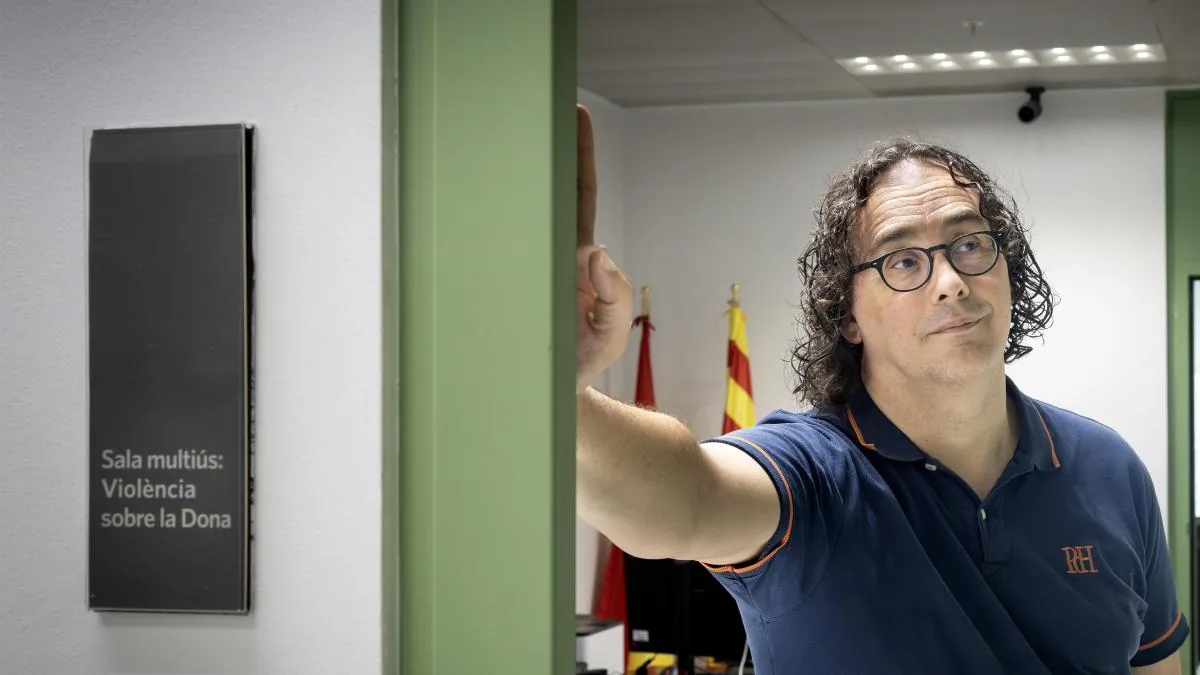
In cases like Cecilia’s, judges in the sections on violence against women can grant protection orders until the matter is definitively resolved with a final sentence. Carlos Pascual Alfaro, magistrate of the Violence Against Women Court number 1 in Barcelona, lets us accompany him on one of his shifts to learn how this judicial process works. Pascual joined the sections on violence against women in 2007, and he has been an on-call judge for 17 years.
The femicides of the past week have reminded us of the importance of timely protection for victims of gender-based violence. On Tuesday, the murder of a woman in Barcelona was confirmed while she was at home with her two minor children. Last week, two more women died at the hands of their partners or ex-partners, and another victim died in the hospital months after being burned in February by hitmen hired by her husband. Additionally, a police report concluded that the court in Figueres could have better protected Kimberly, who was murdered in the street, by not sending her aggressor to prison despite his repeated breaches of the restraining order.
32 femicides so far this year
There have already been 32 femicides so far this year, and it is most likely that the number will continue to rise in the coming weeks. This is explained by Beatriz Durán, a psychologist expert in gender-based violence and trauma from the Official College of Psychology of Catalonia (COPC): “During the summer months, risk factors increase, as the abuser and the victim share more time and spaces.” Added to this are irritability due to high temperatures, increased consumption of alcohol and other drugs, loss of usual support networks, and the fact that some take advantage of vacations to consider separation or to report. “It is a lethal risk factor for the woman. Faced with loss of control, he acts,” Durán adds.
To escape this violence, the first step is to go to the police station, where women are offered the possibility to file a complaint and, separately, to request a protection order. From there, cases are quickly referred to the courts, as they have a maximum of 72 hours to decide whether to grant the precautionary measure. In this way, victims make an initial statement at the police station and then appear before the on-call judge to ratify it. “At the police station, an initial risk assessment is made, which I usually do not consider because most of the time they either do not perceive risk or rate it as low. If I were guided by this parameter, I would not issue any order,” comments Pascual Alfaro.
Specifically, the magistrate listens to the victim and asks questions to guide her testimony: “The court is a hostile environment, so it is difficult for them to testify. I try to help them and listen carefully because I know they are risking a lot and I need as much information as possible to decide.” “It is a crucial moment in their lives because their safety and that of their children may depend on it,” adds Pascual Alfaro. Next, the Public Prosecutor’s Office, the private prosecution, and the defense ask more questions to the declarant. After this procedure, she can leave the court and wait for the resolution by email. Thus, in principle, it is avoided that she coincides with her aggressor, who later enters to testify following the same procedure.
Also read
Once both have been heard, the Prosecutor’s Office requests or denies the granting of the protection order, as do the lawyers of both parties. Finally, the judge retires to his office to make the decision. “I resolve delicate situations: you evict people from their homes, break up families, and limit rights. In case of doubt, I do not issue the order because it is a measure that limits rights,” points out the magistrate. There are days when making this decision is frustrating. For example, a woman said that after ending the relationship with her partner, he threatened to set fire to the place where she worked while she was inside. Although everything pointed to a “risk case” – he had a weapon – the magistrate could not issue the order because the aggressor was in hiding: he could neither be summoned to testify nor was it possible to send him the resolution. “It made no sense to impose prohibitions on him if he was not even going to know he had to comply with them,” he justifies.
During magistrate Pascual’s shift, Cecilia and other women saw their requests for protection orders granted. For example, Adela (a fictitious name) reported her ex-partner for breaching the restraining order and spending the night on a bench in front of her house. Daniela (a fictitious name) also had a resolution in her favor: a man with whom she had no relationship constantly followed her on her way to work. The day she went to the police station, Daniela had been threatened with a knife in front of witnesses.
The femicides of the past week remind us of the importance of timely protection for victims
According to the law, cases must meet two requirements to be granted a protection order. First, there must be founded indications of the commission of a crime. Second, the victim’s situation must be classified as an ‘objective risk’: the magistrate must look beyond the fear the woman feels and instead base the decision exclusively on objective criteria. “The severity of the crime, criminal records, substance use, and the presence of minors are indicators that help me build a prognosis for the future,” specifies Pascual Alfaro. “Since fear is usually subjective, I try to have them explain why they are so scared. I had a woman who came to trial for a very minor episode but was very afraid because her previous partner had stabbed her. And I saw another case where her fear was based on the fact that her stepfather had killed her mother and she made that association. Another person cannot answer for that,” adds the magistrate.
If the on-call judges identify indications of a crime and an objective risk situation, they must establish which measures will protect the victim. On the one hand, the most notable criminal measures are the restraining order, prohibition of communication, or deprivation of liberty. On the other hand, civil measures usually include suspension of visitation rights or custody in favor of the father, as well as granting the use of the family home to the woman.
Contacts for requesting help
There are resources that allow victims of gender-based violence to ask for help every day of the week and 24 hours a day: the phone number 016, the WhatsApp channel at 600 000 016, and the email 016-online@igualdad.gob.es. In case of emergency, you can call 112.
Of the 32 women murdered this 2026, only ten had reported, and among them, only six had a restraining order.