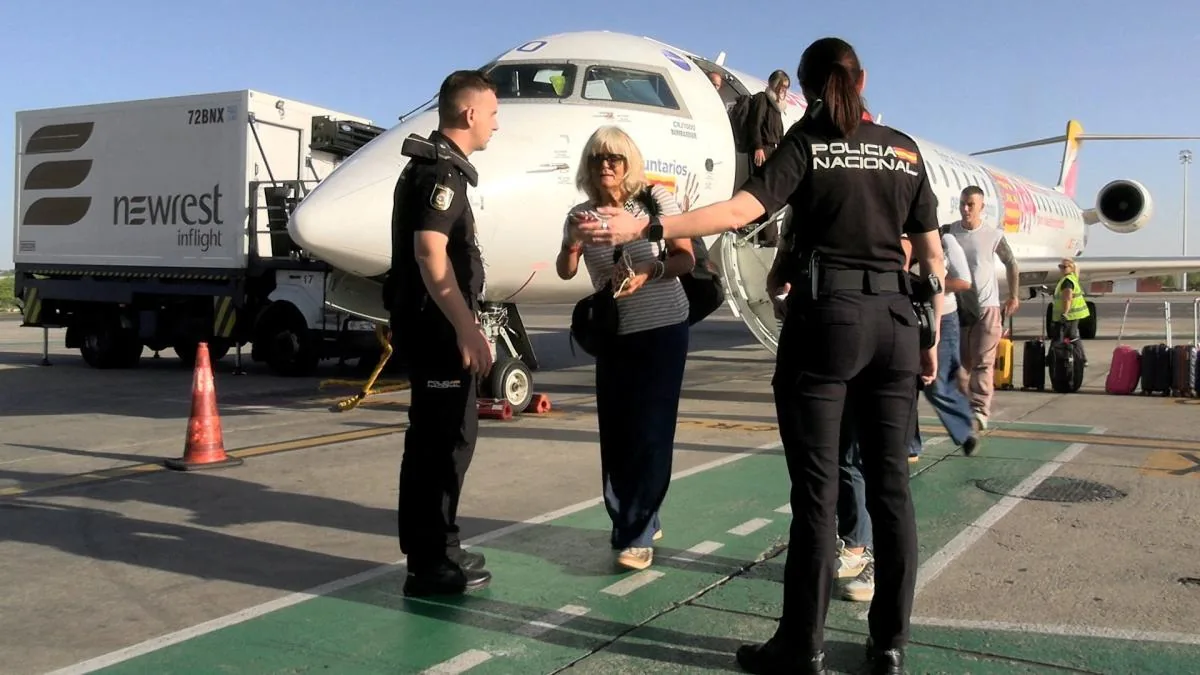
The border controls being carried out since this Saturday, after the Government decided to suspend Schengen with Italy due to the diplomatic crisis following the massive entry of immigrants in Ceuta, are conducted at the airplane door – at the exit of the access gangway to the aircraft, in the so-called finger – without causing a diversion of passenger flow to an external border control area, according to the Ministry of the Interior. National Police officers are carrying out these controls randomly, not systematically, on passengers who are nationals of third countries, in order to verify that they have a valid passport and, if applicable, a visa or residence card.
Read more Barça already knows that Ferran wants to go to PSG
The ministerial order on the temporary establishment of border controls for passengers coming from Italy, which La Vanguardia has accessed, refers to Article 25 of Schengen, which allows the suspension of free movement when there is “a serious threat” to public order or internal security. The Government, using the diplomatic clash with Italy as a pretext, points to migratory pressure on the Mediterranean route, the most active so far this year with 11,600 detections of irregular crossings, compared to 7,100 on the Western Mediterranean route. Furthermore, it focuses, as the far right in Spain has done after the Ceuta crisis, on the route potentially being a gateway for terrorists. The Ministry of the Interior explains that Frontex’s strategic analyses consider “the risk that persons linked to terrorist threats” may use the routes to enter the community territory undetected.
Thus, the order states, “the concentration” of movements on certain flights and maritime links from Italy, which increase during the summer period, “allows the conclusion that there is a serious, real, and current threat” to public order and internal security. The order, with three articles, establishes that border controls will be applied at Spanish airports and ports regarding passenger flights whose last airport of departure before arriving in Spanish territory is located in the Italian Republic, and to ships, ferries, and other maritime passenger transport services whose last port of departure before arriving in Spanish territory is located in the Italian Republic.
Read more The trompe-l’œil of the photo of Pedro Sánchez without legs in La Mareta
The controls, details the Interior document, will be carried out on all persons crossing the affected internal air or sea borders, regardless of their nationality, applying to each the verification regime corresponding to their legal status and, in particular, their condition as a person benefiting or not from the right to free movement under European Union law. Interior sources specify that the controls are focusing on passengers who are nationals of third countries. Depending on the number of passengers on each flight, the appropriate number of Border Police officers is assigned to carry out each control.
The department led by Fernando Grande-Marlaska aims at all times for the greatest cooperation with passengers and company members, so that nationals of Member States are exempt from inspection and greater agility is allowed in the disembarkation of travelers from the aircraft. If doubts arise about compliance with the requirements that make it necessary to carry out an in-depth check on any passenger, they are accompanied to the border post where, discreetly, the necessary verifications and checks are carried out and, if applicable, the processing of entry denial or the required procedure.
Read more First checks at Spanish airports for flights coming from Italy