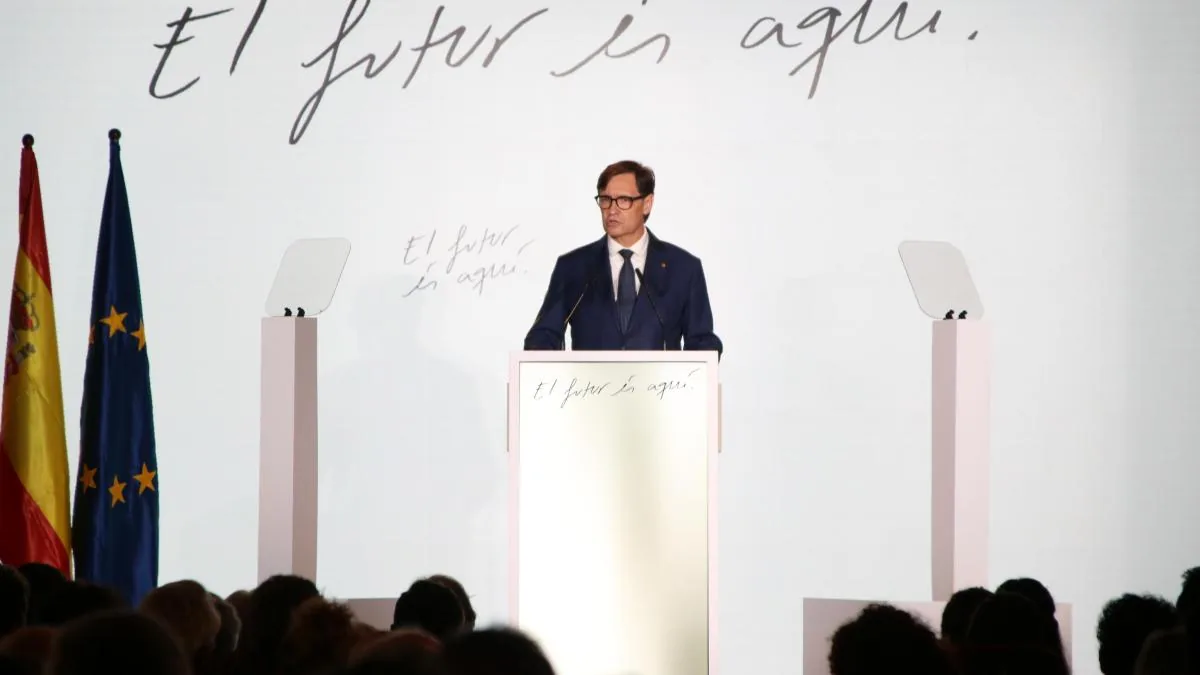








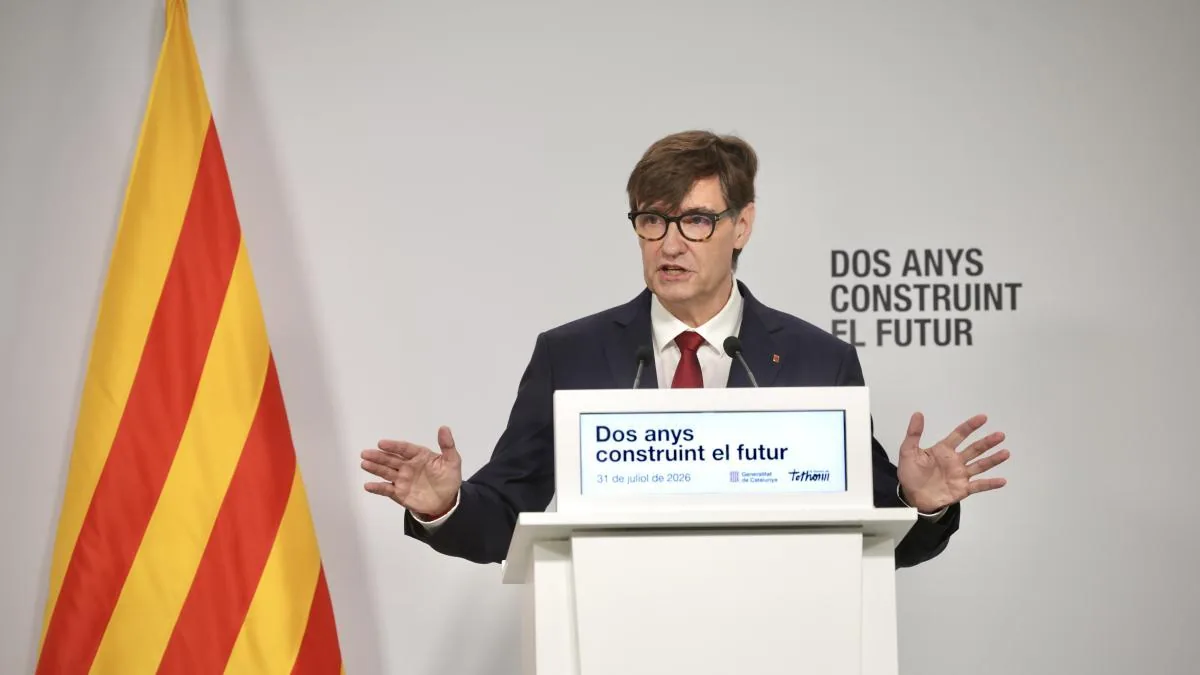
Arriving at the midpoint of his term, the president of the Generalitat, Salvador Illa, made an assessment this Friday of his first two years leading the Government in which he claimed that they have managed to “stabilize the country, improve coexistence, and become predictable.” These are elements that, in his view, deepen the goal of making Catalonia “the best country in Europe to live in” in the coming years, although he admitted that there is still much to be done in housing, education, or Rodalies.
Read more The latest stabbing victim in La Mina had 39 police arrests accumulated
Nevertheless, Illa ends the political course with his eyes on September 4, when the Fiscal and Financial Policy Council (CPFF) will take place, where the new financing model will be approved. The head of the Catalan Executive emphasized that achieving this new system is his priority in the coming months and, without explicitly mentioning them, has asked for support from both Junts and the PP. The socialist leader insisted that the model is “good for everyone” and that he still expects someone to explain “why it is not.”
It was at this point that he referred to the ‘peix al cove’ policy: “Someone says they want more and that they could do it better, but when they could, they didn’t. But even if that were the case, why don’t we take this in the meantime and if in the future this someone can do more, I will support them if it is viable?” Thus, Salvador Illa has called for “responsibility” from the Catalan political parties, a demand he extended to the rest of the autonomous communities.
The president warned the PP that on September 4 “the subterfuges, electoral calculations, and excuses end” and urged them to follow the example of the Canary Islands government: “When negotiating with loyalty and calm, we all win. We are in overtime, but we have a new opportunity to negotiate.” Illa himself has opened the door to involvement with meetings that, in some cases, may be public and other actions without disclosure.
Also read
In any case, he did want to reproach the Popular Party for their argument that the proposal “comes from Catalonia”: “Can’t we make proposals? We are uniting, what privileges are we seeking if what we are doing is reducing the financing differences between communities?”
While the leader of the Catalan Executive puts all the focus on the financing model, he sets aside the transfer of the IRPF. In the press conference reviewing his first year, he promised that the Catalan treasury would manage this tax entirely by 2028. Illa avoids setting deadlines and, although he has reiterated that he maintains his “commitments” in this matter, he has ironically said that “a few years ago I would have said ‘this is not the time,’ I don’t do it but now the goal is set on the model.”
The president of the Generalitat appeared just shortly after landing from his trip to Vietnam and Singapore, where he confirmed that “Catalonia is a respected and admired country that has regained its leadership and voice in the world.” From this perspective, Illa made an “optimistic” assessment because “we came from a stage of division, institutional paralysis, and some resignation” and now companies are returning, there are “good” economic data and “record” investment figures. In his report, the socialist highlights the new financing model, the “most ambitious” budgets in history, the initiated transfer of Rodalies, and the “reduction” of crime.
The housing crisis, the main concern
However, and despite also wanting to praise several “milestones” in housing or education, the president admitted that there is considerable room for improvement and committed to remedy it “soon.” Regarding the housing crisis, Salvador Illa places it as his “main concern” and stressed that he will persist in the recipe of “intervening” in the market.
In this line, the socialist warned that “anyone who wants to speculate with housing or see it only as an asset to obtain profitability is mistaken.” “We don’t tell people they can’t make a living, but housing is primarily an essential good that must be guaranteed to the citizens,” he emphasized.
Read more Body found in a container in Lloret de Mar
Other thorny issues that have marked this first half of 2026 are the chaos of Rodalies and several crises in education. In the field of mobility, he has promised “progressive improvements” and highlighted that 180 actions are being carried out on the railway network “without affecting” the service. And in education, the controversy derived from the PISA tests has cost him criticism from his partners and the opposition. The president hinted that there will be some dismissal: “I have asked Minister Niubó to go to the end to see what happened. It should not have happened. When we have all the information, we will make the decisions we have to adopt.”
Salvador Illa reiterated that he maintains his “confidence” in the Education minister, and when the internal investigation is finished “there will be consequences.” And regarding the conflict with the teachers, he assures that he “respects the right to strike” but has demanded the same for “the right to education,” as well as claiming the agreement to improve their salary conditions. The leader does not plan to dismiss Niubó or make more changes, for now, in his Government: “I am very happy with the work they do.”
Maintains ERC and Comuns as “priority” partners
Asked about the relationship with his allies – ERC and Comuns -, the president of the Generalitat states that his intention is to keep them as preferred partners and fulfill the investiture agreements signed with them. However, he also clarified that those pacts were to elect him as head of the Executive and that, from here, he has to earn support “day by day.”
In this line, he has not ruled out the possibility of reaching agreements with other parties: “The Government also has its project and its way of seeing things.” What he has also made clear is that he will complete the legislature even if the 2027 budgets are not approved.
1.4 billion in public works tenders
Within the framework of the “third great transformation” of Catalonia to which he committed, Illa has placed the increase in investment in public works tenders. In his appearance, he announced that they will allocate 1.429 billion this year to carry out several interventions, which represents a 17% increase over 2025. By June 30, 416 million had been tendered and today eight works have been put out to tender for a total amount of 502. The remaining 510 will be tendered until December.
By June 30, 416 million had been tendered and today eight works have been put out to tender for a total amount of 502. The most relevant work put out to tender this Friday is the Les Preses and Olot variant, a project to which an amount of 447 million is allocated.
Next trip: Ukraine
After his ‘tour’ through Vietnam and Singapore, the leader of the Catalan Executive already has “two or three” more trips in mind for the second half of the year. He has not gone into details and schedules, but he has advanced that the first of them will be to Ukraine: “It is a country with which we are cooperating and it is appropriate to send a message of support and solidarity for the situation they have.”
Read more Accidents and traffic jams mark the start of the second summer getaway operation