







At 25 years old, Fátima has made twenty attempts to swim from Fnideq (Castillejos, northern Morocco) to the Spanish enclave of Ceuta. “I don’t care about the risk, I will return,” she says. Like her, hundreds of young people are taking to the sea without Moroccan security preventing it in the biggest migration crisis since 2021, about which Rabat remains strikingly silent.
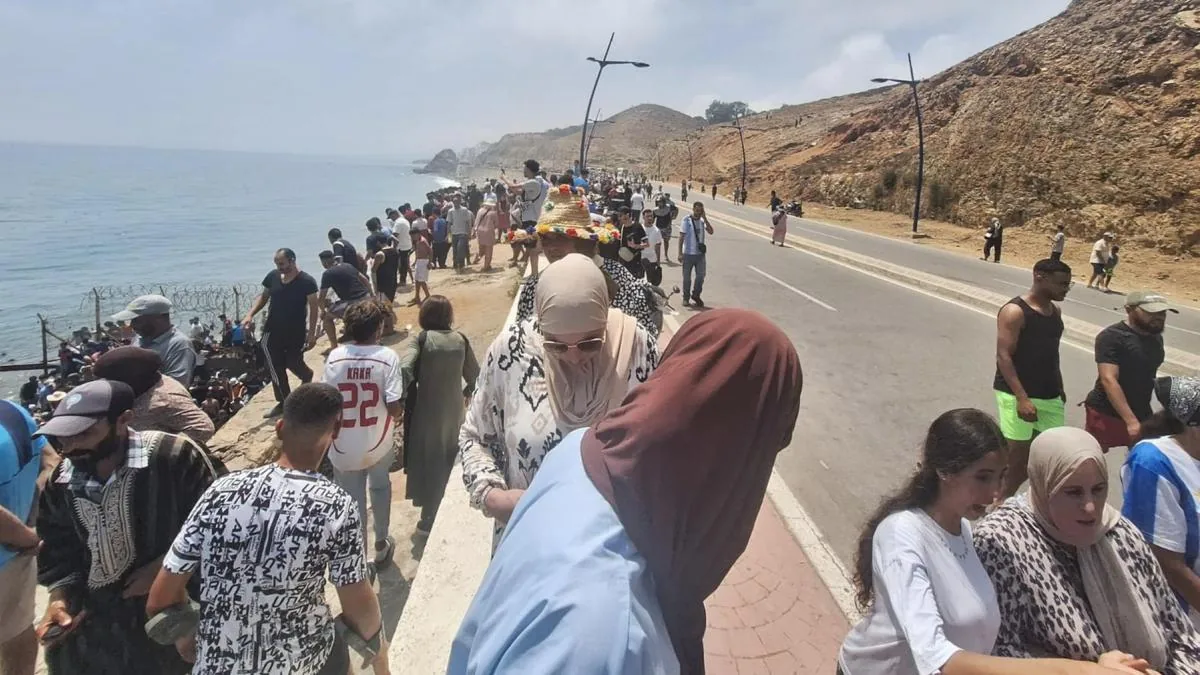
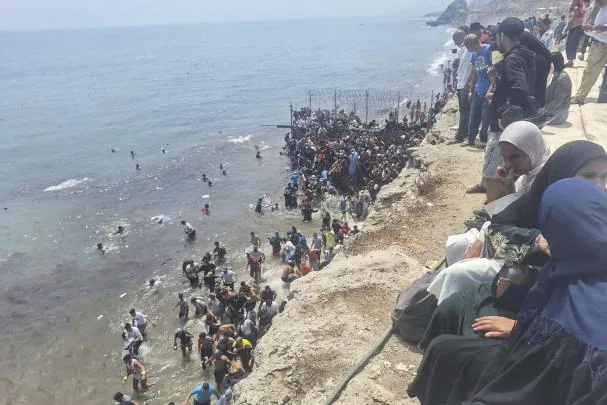
Groups of young people walk through the center of Fnideq, bordering Ceuta, waiting for their chance to enter the sea. Almost all wear light clothing that does not hinder swimming. They come from inland towns and large cities, such as Casablanca, Fez, or Marrakech, hundreds of kilometers away.
They enter the sea during the day, blending in with bathers on the beach in the center of Fnideq; at night and especially at dawn, without Moroccan security forces trying to stop them.
Some wear wetsuits, fins, floatation devices, or truck covers to help them on the crossing—about three kilometers swimming in a straight line. Others jump in wearing only swimwear and many don’t even know how to swim.
They come to Fnideq attracted by friends’ experiences, messages on social media, and in search of the “European dream” seen from a country with 5 million emigrants—more than 13% of the population—and a youth unemployment rate around 40%.
“I have friends who live in Spain, they have made it and I want to go too, there is no future here,” says Fátima after her last attempt to reach Ceuta, her clothes still wet.
“I was in the water for six hours, when I was reaching Ceuta, the Spanish coast guard surrounded us and the Moroccan Royal Navy stopped us and sent us back. Tonight I will try again,” she says alongside more than a dozen young people, some minors, who had the same fate this early morning.
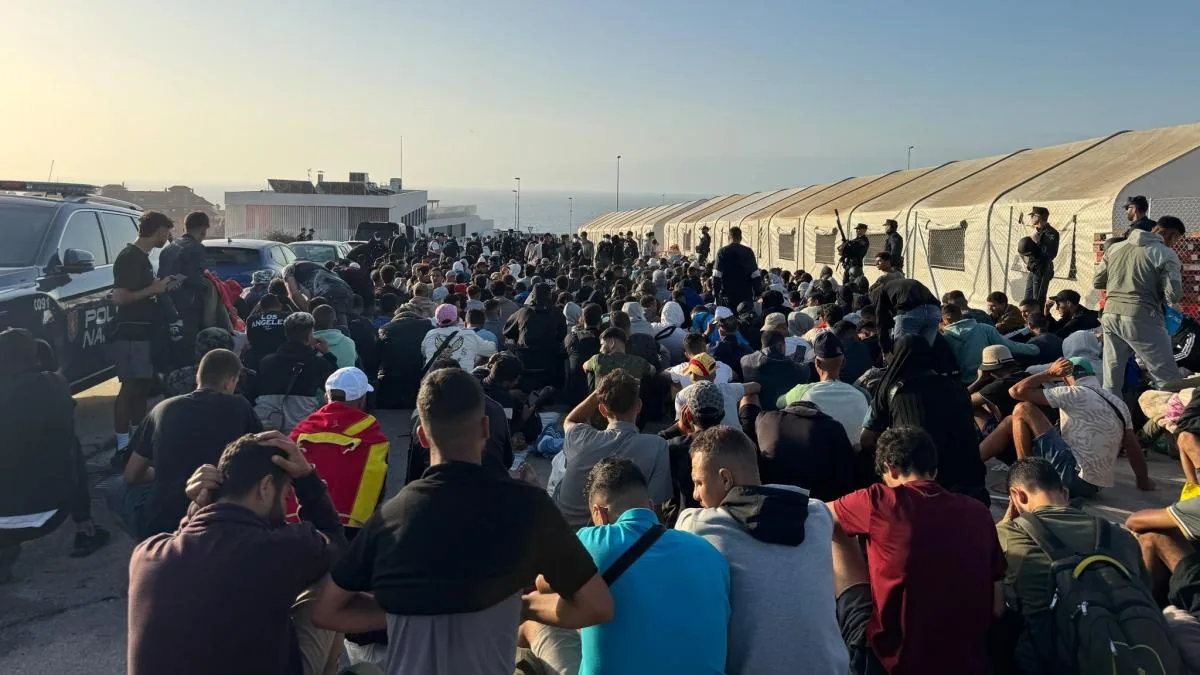
In recent days, more than a thousand young people have entered Ceuta, overwhelming the city’s reception services, overwhelmed by this unexpected migration crisis.
Young people like Nabil, 20 years old, from Kenitra, near Rabat, who tries to swim to Ceuta after failing to jump the border fence.
Nabil tried to cross at dawn helped by a one-and-a-half-liter water bottle filled with air, but with the first symptoms of suffocation, he returned.
Abdul’s dilemma
Dawn advances and the cry of a child about 10 years old draws the attention of onlookers. His brother, 16, has just jumped into the water. Abdul is their father. He admits that the family brought him so he could reach Ceuta.
“It’s very hard, very sad, but there is no other way out,” he says while comforting the younger brother. His son has tried up to three times to reach the Spanish enclave. Today, he hopes he will succeed.
Waiting on the beach is Hanna. She came with her son from Casablanca by train to Tangier. In the taxi that took them to Fnideq, she met other young people and they entered the sea together.
“I have a heart condition and he has to help me,” Hanna confesses with her eyes down and her phone in hand in case her son calls with good news.
Read more The Government highlights Morocco’s cooperation to stop the arrival of more migrants in Ceuta
Aicha lets out a muffled scream when her son and two nephews jump a small protective fence and launch themselves at one end of the beach. All three are minors.
“I didn’t know they were going to do it,” she says. While talking to EFE, a group of onlookers and young people approach. Why do they risk their lives? “Because there is no future here,” the woman replies.
“There is no work, no future, no rights, like healthcare, education. Better to try everything. There is no space for young people,” the boys waiting to try their luck almost shout in unison.
Yassin is 32 years old and works near Rabat with a salary “that is not enough to live three days,” he laments. “We also want to live a little. Where will we go to the doctor if we get sick? How do we pay for treatment? They are laughing at us.”
Social media, decisive
Social media plays a decisive role in this crisis. Images of young people making the victory sign after arriving in Ceuta have spread like wildfire. Everyone wants to emulate those who have succeeded. The presence of the Police and Auxiliary Forces (which operate as a support force to the police) does not deter them, not even the possibility of drowning.
Nor are the calls from civil organizations to stop this exodus enough. Many jump in because they have contacts in Spain, others because they think that after the recent decision by the Spanish Supreme Court to prohibit hot returns of migrants arriving by swimming, it will be very easy to stay.
Although for organizations like the Moroccan Democratic Instance for Human Rights (left), the situation is the result of “unjust public policies that have deepened social inequalities.”
An argument shared by Yousef, a fictitious name for a Moroccan resident in France visiting his family. “A country cannot forget its young people. What future do they have here? They see their friends working in Spain, in France. There, they are citizens with rights.”
Official silence
The eloquence of the young contrasts with the official silence Morocco maintains about the biggest migration crisis since 2001, when more than 10,000 people entered Ceuta amid diplomatic tension between Madrid and Rabat.
Neither the Moroccan Ministry of the Interior nor other official institutions asked by EFE have spoken about this crisis.
Nor did King Mohamed VI refer to the issue in his speech on the 27th anniversary of his enthronement, on Wednesday night. This Thursday, he will preside over a ceremony in the neighboring town of M’diq (Rincón), about 20 kilometers south of Fnideq, which symbolizes one of the oldest traditions in the monarch’s relationship with his subjects.
Unaware of all this, Maryam collects on the beach the remains of a life that young people want to leave behind. Sneakers, t-shirts, pants abandoned on the sand or returned by the sea. Nothing is lost.
“I make a living,” she says while making a bundle with what she finds abandoned on the beach to sell later. “I don’t know if it’s right, but life goes on.”
Read more Thousands of young Moroccans head to the border with Ceuta to cross the fence