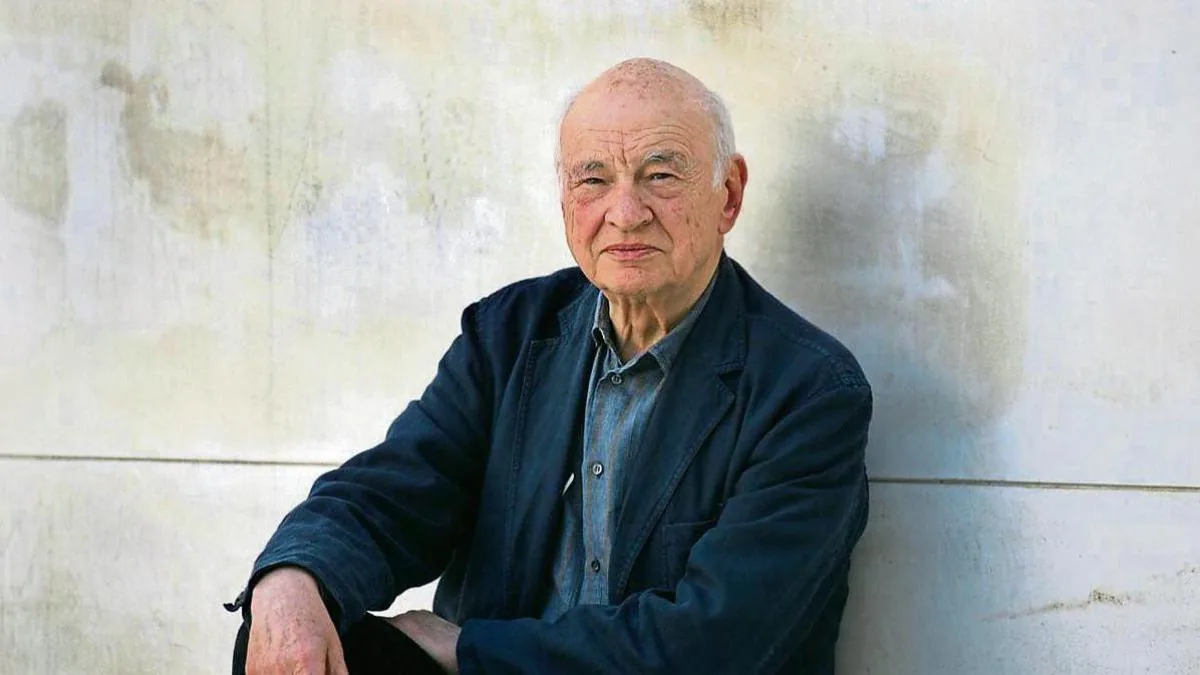
France and Europe have lost one of their greatest intellectuals, a witness and keen observer of the 20th and 21st centuries, who helped decipher them. The sociologist and philosopher Edgar Morin, theorist of “complex thought,” a figure of the anti-Nazi resistance during World War II, died yesterday at the age of 104, his wife reported this Saturday. Morin remained active, publishing books almost until the end.
Read more The King praises the “effort and brilliance” of Princess Leonor’s military career
A giant of transdisciplinary and eclectic theoretical reflection, politically identified with the left—although he soon left, disappointed, the Communist Party—he was the author of a very extensive body of work, known far beyond France. His work went against the current of traditional sociology and presented itself as a reflection on the human being based on scientific data.
The birth name of the deceased philosopher, of partly Sephardic Jewish descent, was Edgar Nahoum. He was born on July 8, 1921, in Paris. He adopted the alias Morin to mislead the Gestapo when he enlisted as a volunteer in the resistance forces and later decided to keep it forever.
A lover of Machado and Serrat, Morin explained that the fall of Barcelona in January 1939 marked him indelibly
In his monumental and dense memoir book, Les souvenirs viennent à ma rencontre, published in 2019, Morin reflected on death, which threatened him several times, including an aggressive hepatitis he suffered during a stay in New York. “I too will depart to the land where the orange blossom grows,” he wrote.
Winner of the International Catalunya Prize in 1994, the late sociologist was closely linked to Spain and Latin America, with countless trips and long stays, for example in Sitges. A lover of Antonio Machado (especially the verse “Caminante no hay camino, se hace camino al andar,” which he used to recite) and Joan Manuel Serrat, friend of Dionisio Ridruejo, Morin explained on several occasions that the fall of Barcelona to Franco’s troops in January 1939 marked him indelibly because it was the harbinger of the tragedy that would soon befall Europe. At 15, he had already sent aid packages to the anarchists of the Durruti column.
Morin’s lucidity at a very old age was impressive. At 101, he published an extraordinary book, De guerra en guerra, in which he addressed all the conflicts he had witnessed, from World War II to the Russian invasion of Ukraine. The author highlighted the “hysteria” of all wars, the constant lies, and the absolute criminalization of the enemy, comparing what happened in Ukraine with the wars in former Yugoslavia, Algeria, or the Israeli-Palestinian conflict.
In 2025 he published his last book, another essay titled Y a-t-il des lessons de l’histoire? (Are there lessons from history?), in which he condensed the conclusions drawn throughout his life. “The result of an action can be contrary to its original intention,” he wrote, citing cases like the French Revolution, when the aristocracy convened the Estates-General to regain influence and ended up giving victory to the bourgeoisie.
Morin maintained that, for better or worse, “a single individual can change the course of world history”
“The improbable can happen,” he states in another lesson. It could be seen as a truism, although he then brilliantly reasons it by explaining “the incredible fate of the Russian revolution,” that triumph of Marxism, driven by a minority and in a country that was not the ideal imagined by Marx and Engels. The paradox of 1917 was repeated in 1991, with the collapse of the Soviet Union, the establishment of savage capitalism, and the return to religious practice, so denounced by the previous regime. Morin, a disenchanted ex-communist, calls it “the most absolute historical failure.”
Read more Teacher strikes scheduled for next week have been called off except for Friday’s strike
Also read
The book highlights that “the nation is a recent invention.” For millennia, what mattered were empires and cities, and even today “three empire nations dominate and control the world”: China, Russia, and the USA.
According to Morin, what characterizes wars is “the robotization imposed on the human being,” already from military education, so that soldiers perform automatic gestures and become “obedient automatons.” The writer admits that, for better or worse, “a single individual can change the course of world history.” He focuses on Robespierre, Churchill, De Gaulle, Gorbachev, and Juan Carlos I, and investigates the phenomenon of the megalomania of Mussolini, Hitler, Stalin, and Mao.
Morin began publishing, very young, about his experience as an allied officer in occupied Germany in the essay L’an zéro de l’Allemagne. The author was very early aware that resentment had to be overcome and bet on Franco-German reconciliation, which was by no means obvious at that time.
In 1962 L’esprit du temps was released, becoming a classic on the analysis of mass culture, required reading in journalism faculties. His main philosophical work was La Méthode, in six volumes, published between 1977 and 2004.
Despite his Jewish background, he was very critical of Israel and, in his last book, wrote that “another lesson to be drawn from this history is that it is not enough to have been persecuted not to become a persecutor.” His words were clear and relentless: “Thus, by a new turn of history, the people who suffered the most persecutions, offenses, and massacres, and finally an extermination plan that, without the German defeat, would have succeeded, this persecuted people has become a dominating, colonizing, and persecuting nation.”
Macron defines Morin as “thinker of the century, defender of nature and peoples; he was humanism made person”
Among the many tributes from the political and cultural world, the text from President Emmanuel Macron on his X account stands out. The head of state defines Morin as “soldier of the Resistance, militant and free, writer and thinker of the century, defender of nature and peoples.” “Edgar Morin was humanism made person,” adds Macron. “With his kindness, his curiosity, he never stopped enlightening us. Complex thought, fruitful life, universal spirit. I send the nation’s condolences to his relatives.”
Morin explains in his memoirs, in great detail and without shame, his many loves and affairs. He declares himself a “slave of love.” His last wife, whom he married in 2012, was the Moroccan sociologist Sabah Abouessalam, 38 years younger, who helped him write his last books.
Read more Peter Thiel, the libertarian founder of Pay Pal and Palantir, is moving to Argentina