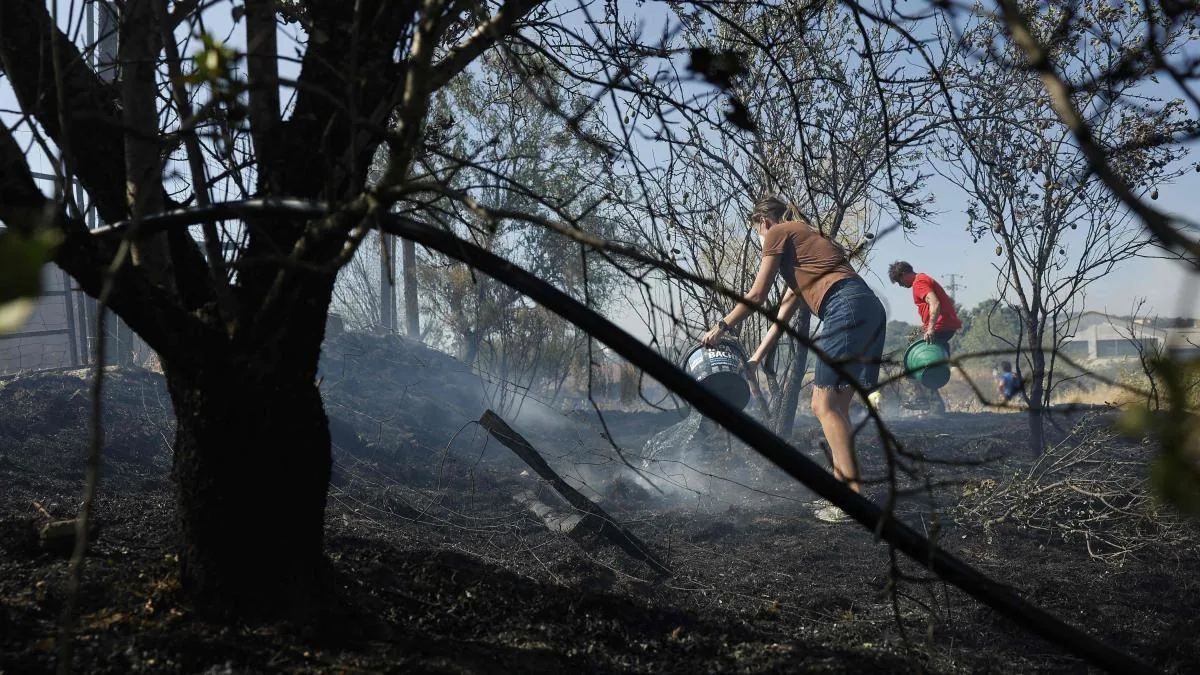
Large forest fires began yesterday to show slight signs of improvement in Ávila, Madrid and Toledo, although the extinction teams still have “very complex hours” ahead, after burning 77,000 hectares – with a perimeter of 280 km – and forcing the evacuation or confinement of nearly 95,000 people, among the three provinces. Meanwhile, the fire in La Vall d’Uixò (Castellón) continues out of control. With this, the number of displaced or confined people is now close to 136,000. After another day marked by flames and moderate optimism about their evolution, in the fires in central Spain alone there are 65,096 evacuated and 29,867 confined. To these must be added the 41,000 affected in one way or another in Castellón.
Read more The fires in Madrid, Ávila and Toledo are starting to subside due to improved weather conditions
The figures for these forest fires are record-breaking. Not only because of the number of affected people, but also because of the number of hectares burned. The flames have devoured 50,000 in Ávila, making it the worst fire in Spanish history, surpassing the one that occurred in Larouco, Quiroga and Oencia, in August 2025. The more than 25,000 hectares that have burned in Madrid constitute the worst in the history of this community.
The 50,000 hectares that have already burned in Ávila constitute the worst fire in Spanish history
But yesterday’s situation was different from Saturday’s, when meteorological conditions – especially the wind – did not exactly play in favor of the teams working to contain the fire. The President of the Government himself, Pedro Sánchez, highlighted yesterday during his visit to the advanced command post in Navaluenga (Ávila) that the evolution was “very positive” and affirmed that some outbreaks were already “consolidated”.
In the same vein, Lieutenant Colonel Alfonso Arribas, from the UME, pointed out that yesterday the extinction efforts faced a “more favorable” day to attack the flames and reduce the intensity of the outbreaks which, in any case, still remain out of control. In fact, the UME declared, before noon today, the Madrid and Ávila fronts contained, although it acknowledged that “active heads” still remained.
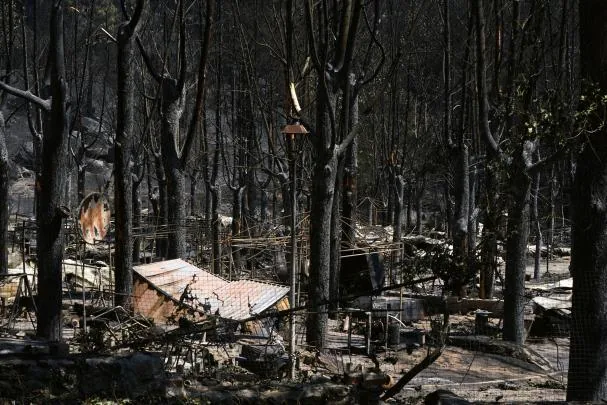
Along the same lines, the technical director of the Ávila fire extinction, Pablo Montejo, considered that “a small opportunity had opened up that had not existed on other days” due to the improvement in conditions.
For his part, the Government delegate in Madrid, Francisco Martín, explained that yesterday’s main concern in the evolution of the fire was to control the western flank and prevent its advance northwards. Regarding the evolution of the Sierra Oeste de Madrid fire, the Government delegate explained that the eastern flank was contained, that it was not advancing, and that work continued on the western flank to stop the fire after efforts were made from Saturday night to Sunday to protect municipalities such as Cadalso de los Vidrios and San Martín de Valdeiglesias, which bore the brunt yesterday. In the mid-afternoon, efforts intensified in the Villa del Prado (Madrid) area, the area where the fire registered the most activity and where, after 6 p.m., the evacuation of the El Encinar del Alberche urbanization was decreed.
Read more The Monarchs visit the residents displaced by the fires in the Community of Madrid
Read also
Regarding the Almorox (Toledo) fire – 2,000 hectares burned – the Government delegate in Castilla-La Mancha, José Pablo Sabrido, assured that the fire was “stabilized”, which makes them “optimistic”. “We must be very cautious and the technicians say it is stabilized, but not yet controlled,” he specified. After the Cecopi meeting in Navalcarnero, it was decided to install an Advanced Command Post in La Iglesuela del Tiétar (Toledo), from where efforts will be coordinated.
According to forecasts, yesterday’s good weather conditions will extend to today, which, according to Martín, provides a “wide window to work and definitively overcome this fire”.
But not all news was good. The president of the Community of Madrid, Isabel Díaz Ayuso, explained that at least 43 homes have been completely destroyed – in El Encinar de Alberche, in Villa del Prado – and another 300 with extensive damage, but she was convinced that “this figure will rise enormously, as we have never seen before.” “Hopefully we won’t have to backtrack on figures that have improved, because it’s true that the winds continue and the situation is extreme due to high temperatures,” she noted. At least – she added – the fire has not continued to evolve rapidly towards El Escorial, San Lorenzo de El Escorial and Valdemorillo, which was still in doubt on Saturday.
Late in the afternoon, new news arrived from Ávila, and it was not good. The fire had reactivated “strongly” due to the wind – the wind again – and presented two main outbreaks in Casillas and Mijares, in the upper part of the mountain range, according to the Ministry of Environment. Despite the optimism, it will be a long haul.
Read more A person dies in the Manises fire, already stabilized by firefighters