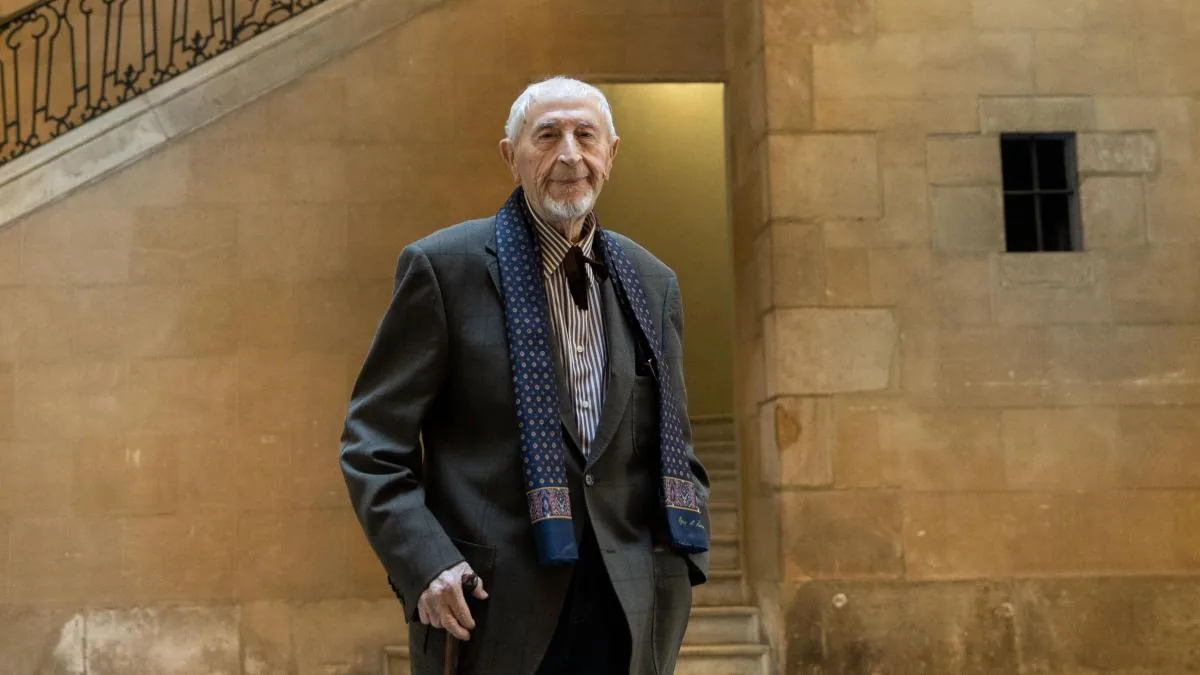
Josep Vallverdú (1923-2026) did not consider himself a specialist in children’s and young adult literature (LIJ), for which he was so recognized, but rather preferred to speak of “adventure novels.” And although in many cases this was true, what was an adventure was his life, which ended on Tuesday and which is not easy to approach with much perspective given the relevance his figure gained in recent years.
Read more Amy Winehouse and the broken love that turned her into the voice of British soul
As birthdays passed, his aura grew by his own merits, and he continued publishing: if at 98 years old he already seemed old when he published El vuitè nan (La Galera), the year he celebrated his centenary, the institutional tribute took him all over the country from event to event and, in addition to several reissues, he published books such as a new memoir, Mosaic de tardor (Proa), the poems of Aragalls (Pagès), the articles and drawings published in the magazine El Francolí from Potser sí… (La Musca) and the linguistic reflections of La llengua viscuda (Tres i Quatre), and even later a first crime novel, El captaire (Salòria, 2024) and the diary Quadern de Balaguer (Salòria, 2025). But Vallverdú did not act on impulse, and knowing that at his age nothing could be taken for granted, he planned his closure.
Carme Vidalhuguet, the writer’s right-hand woman and literary executor, explains that “he wanted to close the circle with El retorn de Rovelló (La Galera, 2025), a book fully conceived and with open windows to other books in his universe.” For years he had refused to revisit his most famous character, and when he decided to return, it was to bring it to a definitive end. Vidalhuguet, however, explains that Vallverdú leaves two new books and one unfinished, of different genres, which had been completed some time ago but he wanted to reserve: “This last year he has had time to organize it and almost finish it, and now is the time to highlight his legacy.”
Born in Lleida in 1923, Josep Vallverdú already felt a passion for literature as a young man, but it took him a long time to dedicate himself to it seriously, especially because he could not do so in Catalan. After the war, he lived in Barcelona, where he studied Philosophy and Letters, but life led him to reside throughout Catalonia: first, already married to the pedagogue Isabel Arqué, in Sant Feliu de Guíxols, then he returned to Lleida, later in Puiggròs, once retired in Espluga de Francolí and, finally, in Balaguer, after marrying Antonieta Vilajoliu, both widowed, in 2012. An autumnal love that revived him.
Read more Is it safe to thaw food directly on the kitchen marble?
Although he was not especially interested in children, he saw that it was important for them to have access to books in Catalan
Although he often stated that he was not especially interested in children, he saw that it was important for them to have access to books in Catalan. It was the editor Miquel Arimany who suggested he write “an adventure book with children in it,” which in 1961 would become El venedor de peixos, the first young adult novel in Catalan since Francoism. At 38 years old, he was no longer a young man debuting in his language. The following year’s birth of the magazine Cavall Fort, where he began to collaborate, helped him gain confidence in his writing, while with the arrival of Edicions 62 he began to dedicate himself intensely to translation: Raymond Chandler, Dashiel Hammet, Martin Luther King, Jack London, Edgard A. Poe, Gianni Rodari, Walter Scott, G.K. Chesterton or Oscar Wilde… In the early years, he considered himself a translator who wrote, but he began to gain notoriety with awards such as the first Joaquim Ruyra, in 1963, and especially in 1968, with the Josep M. Folch i Torres for Rovelló –which in 2000 was turned into an animated series–, a book that would mark the entry into the mythical Els Grumets collection by La Galera, where he has published most of his children’s and young adult production, books such as En Roc drapaire (1971), En Mir, l’esquirol (1978), Saberut i Cua-verd (1982), El testament de John Silver (2007) or one of his most beloved, Blai Joncar (2009).
But his life cannot be understood without the rest of his work, with recent titles such as memoirs and poetry, but also earlier ones such as the Catalunya Visió collection, with photographer Ton Sirera, between 1968 and 1974, Proses de Ponent (1970), which promoted this denomination in the lands of Lleida, or Indíbil i la boira (1983), books that made him, with permission from Pedrolo and Viladot, the patriarch of local letters, first, and then Catalan, but literature is, ultimately, universal.
On Friday, a farewell will be held for him at the church of Sant Domènec in Balaguer, very close to his home.
Read more Drug thieves: assault on the Riudarenes plantation