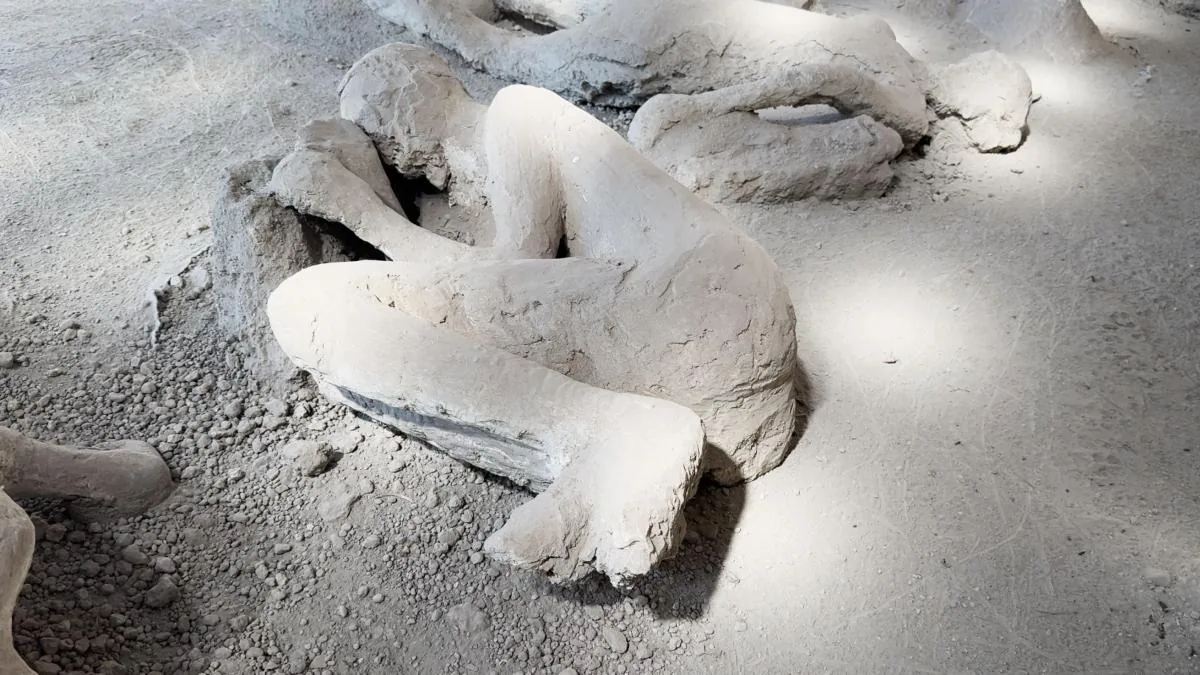
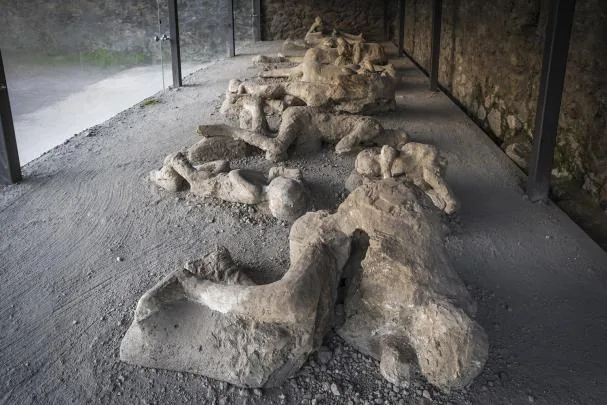
The site was called the Garden of the Fugitives. You can already imagine why. In the year 79 AD, when Vesuvius had already been erupting for hours, fourteen people tried to cross this ancient vineyard, seeking an exit through the Nocera Gate. The pyroclastic flow caught them and none escaped alive.
In 1961, the superintendent of Pompeii, Amedeo Maiuri, led a team of archaeologists who studied the site and found the remains of adults and children (including a baby between 12 and 14 months old, the youngest victim recovered in the excavations), very close to each other forming three nearby groups.
Sixty years later
Sixty years after those works, a new investigation has made it possible to discover the identity of one of the victims: a doctor who was trying to escape through the Garden of the Fugitives carrying some of his work instruments with him.
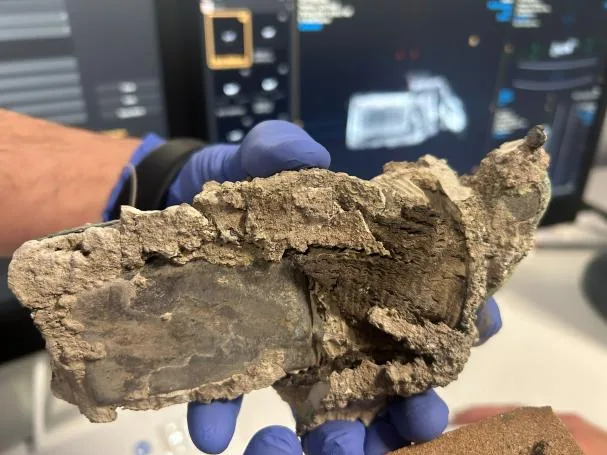
The discovery was made while studying a small case hidden inside the plaster mold of a human body. The analyses carried out revealed a small box made of organic material with metal elements, a cloth bag with bronze and silver coins, and instruments compatible with a medical kit.
Archaeological Park of Pompeii
The investigations carried out using X-rays and computed tomography at the Casa di Cura Maria Rosaria in Pompeii identified a small slate slab (used for the preparation of medical or cosmetic substances) and small metal instruments interpreted as surgical tools.
Read more Sánchez Llibre renews as president of Foment del Treball until 2030
“These elements support the hypothesis that the victim was a doctor, providing a valuable and uncommon clue about his profession,” experts say in a statement. “The use of advanced diagnostic technologies allowed us to analyze the contents of the mold without compromising its integrity,” they add.
Also read
The box also had a refined mechanical structure and was equipped with a sophisticated locking system with a gear wheel. Archaeologists, restorers, physical anthropologists, archaeobotanists, numismatists, radiologists, diagnostic technicians, and digital modeling specialists participated in its restoration.
“Two thousand years ago, there were people who did not practice medicine limited to consultation hours, but who were simply present at all times, even when fleeing the eruption and the pyroclastic flow reached the group of fugitives trying to leave the city through the Porta Nocera,” says the park director, Gabriel Zuchtriegel.
This doctor took his tools with him to be able to rebuild his life elsewhere, thanks to his profession, but perhaps also to help others. The discovery also confirms once again the extraordinary value of the Pompeii deposits as a living archive of stories yet to be reconstructed.
Read more Italy confirms that the bodies of four of the Maldivian divers have been recovered