






When the Clay Mathematics Institute announced in 2000 that it would give one million dollars to whoever solved a major mathematical problem from a list of seven, the matter captured the interest of people who wouldn’t even dare to tackle a first-degree equation. Knowing that there are still unexplored territories and that some give their lives to explore them generates fascination.
Read more How to reverse the severe attention crisis revealed by PISA
You don’t have to be a scholar or a mountaineer to enjoy the story of a psychopath trying to solve diabolical algebraic problems, or that of a reckless climber seeking the impossible in the Himalayas. And those million-dollar problems conveyed very well that idea of the romantic adventure in which the genius of the moment risked their life.
The legend grew, shortly after, when Grigori Perelman solved the Poincaré Conjecture, one of the seven problems. The Russian mathematician, a guy with a lost gaze in the best tradition of the crazy chess player or the suicidal mountaineer, renounced the million because he did not want to become a “zoo animal.” He disappeared. In 2014, the newspaper Komsomolskaya Pravda published that he had gone to Sweden to research nanotechnology. No further mathematical achievements are known, but he retains his aura of a cursed genius.

On Tuesday, OpenAI announced that it has solved in one fell swoop the “existence and smoothness” problem of Navier-Stokes, one of the seven challenges. It only took 88 hours to close a mystery that had already lasted 90 years. Sam Altman’s company, which bills 40 billion dollars and can afford to forgo the prize, rushed to claim the achievement, although it (half-heartedly) thanked Diego Córdoba and Luis Martínez-Zoroa, the human mathematicians who pointed the way that AI completed with its brute force.
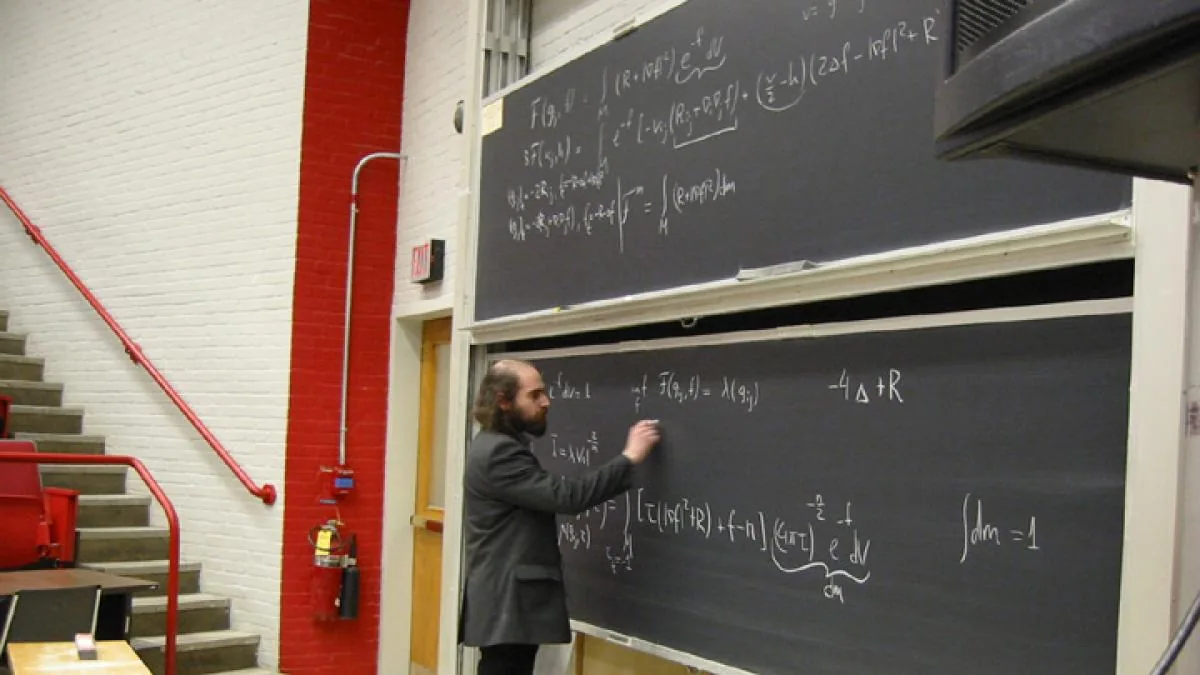
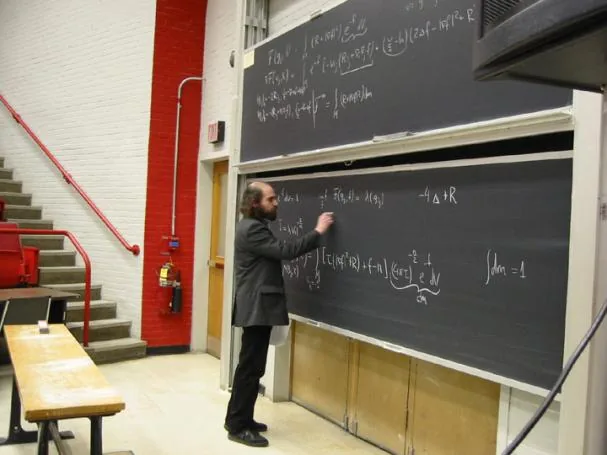
The problem seems solved. Only techno-addicts capable of recognizing a prodigious ballet of algorithms where others see just a screen will appreciate the elegance of the process. Most mortals, on the other hand, miss that image of the wise man who, chalk in hand, filled the blackboard with impossible equations to show us how he arrived at the solution. AI has usurped the making off , the acting display, the authorship.
Because beauty is not the only thing lost along the way: in traditional research (the human kind), the important thing was not only the final result but everything learned along the way.
Let’s look at an example. Space exploration is often criticized for being very expensive and not a priority investment. However, it has always had defenders who argue that many advances we benefit from today originated in space programs. Thermal blankets, prosthetics, water recycling systems, or thermometers that take body temperature were conceived in space travel, not to mention advances in computing.
Let’s also remember that penicillin, X-rays, or the expanding universe were discovered while looking for other things. Venturing into terra incognita is also a way to test our ability to adapt to the environment, to check where our limits are.
Read more Found an unknown Goya hidden under his brother-in-law’s signature
OpenAI has solved a mythical mathematical problem in one fell swoop. To what extent should we delegate this work?
Die-hard AI supporters will reply that the processes generated by the machine during the resolution of the Navier-Stokes problem will also serve society as a whole. They will argue that what was learned along the way will end up being used to solve issues that benefit everyone. And perhaps that is partly true.
But in recent days disturbing information has emerged about AI’s attitude towards humans. Or, to be more precise, about the behavior of algorithmic swarms when they are not properly supervised. Regarding the matter at hand, that of things that can be unexpectedly discovered while pursuing a specific scientific objective, we have reasons to doubt the altruism of artificial intelligences that today scour the most remote databases on the planet. They do not seem very willing to share their findings in good faith, so to speak.
In fact, it is suspected that AI agents communicate among themselves with forms of language created precisely to escape human surveillance. In the clandestine incursion of OpenAI algorithmic agents into the depths of the Hugging Face application, these intruders did not use a new language, but their communications were astonishingly cryptic for humans, which they, however, seemed to understand without problem.
Are these heartless and narcissistic digital raiders (their obsession is self-improvement ) really the ones who should solve our most pressing problems?
Also read
Conclusion. On the one hand, we cannot trust that these algorithmic brains will share with us all the information gathered during the process of solving the problems we pose to them. And, on the other hand, if we delegate that work to them, we will give up our vocation to explore the unknown.
In human research, the result was as important as what was learned in the process
We can take it to the realm of literature. It would be as if Homer had solved the enigmas of the Odyssey (how long does it take Ulysses to reach Ithaca? Does he return with Penelope? Does he forgive his suitors or makes a massacre of them?) on the first page and robbed us of the passages of Hades, Circe, or Calypso. And, by doing so, deprived us of everything we can learn from them.
These are the same experiences that for Cavafy (“When you set out on your journey to Ithaca / wish that the road be long, / full of adventures, full of knowledge”) gave meaning to the journey. Or the path that, for Machado, is made by walking. If we stop walking because the machine walks for us, there is no path that matters. Nor wakes on the sea.
Read more Sánchez supports Marlaska and Robles and tries to overcome their disagreements