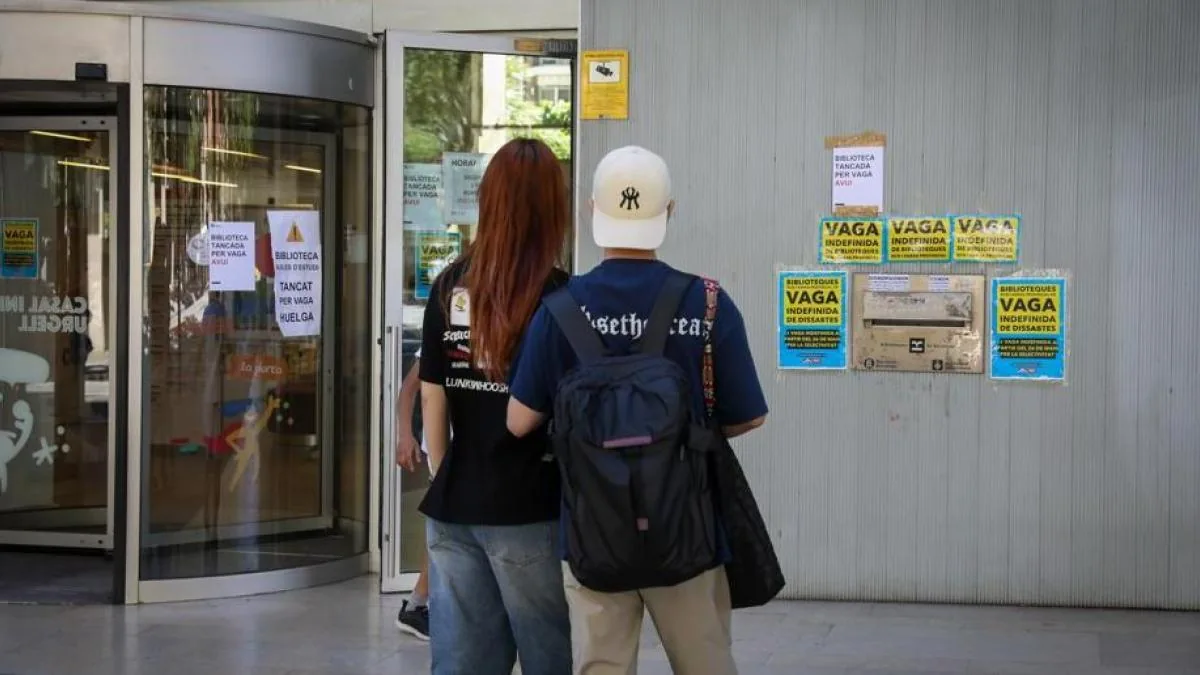
Workers of the Consorci de Biblioteques de Barcelona have started an indefinite strike this Tuesday to protest the lack of progress in the negotiation process with the City Council regarding their working conditions, and 37 of the 40 centers in the city have not opened; only the libraries of Collserola-Josep Miracle, Canyelles- M. Àngels Rivas, and Joan Miró have remained operational.
Read more The EU on alert over the «new reality» of drone incursions in the Baltic
For weeks, the libraries had been stopping work on Saturdays, as part of the negotiation process for the adhesion to the City Council of Barcelona’s agreement for the workers of the Consorci, a mixed entity between the City Council and the Diputació, where until now some workers are governed by the provincial agreement and others by the municipal one, with differences between them affecting, among other things, schedules and pay.
“We have had many meetings but they have not been productive, because there were no concrete proposals,” denounces the president of the works council and worker at the Camp de l’Arpa library, Montse Serra, who acknowledges that she believes “the company wants to reach an agreement” and therefore continues the meetings despite the strike, but hopes it will propose “real solutions, because sometimes what they propose is not viable.”
Serra points out three red lines in the negotiations: that library staff have the same rights as the rest of the City Council workers; that the change of agreement does not entail a cut in pay; and that schedule improvements reach the entire staff, contrary to the proposals that, according to her, have been made so far, which also relate to the diversity of libraries in the city.
Read more Indra appoints Josep Maria Recasens as CEO replacing De los Mozos
One of the red lines is that schedule reconciliation improvements reach the entire staff
Additionally, she points out that “although when a new library is inaugurated – like in recent years the J.V. Foix in Sarrià or the García Márquez – the appropriate staff is assigned, there are often mismatches, because they increasingly have to take on more tasks.” “We are a center open to the public, but our functions have grown and currently we are a catch-all for assistance, especially in a context where the entire social shield of the city is vague,” says Irene Lameiro, CGT union delegate and committee member, referring to the conflict that also affects the Municipal Institute of Social Services, the Citizen Attention Office, and nurseries. For Lameiro, “there is a need for better recognition of our work, like that of many feminized professions that are not considered as they should be, nor sufficiently remunerated,” and that also involves the creation of “protocols against violence, because every day we face all kinds of situations.” Despite the ongoing negotiation, Lameiro believes there will be mobilization throughout this week, especially on Friday, with a call in Sant Jaume square during the municipal plenary. Additionally, on June 5, a unified strike of Catalonia’s libraries has been called to defend some of the shared demands in the sector.
The Consorci points out that “the collective bargaining process remains open, with the aim of advancing the adhesion to the regulatory agreement on working conditions of the City Council of Barcelona. This agreement includes, among other measures, the reduction of the working day to 35 hours per week and the civil servant status of the staff,” and adds that “the staff of Biblioteques de Barcelona are sized in the mid-high range of the standards established for public libraries in Catalonia.” They also say that their workers “do not work a volume of hours exceeding what is determined by the regulatory framework” of the reference agreement. Furthermore, they recall that in recent years 70 new workers have been incorporated and that, “with the completion of the ongoing selection processes, temporality will have been reduced to 3% in four years.”
The consortium assures that “the staff are sized in the mid-high range of the standards”
This happens at one of the most decisive moments for many students preparing for exams, especially the university entrance exams, on June 9, 10, and 11, but the impacts go beyond the students, since the activity carried out in the centers is very diverse, with book clubs, courses, and book presentations such as Li agradava l’estiu i no sabia dir per què (El Jardí), which Montserrat Margenat had scheduled at Clarà this Wednesday. The writer from Sarrià explains that until last Thursday she was not told it could not take place, although she was able to move it to Casa Orlandai, in her neighborhood.
Read more Sánchez advocates at the FAO for «no to hunger» against wars