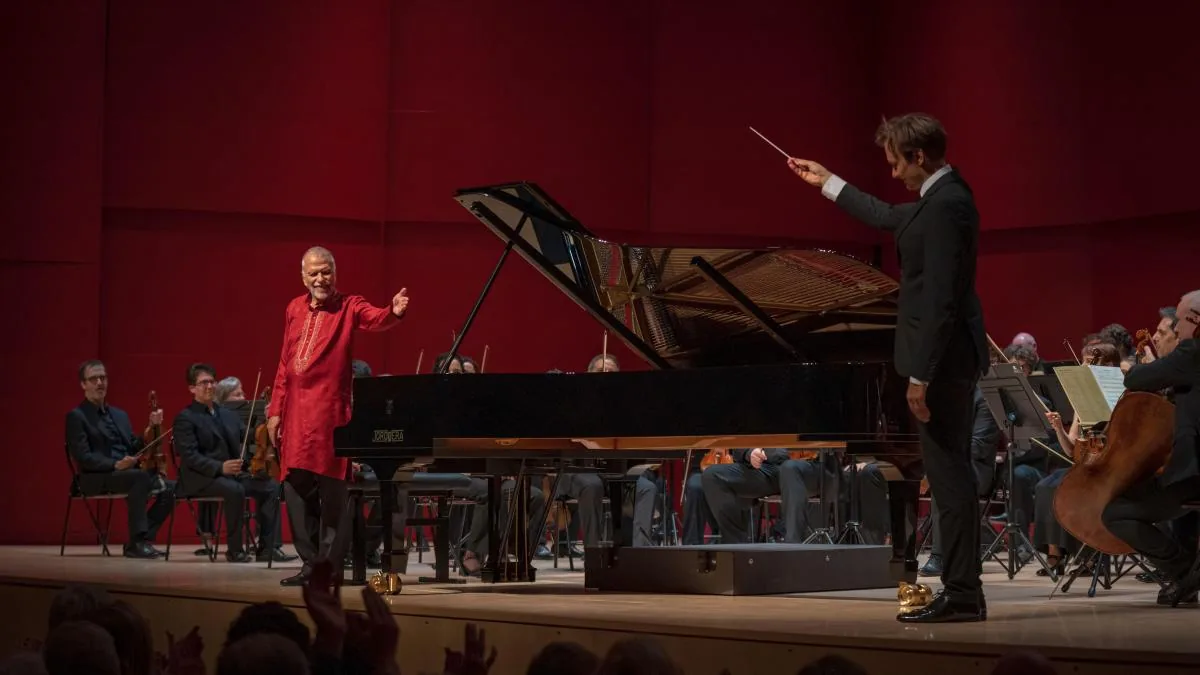
“Inhabiting beauty” is the proposal that in a turbulent and contradictory world the artistic director of Torroella, Montse Faura, makes to us for this edition of the Festival. Nothing less… And she opens the doors to it with a central program of 15 important concerts, some due to the quality of the work of our performers, like this inaugural Beethoven by the OBC and Josep Colom that we have just enjoyed. In it, the musicality and expressive strength of the Catalan pianist was well understood by the OBC and its conductor, the young Belarusian Vitali Alekseenok, current principal of the Deutsche Oper am Rhein in Düsseldorf and Duisburg, who looks very promising in terms of understanding the language and clear gesturality.
Read more Advances in oncology: how cancer treatment is changing at Sanitas CIMA
If Colom left us on Friday the intimate beauty of Beethoven’s Concerto No. 5, with a meaningful second movement, the conductor seems to understand very well the lines of force that animate Beethoven’s music, especially in a wonderful version of the Sixth Symphony, vital, subtle at times, also vibrant, which he sealed with a Mozartian encore and long applause. All this with a magnificent response from the orchestra, this time dressed for the festival; good woodwinds and winds, concentration, attention, good sound, and a very subtle string section.
Vitali Alekseenok sealed Beethoven’s vital and subtle 6th with a Mozartian encore, with long applause
What follows in this horizon of Torroella is also full of hope. This Festival has a unique history as a result of the Joventuts Musicals and, unlike other similar summer Catalan events, a very important part of its population attends the concerts, something that new generations will surely have to embrace. Thus, upon entering the hall, after greeting Faura and Víctor Medem, director of L’Auditori de Barcelona, who shows happy renewal, we find the enthusiastic smile of Josep Lloret, the great architect of what has been this artistic experience of almost half a century and also the first director of L’Auditori. And shortly after came the smiles of some of the people who fostered and accompanied this eagerly awaited experience each year of reunion in the church of Sant Genís, with a festival that opened musical chests from the Renaissance to the Baroque-Classicism.
Now – in the Espai Ter – the great Romantic symphonism that in those years passed through the square of Torroella with complex acoustic devices that left numerous musical anecdotes, will accompany us in that “room of beauty” I mentioned at the beginning. For example, the original and already veteran (although always renewed) Mahler Chamber Orchestra, which combines youth and the experience of Daniel Harding on the podium and the symphonism of Brahms and Dvořák… or the concert on the 8th with Leonskaja and the tradition represented by the English Chamber and related repertoires, such as Schubert’s 5th Symphony or Mozart’s Concerto No. 12; also Mozartian will be the one by the Freiburger on the 16th…
Read more Red gold and Coca-Cola in Sudan
The breath ends in this phrase, but we recover it because of what the power of the proposal of these twenty days of Festival in its 46th edition means. Contents that surprise by pointing to a new programmatic profile and that today, after a brilliant history of summer classical festivals in Catalonia with its ups and downs, Torroella seems to establish itself as the most significant space.
The Diotima Quartet on its 30th anniversary today tackles the world of Ravel and Debussy and premieres És, a quartet commissioned by the Festival to Joan Magrané… A powerful festival, yes, in different aesthetic fields, and that does not forget its old paths. Thus, we will be able to enjoy in the church with The Tallis Scholars and works by Palestrina or Lassus, or also with the “dreams” of John Dowland. Also on the 7th Cantoría, directed by Jorge Lozano, recalls musical essences of the nearby Baroque, while on the 21st, Le Poème Harmonique brings the 17th-century carnival to the stage.
This invitation to “inhabit beauty” with proven quality and variety content leads us to reflect on the importance of this summer history of Catalonia, on the significance of private initiative, on the importance of the support that we must – companies, public administration, people who believe that in beauty lies the transcendent – give to projects of this nature that recall historical times of Modernism that united music, art, and nature, and that configure identity signs in which many people currently participate, in different projects in the country, with perhaps smaller but characterful initiatives, proposals that from outside reveal an exciting concept of culture, unfortunately now so tinged in the media with mere spectacle.