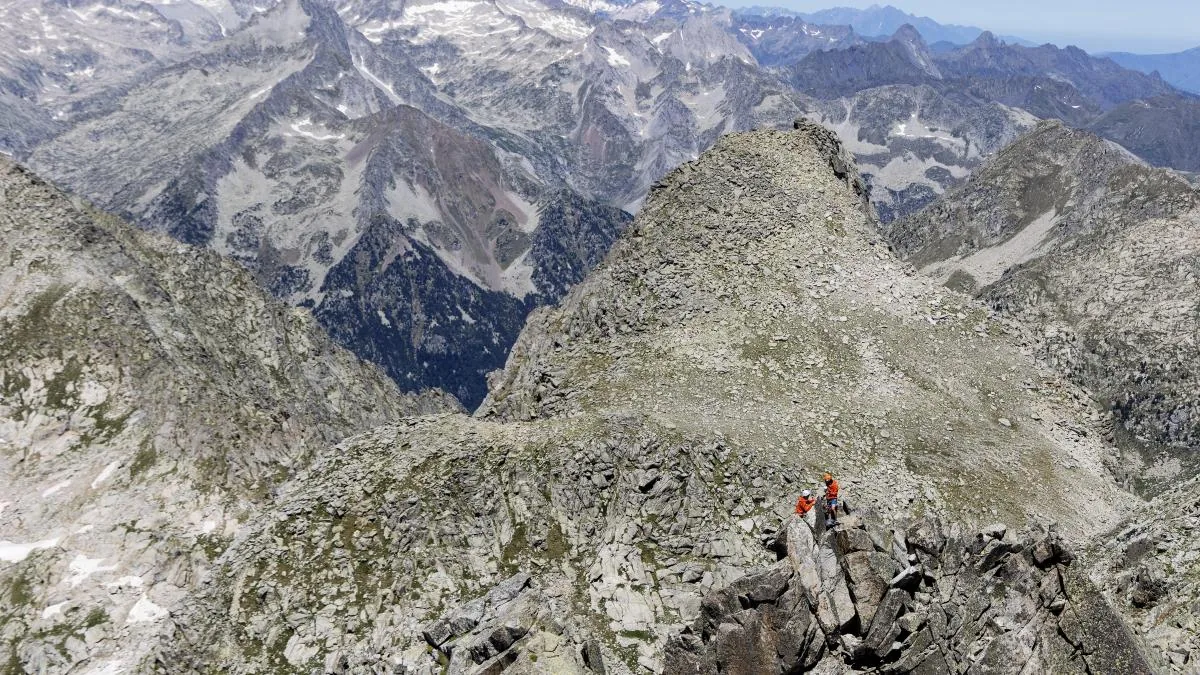
The team of surveyors from Sostremetries, who have been reviewing the altitudes of the peaks of the Pyrenees for years, has certified a new three-thousander in Catalonia, the South Needle of Malavesina, at 3,012.9 meters altitude and a prominence of eleven meters from the last col, in the Aigüestortes i Estany de Sant Maurici National Park, according to measurements taken on July 5. In this way, Catalonia goes from twelve to thirteen summits exceeding this elevation: Pica d’Estats, Verdaguer, Punta de Gabarró, Sotllo, North subpeak of Sotllo, Rodó de Canalbona, Comaloforno, Besiberri South, Besiberri North, Punta Alta de Comalesbienes, Tuc de Mulleres, North Needle of Malavesina, and now the South Needle. In the entire Pyrenees range, the number will increase from 216, of which 125 are main and 91 secondary, to 217.
Read more Torroella bursts into the summer festival season with the intimate beauty of Beethoven
It should be remembered that the inventory most mountaineers use as a reference is the one created by the group Los Cazafantasmas, which they periodically update as a result of their research and, lately, thanks to the valuable contributions of Sostremetries.
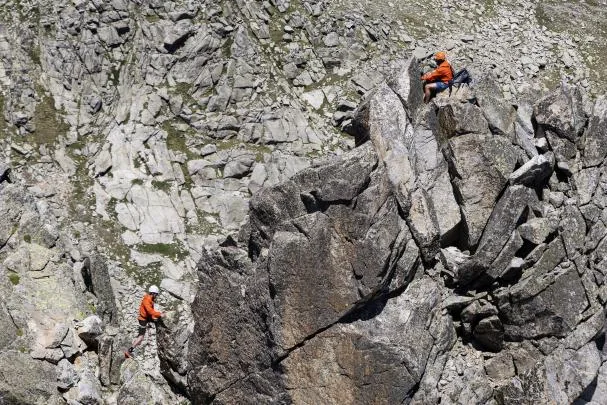
The list of the Pyrenean three-thousanders thus goes from twelve to thirteen in Catalonia, concludes Sostremetries
For a peak to be considered a 3,000-meter peak, it is not enough to reach this altitude; it must also have a prominence or elevation difference of at least ten meters between the last col and the summit. This is the criterion established by the late Juan Buyse in Los tresmiles del Pirineo, published in 1990, and followed by Los Cazafantasmas and Sostremetries.
The Catalan surveyors verified that in the case of the South Needle of Malavesina, in the municipality of La Vall de Boí, the prominence is eleven meters. The last col is located just below the needle, on a vertical wall near Comaloforno, according to Marc Calaff, a member of Sostremetries along with Andreu Alvarruiz, Oriol Boixareu, Salvador Sala, and David Segura. In this measurement, they had the collaboration of a surveyor expert in satellite navigation, Isaac Hoyas.
Also read
Carles Giné, from Los Cazafantasmas, confirms that they will add the South Needle of Malavesina to their list. Another question they have not yet addressed is whether it is considered a main peak or, more likely, a secondary one.
Read more Advances in oncology: how cancer treatment is changing at Sanitas CIMA
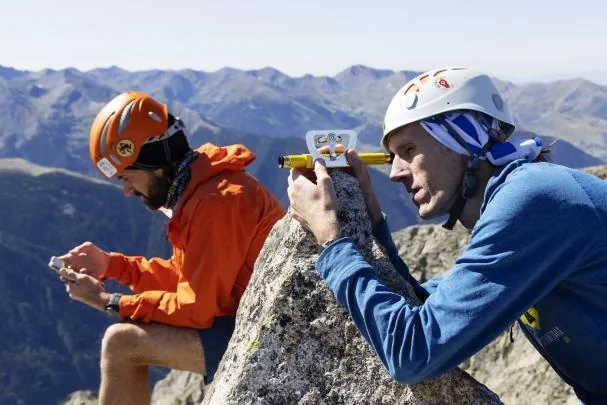
Thanks to having modern devices and the latest Lidar (Light Detection and Ranging) technology, which uses laser beams to measure distances and create 3D maps of the terrain, very precise results can be achieved. The surveyors explain that on Sunday, July 5, they ascended the South Needle of Malavesina and left a GNSS receiver at a high point of it for about two hours “to obtain data from the satellites and calculate the coordinates based on reference stations, such as those of the Institut Cartogràfic i Geològic de Catalunya.” “Simultaneously, with another receiver, we took measurements at the summit and at the cols,” they add.
Carles Giné recalls that Los Cazafantasmas climbed, in 2008, the ridge linking Besiberri South and Comaloforno and identified five needles. On that occasion, they determined that one of them, named the North Needle of Malavesina, met the requirements to be part of their list. Now, 18 years later, this new three-thousander is confirmed. “They had no name, and we decided on Malavesina because it is a nearby toponym, designating the ravine that collects the waters of the Besiberri massif that flow into the Malo river and the Cavallers dam,” Giné clarifies.
Also read
Sostremetries’ investigations already modified last year the map of the three-thousanders of the Aragonese Pyrenees by adding two new ones, Punta de la Lit or Tuca Llardaneta southwest (3,292 m) and another unnamed one, between Espadas and Pavots, at 3,247.8. They also delisted two, Maldito and Culebras, for not reaching the minimum prominence of ten meters.
Read more Red gold and Coca-Cola in Sudan