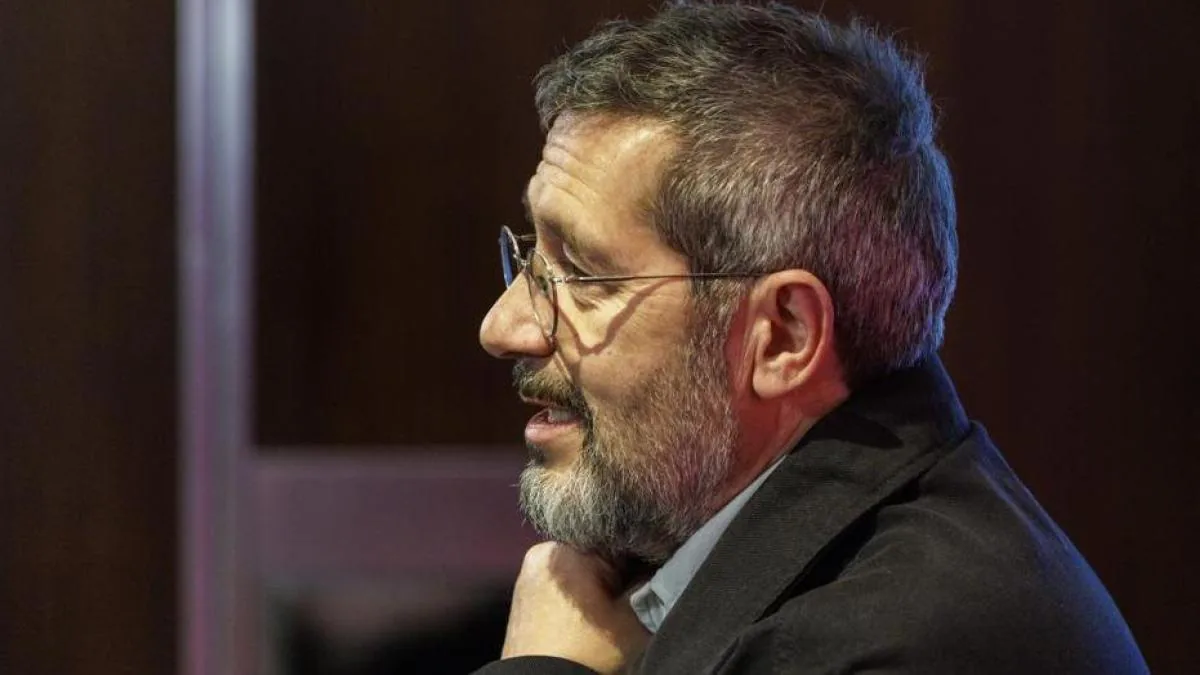
“It’s a scam, we do not charge for promoting books,” says Adrián Díaz, founder of Ciervo Blanco, a non-profit association that organizes book clubs. This was his response to my question about the email I received, signed by “Tatiana. Director and Super Organizer. Ciervo Blanco Literary Salon. Madrid, Spain,” in which she offered her services for 195 euros. “The real Tatiana works with us,” Díaz comments, “but she is not the one who wrote to you, I suppose her name is not really Tatiana, she has also used my name and those of other people from the association, she takes them from Meetup and our website, I think she is in India, although of course I don’t know if it’s a woman or a man, or several people.”
Read more The Government risks losing 1.5 billion in EU funds if the lobby law fails
The alarm was raised at the beginning of the year, when half a dozen Indian authors wrote to him to ask about the supposed activities offered to them in exchange for fees ranging from 40 to 300 euros. All of them had received emails in which Ciervo Blanco supposedly showed interest in their book and promised that it would be read and discussed by members of their book clubs, both in person and online, and promoted on their networks. Several established authors and Spanish publishers confirm that they have received the same type of suspicious messages in our language, also signed by Tatiana Organizer. None of them ended up hiring their hypothetical services, although they point out that non-professional writers might have done so.
The scammers impersonate legitimate and well-known book clubs, podcasts, or public broadcasters
The UK Authors’ Society published a guide to scam prevention on May 18, and Bristol University Press also posted a warning article on its website on June 1: “Sometimes, they impersonate legitimate and well-known book clubs, podcasts, or public broadcasters (such as the PDX Silent Book Club or radio programs).” While indiscriminate emails targeting self-published or independent authors were already common before the explosion of generative AI, baiting with editorial services or positive reviews, in the last two years the scope of the scam attempt has increased dramatically, now including a polite, refined phishing in which the author’s book is praised in detail and they are told they have been selected for a club’s programming or a reading challenge.
In the last month, the undersigned has received four of these emails, about four of my books, two in English and two in Spanish. To write these lines, I replied to one in each language. The one from the mentioned Tatiana Organizer led to a conversation that stopped when, after telling her I could not make the payment via Paypal and needed a bank account, she sent me the account of her supposed accountant, a Ukrainian named Oleksii Mykhailiuk, with a Cyprus address that looked like a bank branch but actually disguised data from CardPay (an electronic payment service provider) and Unlimit (a global fintech company specializing in international payment infrastructures).
The exchange with Bella Annis, the supposed founder of Bella’s Book Discovery Network, was more interesting. The first email I received from her, on August 20, included no link and had no indirect support from a real book club like Ciervo Blanco, so when after several emails I asked her for a link, she sent me a Goodreads profile with 24 members. All of them had started their activity on August 17. The fee to be read in her network of readers was 159 dollars, which I had to transfer to a Unicredit Bank Austria account in the name of Danielle Guttler. I have not found anyone with that name on the internet.
Read more Sweden’s social democracy aims to regain power in Sunday’s elections
These are small scams that take advantage of the lack of knowledge and experience in the publishing world of people who self-publish on Amazon and other platforms. Or who are very frustrated by the lack of impact of their works published by small independent labels. But the scale can be much larger. Instead of promising a book club or social media posts, some offer a work amplification plan that can include contacts with Hollywood producers. According to an investigation by Kelly Burke, published in The Guardian last March 11, victims have paid between 5,000 and 20,000 dollars for these fictional audiovisual arrangements. And last year, the FBI “arrested three people involved in a 38 million euro scam, which defrauded more than 800 elderly authors through false promises of film deals.”
The threat is global. Cybercrime farms in the Philippines, Russia, or Indonesia can send thousands, millions of emails in dozens of languages. And artificial intelligence agents can exponentially increase those numbers, in coherent exchanges, with details and exploitation of emotional weaknesses. The level of concern about the phenomenon is clear in the text that the website of Penguin Random House’s headquarters in New York dedicates to the fraud problem: https://www.penguinrandomhouse.com/prh-fraud. It ends with six email addresses to write to if you have received a publishing or job offer supposedly sent by any of their imprints or literary divisions, depending on whether you live in the United States, United Kingdom, New Zealand, Australia, or Spain.
In February or March, he does not remember exactly, Adrián Díaz had already confirmed that there was a pattern and that it was identity theft, so he filed a complaint at the Guardia Civil barracks in Brunete, near Madrid, but has not heard back about it. “We also published a scam alert on our website, but since I kept receiving emails from people asking if it was us offering their services, we decided to remove it,” he also tells me by phone. Meanwhile, they continue organizing their reader meetings at the cafeteria of the Student Residence: “The most successful are the ones we hold in English, but we also convene in Spanish, Portuguese, and Russian.” The last salon is coordinated by the real Tatiana: they are now reading Crime and Punishment.
Read more Good old times claims