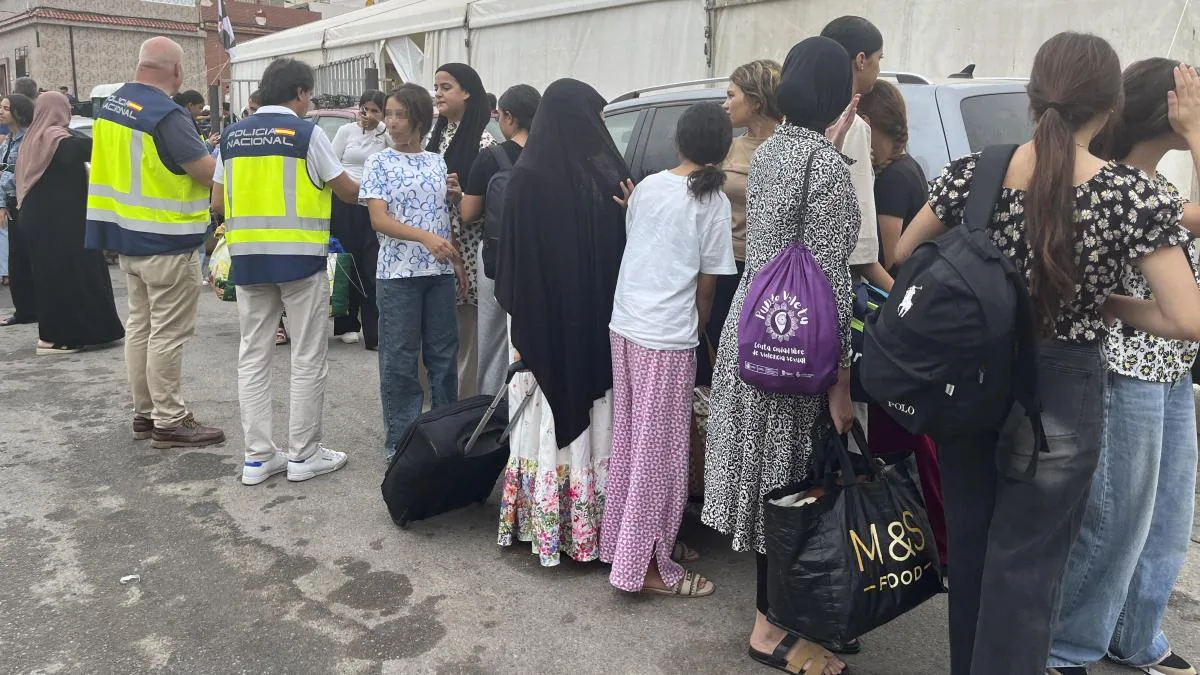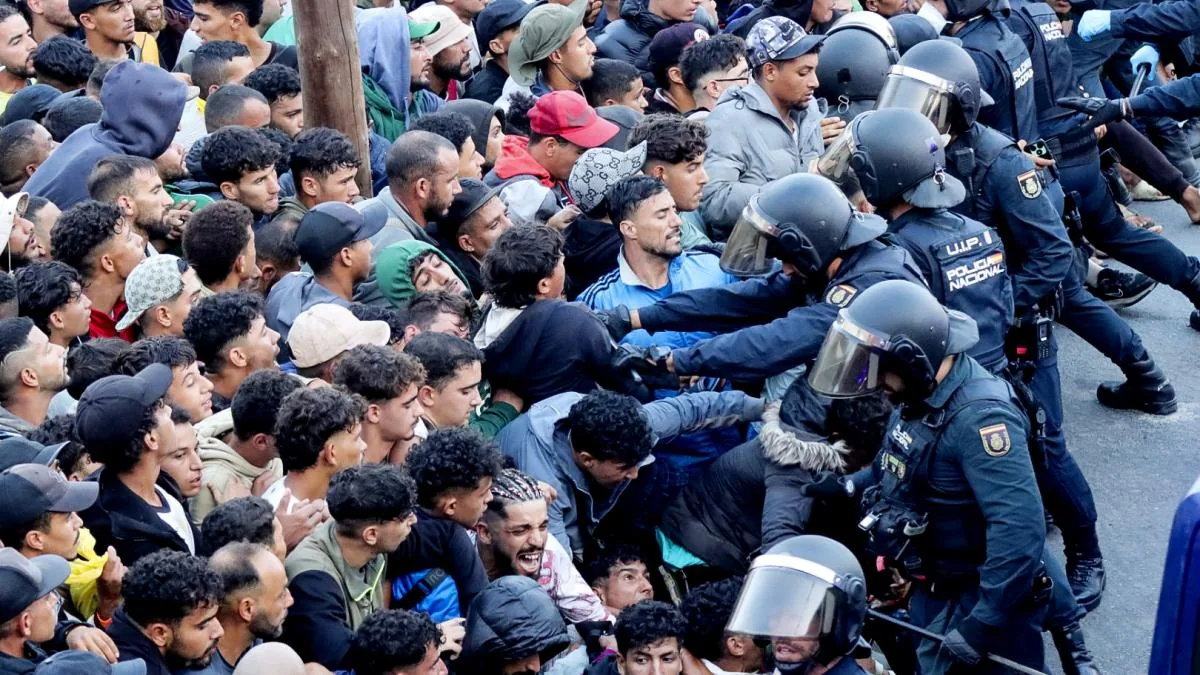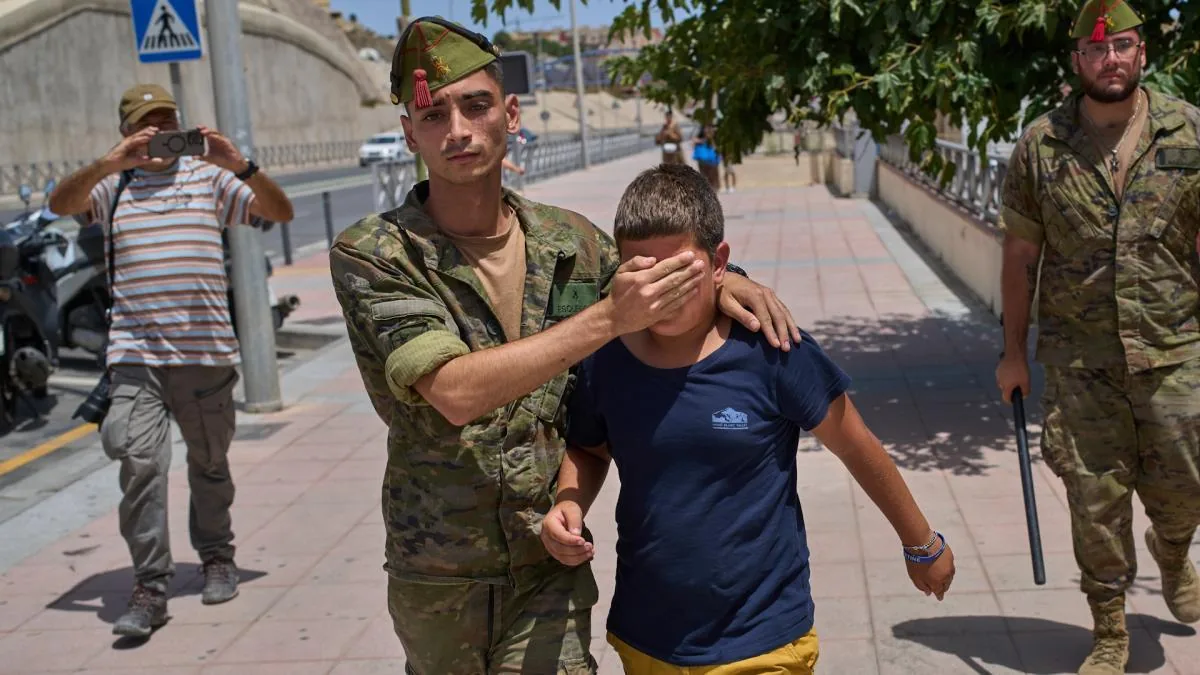
Paper can withstand anything. When the Immigration Law was reformed a year and a half ago to redistribute unaccompanied immigrant minors without family support among the autonomous communities, the term “ordinary capacity” was established. A standard for the reception places for unaccompanied foreigners that each territory should have, based on its population. With calculator in hand, Ceuta’s ordinary capacity was set at 29 beds. The autonomous city, after last week’s massive influx, is caring for 862 minors; four times more than just two weeks ago. 2,865% over its capacity. And there are still dozens of them on the streets, hiding, unidentified.
Read more Attention: “The border of Ceuta is open”
The Regulars units and the Legion of the Army were still conducting sweeps yesterday through the city’s peripheral neighborhoods in search of people still wandering the streets. Five days after the avalanche that skirted the El Tarajal breakwater, while Morocco remained passive, the figures on how many immigrants remain in Ceuta continue to fluctuate. About 2,500 says the Government Delegation. Up to 5,000 – double, no more no less – points out the Ceuta government. The modus operandi repeats: the Maghrebis who show the least childlike features, to a military truck back to the border crossing; the sub-Saharans, as possible applicants for international protection, to Benítez beach where the Temporary Stay Center for Immigrants (CETI) is nearby; the minors, to keep circulating until the Police register them.
The autonomous city prepares two centers in anticipation of having to shelter a thousand teenagers
The Ceuta authorities are overwhelmed. They are searching for resources under every stone to care for the teenagers who crossed into Spain without family, while local agents comb the city to leave no one behind. One of the lessons from the 2021 crisis, when about 10,000 people entered Ceuta encouraged by Rabat, was that summary returns of minors are illegal, that each case requires an individualized file in which, above border priorities, the best interests of the minor always prevail. Those reports, in which consents are gathered, X-rays are taken to calculate their age, and the minor is heard, require time. Sometimes more than the emergency demands.
Since there is no time to lose, Ceuta is rapidly expanding its reception capacity with two new large spaces: one of them, an industrial warehouse in the El Tarajal industrial park, which also served to shelter the kids who entered five years ago. When talking about Ceuta’s return to normality, that industrial park is excluded. There, the accumulation of immigrants, who report neglect, is the norm. The traffic from days ago has given way to exhaustion, to unease. In this part of the city there are more Maghrebis than sub-Saharans. There are also minors who have not yet been registered by the police. They wait, not knowing if they will soon have news about their immediate future, lying on mattresses, with barely any belongings. They crossed into Spain after seeing on their social networks, almost live, that many of their compatriots were doing so.
The minors will be distributed to other communities thanks to the mandatory distribution approved a year ago
The nearly thousand minors hosted in Ceuta should be redistributed across the Peninsula, which forecasts that the migration challenge will again be at the center of the political stage. Ceuta has been in a state of extraordinary migration contingency since August 2025. It was the green button activated, like the Canary Islands and Melilla, to relieve the pressure on its minor reception system. For almost a year, about 650 teenagers have been transferred to other autonomous communities. It is the territory, according to ministerial sources, that has processed files the fastest so that transfers can be made. In percentage terms, the one that has transferred the most minors. Now, there are fears that the autonomous communities where Vox has been decisive for the Popular Party to govern may put obstacles to accepting more transfers. In fact, some agreements with the far right include opposition to the arrival of more immigrant minors.
Read more The Government dismisses a National Security official after publishing a figure of entries in Ceuta
Sources from Youth and Childhood assure that the ministry is working on “activating all available mechanisms to provide a dignified reception to all these children and adolescents.” And one of them, the key one, is the mandatory and solidarity-based distribution by the rest of the autonomous communities. Mechanisms that will be applied individually according to the best formula to guarantee the rights of each minor. In addition, the same sources say that extraordinary financing and credit allocations will be enabled for this, which have not yet been specified.
The PP, which governs in Ceuta, agreed in several regions with VOX not to host more foreign youths
Ceuta’s crisis took another turn yesterday, which slipped into conversations on downtown terraces, where no one doubts that total normality has been restored. If the Interior Minister, Fernando Grande-Marlaska, lied last Thursday, in the autonomous city itself, when he assured that the National Intelligence Center (CNI) did not alert him about the tide of immigrants coming from Morocco heading to the border. New journalistic information points out that intelligence services issued “several warnings” of a massive entry into Spain. However, the Government spokesperson, after being asked several times in a television interview, denied the existence of any CNI report, in line with what the Interior Minister defended, warning of the magnitude of the avalanche, which authorities have raised to 60,000.
Ministerial sources explain that the intelligence services focused on the possible pull effect that the Supreme Court ruling could provoke, which determined that hot returns of immigrants intercepted at sea are not allowed. It was feared that mafias could take advantage of the new doctrine to encourage migrants, causing a security breach at the border. However, Interior defends that no intelligence warning was needed to realize this. That from the very day the Supreme Court ruling was known, work began on this possible migration surge scenario. Interior distinguishes between the rise of swimmer migrants, which grew daily, versus the qualitative leap last Thursday, which was described by the Prime Minister as a “violation of territorial integrity.” Of that crowd advancing, encouraged by social networks and the permissiveness of Morocco, Interior maintains that no “report” was received from the CNI.
While the words of the Moncloa spokesperson support Marlaska’s version, the Defense Minister, Margarita Robles, avoided directly answering about the role of the CNI, which depends on her department. Robles highlighted the “exceptional work” carried out by her workers, refusing to enter into controversies.
Read more EU ministers’ meeting on immigration in a tense political climate