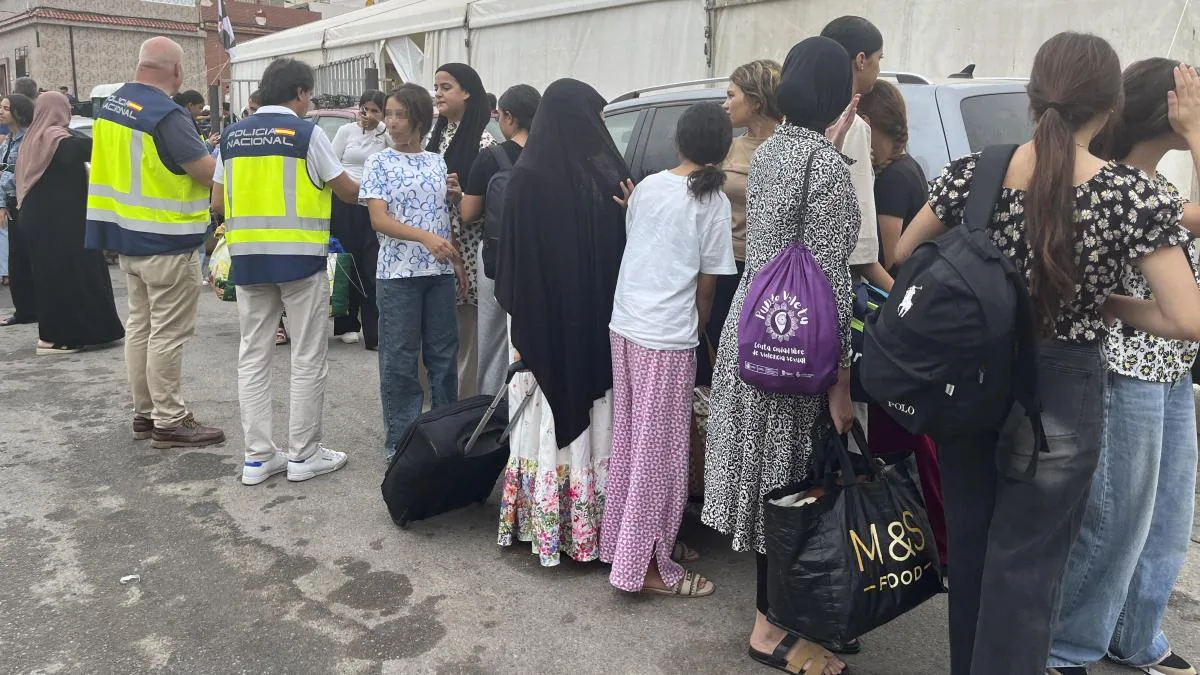
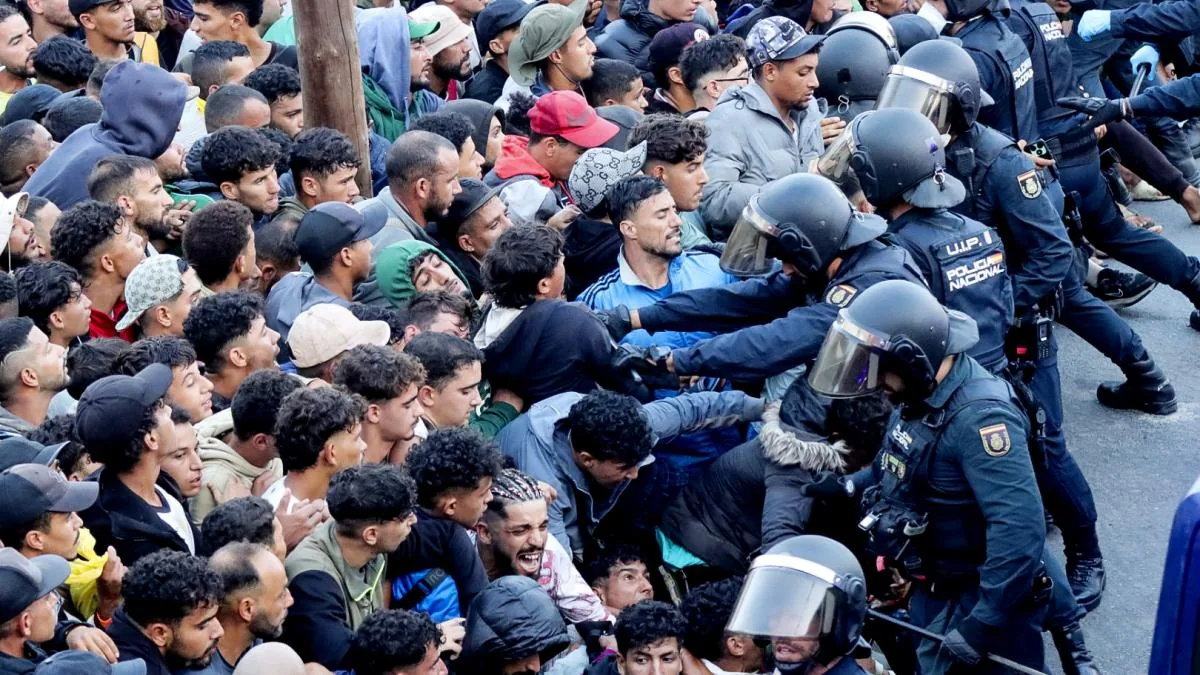
The people of Ceuta, who, filling the void left by public administrations, have voluntarily taken charge of welcoming people who crossed irregularly into the autonomous city, have exploded. Days go by, about twenty already, but the authorities still have not provided a decent (and safe) space for thousands of immigrants who continue to be exposed to the elements, despite the Government’s promise to deploy “immediately” four centers with 1,500 beds. “If there is no solution now, the volunteers will not take care of anyone else,” warned Hafida Mustafa yesterday, a resident of the Príncipe neighborhood who has been guarding the sports court that became the refuge for girls and adolescents who arrived alone in the city, in a situation of enormous vulnerability to sexual violence, exploitation, or trafficking. Patience is running out on the streets, with neighbors feeling tired and insecure and immigrants in inhumane conditions, while the new spaces have yet to be enabled. Nor do they have an opening date.
Read more The Moroccan Gambit
The Government remains firm in its plan not to carry out a single transfer of immigrants to the Peninsula, despite the obvious difficulties in organizing all the receptions in Ceuta, whose residents feel that their city is increasingly a powder keg about to explode. In previous migration crises, in Ceuta in 2011 or in the Canary Islands since 2024, the Executive always appealed to the solidarity of all autonomous communities: even reforming the Immigration Law to establish a mandatory distribution among territories of minor migrants. Now, with Brussels scrutinizing Spain’s migration policy due to criticism from some community partners, the premise is to provide reception in the autonomous city itself while advancing deportations of immigrants who do not meet the legal requirements of persecution to obtain international protection, or who come from a safe country. As is the case with Morocco following the approval of the European asylum pact. According to ministerial sources, neither sending to a foreigner internment center (CIE) among the seven operational in Spain is contemplated. All are on the Peninsula, with the closest in Algeciras. So much so that the Government spokesperson, Elma Saiz, does not rule out that the number of beds could rise to 4,000.

The premise is to host in the autonomous city while Brussels scrutinizes Spain’s migration policy
The distribution of minors among autonomous communities is also on hold since the massive crossing. Yesterday, the Ministry of the Interior reported that 2,168 minors have been identified in Ceuta since July 30. According to police sources, the vast majority are Moroccan, although there is also a percentage of children and young people from Chad or Sudan, countries with a high positive resolution rate for international protection. On July 15, Ceuta was attending to 213 minors. The figure now rises to 1,376: a 4,600% increase in its occupancy. The Ceuta Government states that the number will be “much, much higher.” Meanwhile, at some point, the dozens of girls who continued yesterday in the Príncipe sports center will have to be accommodated. The volunteers, exhausted, do not even know what number to give about how many minors are in the facility. Police or military personnel still have not appeared to protect them. The authorities placed two new portable public toilets on Monday. They now have three for about 400 people. No showers.
Read more Deny the evidence
There is another large group of adolescents on the slopes near the temporary immigrant stay center (CETI). Among the trees, the count of huts built to shelter men is lost, but they have chosen to settle on the edge of the road. The reason? The riot vans that are permanently stationed at the CETI gates. They explain that there, with agents by their side, they feel safer. A few meters away is the equestrian center, with a track on which a new center is planned to be built. During yesterday morning, there was no movement. In the Embolsamiento esplanade of the Loma Colmenar neighborhood, very close to the border, the army only installed about ten military modules that will fill the temporary emergency complex and will have health care and protected spaces for women and minors.
Patience is running out in Ceuta with tired and insecure neighbors and immigrants in poor conditions
Late in the afternoon, the volunteers extracted the promise from the authorities that relocations were just around the corner. To be patient. “It is worth waiting just a little longer,” the associations from the outskirts asked their neighbors. “No one can teach us patriotism,” they expressed in a statement.
Read more La Alhambra presents minor damage, none structural, focused on the Alcazaba