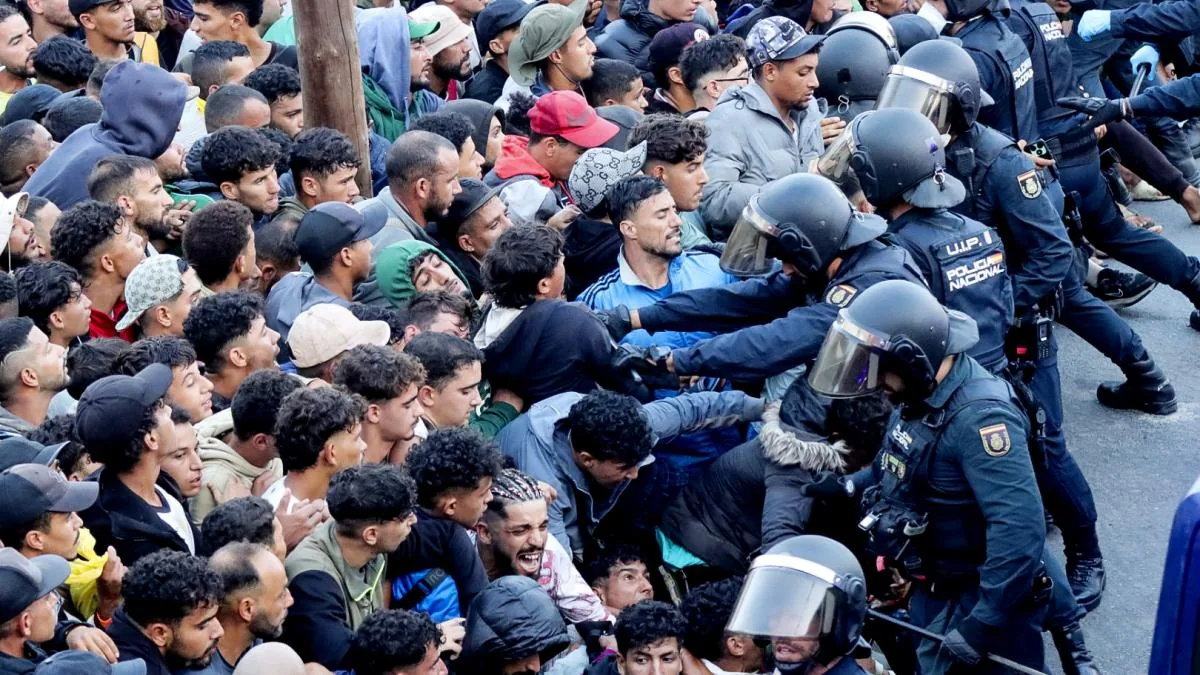
“We have nothing to hide and we act with transparency,” warned the Government spokesperson, Elma Saiz, yesterday after the Council of Ministers approved the declassification of “all” the reports in its possession, including internal communications between different government departments, prepared from July 1 to August 1, about the massive influx of immigrants that occurred in Ceuta on July 30 and 31.
Read more A scandalous news

There are around 40 documents from the National Police, the Civil Guard, the National Intelligence Center (CNI), and the Armed Forces intelligence services (CIFAS), which are scheduled to be made public today at noon through the Moncloa website, as was done last February with the 23-F papers.
None of these reserved reports, to which the public will now have access, affect national security, since in such cases the Government would only send them to the official secrets commission of the Congress.
And the Executive insists that, at least for now, there is no evidence pointing to Moroccan authorities being behind the assault on the Spanish border in the autonomous city, despite the fact that both the president of Ceuta, Juan Jesús Vivas, and the leader of the PP, Alberto Núñez Feijóo, already took this as a fact.
The Executive demands the PP leader stop encouraging “conspiracy theories” about Rabat’s involvement
“Feijóo would do well to behave like a true opposition leader and a statesman, to stand alongside the Government with responsibility and prudence, and to stop embracing conspiracy theories or misinformation,” demanded Elma Saiz to the PP leader.
“The timeframe to return Ceuta to normality and solve this crisis depends on collaboration between administrations, and being an opposition party that only puts obstacles in the way does not help the people of Ceuta at all, not at all,” she warned. “I demand that he act with responsibility and prudence, as an opposition party that must live up to what the public demands,” said the spokesperson minister.
Read more Inter gifts the match to Madrid
The second vice president of the Government, Yolanda Díaz, was even more forceful in her criticism of the PP, accusing the leaders of this party of being “pyromaniacs of hatred” in the face of the humanitarian crisis in Ceuta, after an assault on the border in which 141 immigrants lost their lives. “They are fracturing coexistence throughout the country, for short-term electoral purposes,” she denounced. “The PP is feeding the far right. And although they think it gives them many votes in the short term, the consequences are brutal. You can’t do this for a handful of votes,” Yolanda Díaz reproached.
Elma Saiz, in any case, assured that the declassification of documents about the Ceuta crisis, for now limited to the period between the first day of July and the first of August, might not be the last. “If other documents appear and are relevant, they will also be shared,” she pointed out. For now, however, the Executive sees no evidence accusing Moroccan authorities of having encouraged the assault on the border in Ceuta. But the spokesperson minister reiterated the words already expressed last week by the President of the Government, Pedro Sánchez: “If there is evidence, action will be taken decisively.”
Moncloa supports Minister Puente in his questioning of Judge Tardón’s impartiality
However, the National Court judge María Tardón already pointed to Morocco when she opened a criminal case the day before to investigate the Ceuta crisis. Minister Óscar Puente questioned the judge’s impartiality for asking police investigators not to inform their superiors of their inquiries and because in the past she was a councilor in the Madrid City Council, governed by the PP, although as an independent. “It smells a bit fishy,” warned Puente.
And Moncloa supports this questioning of the judge: “Puente is an authorized voice of this Government,” they argue.
Read more The Government of Portugal overcomes the motion of no confidence that exposes its fragile situation