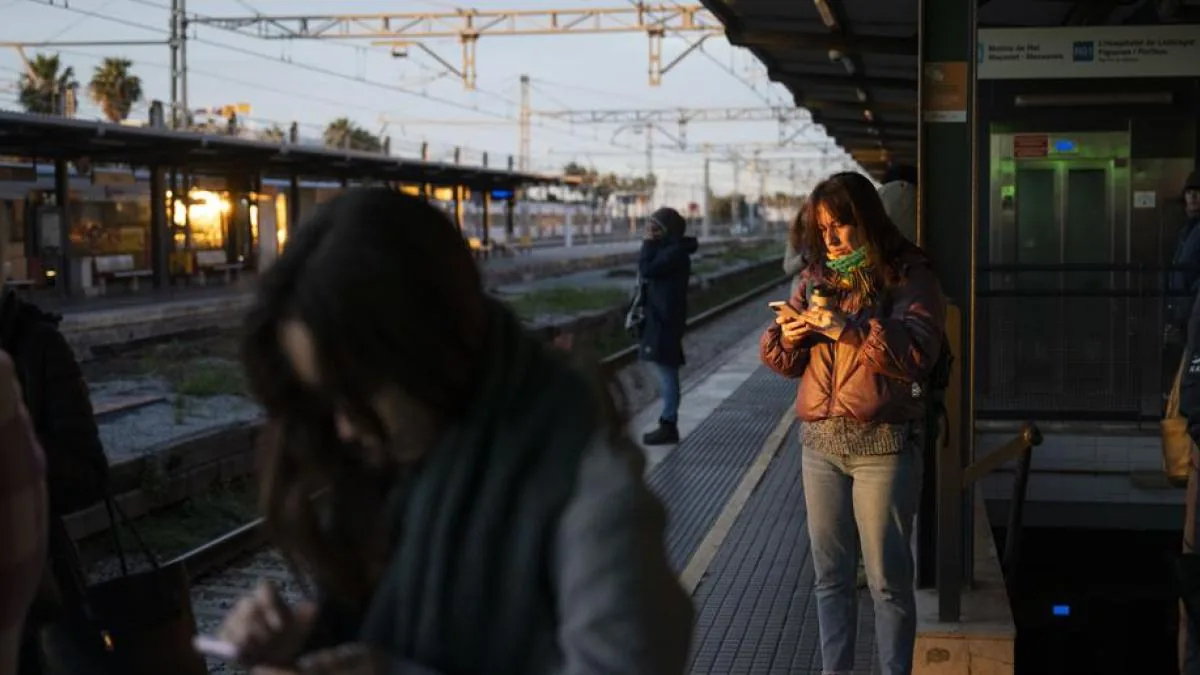
The Govern and Esquerra Republicana are in the final phase of budget negotiations and, to finalize these accounts, both parties will announce next Monday one of the commitments that will facilitate the agreement: the orbital railway line. The talks are so advanced that ERC has called its national council, the highest body between congresses, for next Monday at 5:30 p.m. to assess whether the conditions are met to approve the budgets.
Read more U.S. cancels deployment of 4,000 soldiers in Poland and opens a new crisis with Europe
This project was first put on the table in 2004 with Joaquim Nadal at the head of the Ministry of Territorial Policy. The line plans to connect the cities of the second metropolitan ring – from Vilanova i la Geltrú to Mataró – without passing through Barcelona, which represents a “paradigm shift in mobility” for ERC, leaving aside the classic radial scheme.
It does not mean starting from scratch, since in 2010 the urban master plan was approved with the establishment of land reserves to carry out the works. Awaiting the exact details to be specified on Monday, Esquerra’s proposal is that the State invest a total of 5.2 billion (of which 4.8 billion would be for infrastructure works and the remaining 400 million for rolling stock) and that the project be carried out in five phases, with the estimate that it will be fully operational by 2040. This has been discussed with the Ministries of Finance and Transport, which would have given the green light, and it would have to be confirmed through a bilateral meeting that some consulted sources place at the end of next week.
This line will be about 120 kilometers long. ERC argues that the suggested timelines are “realistic” because, of new construction, it will be 68. The network would have 39 stations, of which 18 will have to be created. The rest are already built. This is the plan they presented this Thursday afternoon in a meeting with their elected officials.
Sources from ERC propose five phases for its development, although the prioritization and order of each are not yet defined. The Republicans believe it could start with the reinforcement of the R8, with the construction of three interchanges in Rubí, Sant Cugat, and Riu Sec, to begin connecting nodes. In fact, these works already have a budget of 135 million. Subsequently, the route from Santa Perpètua de Mogoda to Sabadell would be built (665 million); the connection from Mataró to Granollers (1.45 billion); completing the Terrassa-Martorell axis (1.15 billion) and the last would be the closure of the orbital, linking Vilafranca and Vilanova i la Geltrú (1.4 billion).
Read more The violence of the settlers marks Jerusalem Day
Regarding the disbursement of resources, the State would assume full responsibility as it is the owner of the infrastructure. Given that it could be carried out over several years, the republican party sees it as feasible. Additionally, part of the funding could come from the European Investment Bank.
The agreement on the orbital railway line – which will not have a specific item in the Generalitat’s accounts – is one of the cards bringing the budget pact in Catalonia closer, which, if nothing goes wrong, will arrive next week, as La Vanguardia explained. Also the commercial company or a reinforcement of competences in an area where the State has exclusive governance.
A different matter from these issues is the financing model agreed upon in January. Its processing is halted pending the convening of the Fiscal and Financial Policy Council to validate the legislative amendments that will go to Congress, and because the voting intention of Junts is uncertain, leaving the future of the proposal in the balance. What is gaining certainty is that Catalonia is approaching its first budgets since 2023.
Read more Xi seduces Trump with pomp and business