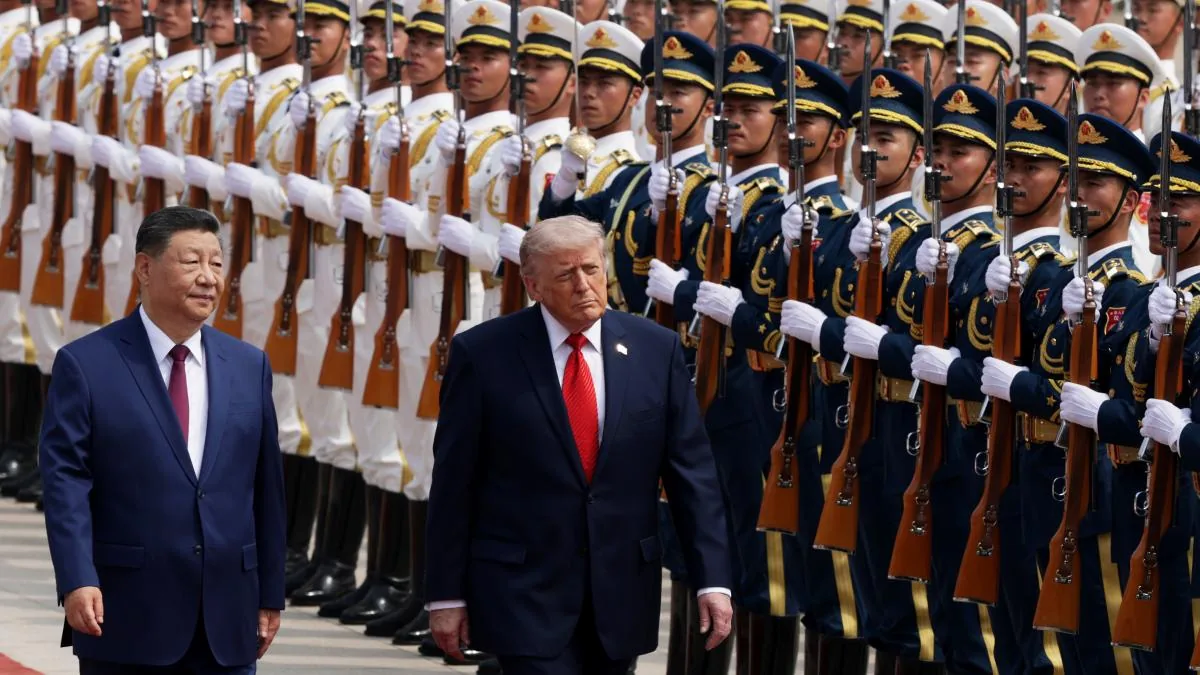
With a grand parade of flags waved by children, a military review of the honor guard, a visit to the sacred Temple of Heaven, and an opulent banquet in the Great Hall of the People, Xi Jinping has charmed Donald Trump with a pomp superior to that usually granted to his invited counterparts. The U.S. leader has returned the hospitality with a level of praise that his European allies, including the kings of the United Kingdom who visited the White House two weeks ago, will hardly hear.
Aware of the significance of the meeting, nine years after his last visit to China, Trump has been seen exceptionally restrained. He remained silent when the press asked him about Taiwan, set aside his insults and outbursts, and limited himself to smiling, thanking the cordiality of his “great friend,” and sticking to the script in his brief speeches. Xi is a “brilliant leader” and a “wonderful guy,” he said about his counterpart, who emphasized that they should be “partners, not rivals.”
Also read
Behind the public respect and courtesies, however, mutual distrust reigns in private between the two most powerful men in the world, typical of the most consequential geopolitical rivalry of the century. While Xi mentioned the need to avoid the “Thucydides trap,” according to which a hegemonic power tends to conflict when it feels threatened by an emerging one, Trump marketed his state visit as a business trip, accompanied by about twenty top U.S. executives, including Elon Musk (Tesla and SpaceX), Tim Cook (Apple), and Jensen Huang (Nvidia).
His son Eric Trump, who runs the president’s real estate company and has already secured lucrative deals on other state visits, especially in the Persian Gulf, also attended. In China, he could advance the agreement between a company linked to the Trump family’s cryptocurrency company (World Liberty Financial) and the Chinese Nano Labs, with whom they signed a memorandum of understanding last month to build data centers in the U.S.
Weakened in Washington by a strategic defeat in Iran, by polls giving him the worst approval ratings of his decade in politics, and by rising inflation, Trump seeks victories in Beijing, symbolic or material, for the American people. After his first meeting with Xi this Thursday, and in anticipation of tomorrow’s “bilateral tea,” the White House issued a triumphant statement without mentioning Taiwan, the major point of friction between the two powers.
The White House boasts of trade agreements and states that China agrees that “Iran can never have a nuclear weapon”
Both leaders “discussed ways to improve economic cooperation, including expanding Chinese market access for U.S. companies and increasing Chinese investment in our industries,” the statement says, published amid a one-year trade truce forged in November after their last meeting in Busan (South Korea), on the sidelines of the Asia-Pacific Economic Cooperation (APEC) summit.
During Trump’s last visit to China in 2017, the president said Beijing had “taken advantage” of the trade relationship with the U.S. for years, although he did not blame China but his predecessors. That meeting marked the start of a decade of economic disagreements between the two powers, which peaked last year when Trump temporarily raised tariffs on China to 145%, citing the trade deficit and China’s role in the fentanyl supply chain.
Nine years after the previous visit, Trump traveled to Beijing accompanied by businessmen seeking mutual investment opportunities, publicly urging the need for the two countries to open their markets. In its statement, the White House says both presidents “highlighted the need to continue advancing to end the flow of fentanyl precursors to the U.S., as well as to increase Chinese purchases of U.S. agricultural products.”
Also read
This Friday, both parties could announce an agreement to establish new mechanisms in the bilateral trade relationship, as well as an extension of the truce announced in November. U.S. Treasury Secretary Scott Bessent and Chinese Vice Premier He Lifeng held new talks today in this regard. Washington wants to present its alternative to the World Trade Organization, the so-called Trade Council, whose details remain vague. Although it probably will not balance the economic relationship between the two countries, it could be a victory Trump boasts about to his people.
On the other hand, according to the U.S. version, Trump and Xi “agreed that the Strait of Hormuz must remain open to support the free flow of energy” and the Chinese leader “made clear China’s opposition to the militarization of the strait and any attempt to charge tolls for its use, and expressed interest in buying more U.S. oil to reduce China’s dependence on the strait in the future. Both countries agreed that Iran can never have a nuclear weapon.”
In their conclusions of the meeting, however, Chinese state media do not mention this supposed agreement on the Iranian nuclear program, on the purchase of U.S. oil, or on tolls in Hormuz. Beyond the symbolic victories obtained by Trump in China, shortly after the meeting, Xi achieved a material victory in the strait: Iran, from whom Beijing buys 90% of its oil, allowed the passage of 30 vessels through Hormuz, most of them flying the Chinese flag.
Awaiting possible announcements this Friday, the first day of the summit in Beijing staged a rapprochement between the two leading world powers. Gradually, Trump is moving away from the more orthodox positions of the Republican Party, which sees China as the great geopolitical rival to confront. In his actions and statements, he has adopted a message closer to that always maintained by Xi: that an open trade relationship will be beneficial for both countries, as well as for world peace.