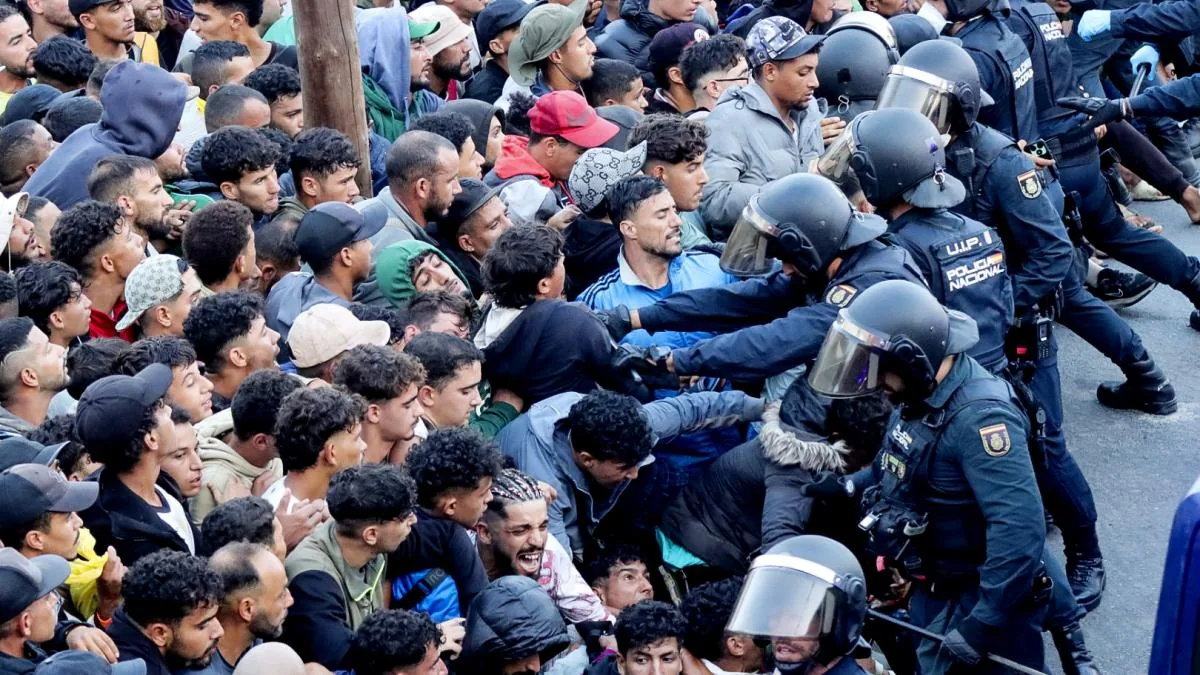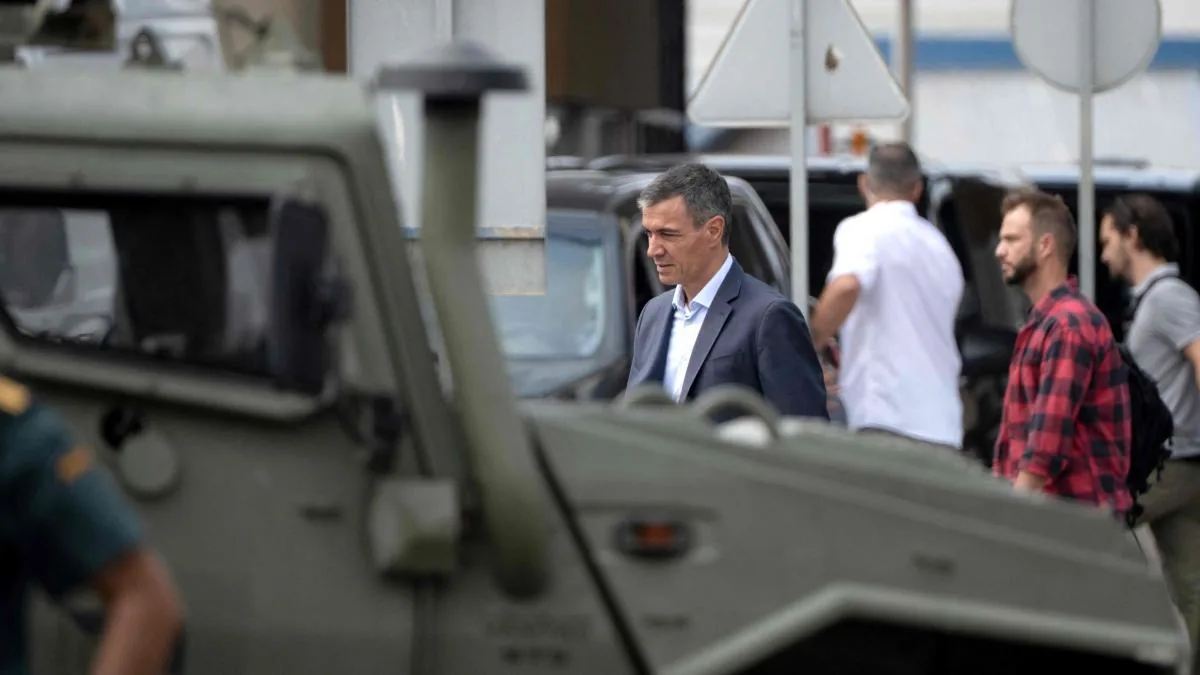
The return to Morocco of “virtually all” those who entered Ceuta irregularly, as highlighted by the Foreign Minister, José Manuel Albares, did not manage to ease the political tension this migration crisis generated in Europe. What began on Thursday night as an impulsive reaction from Giorgia Meloni’s government ended up becoming a political offensive against Spain supported by several European executives, provoking a strong response from Pedro Sánchez, who visited Ceuta yesterday and denounced “the violation and attack on Spain’s territorial integrity.”
Read more The agnosticism of Page, Borràs and Ayuso
But it did not prevent several governments, especially conservative ones, from demanding that Madrid toughen its migration policy, which they have traditionally criticized.
Meloni’s position was joined yesterday by Poland, Finland, Austria, the Czech Republic, and Denmark. The President of the European Commission herself, Ursula von der Leyen, warned that “we cannot allow anyone to enter our Union without respecting our rules.”
Against this bloc, the French Emmanuel Macron held a phone conversation with Sánchez to express his solidarity, although France decided to maintain reinforced controls at its borders — already monitored by the G-7 summit. More explicit support came from the President of the European Council, António Costa.
And, as expected, Washington also intervened. “We will also have an invasion like Ceuta’s if the Democrats win,” said President Donald Trump.
Italy finally announced the suspension of the Schengen treaty with Spain and, as pressure grew demanding Spain manage its borders more strictly, Sánchez responded firmly: “Solidarity and empathy are optional. Respect for European treaties and data is not.”
He cited the figures of irregular entries recorded by Frontex between 2021 and 2026: 478,600 through Italy, 340,600 via the Western Balkans route, 259,800 through Greece, 234,760 through Spain, and 48,000 through the eastern border. “This is not the time to divide. It is time to continue building a strong and united EU,” he warned.
The head of the Executive denounces “the violation and attack on Spain’s territorial integrity”
By the afternoon, Italy’s determination regarding the borders with Spain began to ease. “It will not affect tourism,” the Italian government hastened to clarify, after the concern generated among thousands of travelers in the middle of the summer season.
Meloni’s goal is to turn the standoff into a European-wide initiative. And in this context fits the phone conversation she had yesterday with the Danish Prime Minister, Mette Frederiksen.
Albares also responded: “The integrity of the Schengen area is absolutely guaranteed. Enough of interested confusion,” he replied.
“It is not an invasion,” they warned at Moncloa. Rather, they likened it to a student holiday, with an improvised explosion of joy encouraged by social networks and mafias that spread the rumor – based on a Supreme Court ruling – that it was possible to cross into Spain and there would be papers for everyone. But with the tragic consequence of 57 deaths.
With the dream shattered, of the nearly 50,000 people, mostly young people armed only with a mobile phone, who had joined the adventure on Thursday, more than 48,300 had returned to Morocco by mid-afternoon yesterday, according to the Interior Ministry.
Read more Feijóo speaks with about twenty European leaders and with the United States
“Virtually all those who entered Ceuta,” as Minister Albares stated already at night, recalling that “it is not possible to move from Ceuta and Melilla to the Peninsula without identifying oneself at a police checkpoint. The integrity of the Schengen area is absolutely guaranteed. Enough of interested confusion.”
The PP and Vox did coincide in denouncing an “invasion,” which they blamed on Sánchez and his regularization of immigrants as a pull effect. Some far-right leaders even called for the “hunting” of immigrants.
The head of the Executive denounces “the violation and attack on Spain’s territorial integrity”
The atmosphere was already very tense when Sánchez arrived in Ceuta with the Interior Minister, Fernando Grande-Marlaska. Most shops were tightly closed, as were many residents in their homes, who said they were afraid. Thousands of Moroccan youths roamed the squares with nothing to do, hungry after having slept outdoors while their clothes dried.
Sánchez and Marlaska met with the commanders of the security forces at Tarajal, the epicenter of this migration crisis. Then they went to the Assembly palace, where the President of Ceuta, Juan Jesús Vivas, awaited them. A group of citizens greeted them with insults: “Sánchez, resignation!” The head of the Executive then appeared to make a statement. He did so without Vivas, who rejected the joint appearance initially planned.
“The State is here. We defend security and coexistence in Ceuta as we would defend it within the M-30 perimeter in Madrid. We are all one,” Sánchez said. He condemned “the violation and attack on Spain’s territorial integrity.”
“Ceuta is a Spanish city, and what happened deserves all our reproach and all our condemnation, at the strongest possible level of rejection,” he stressed.
“The Government will use all State resources to guarantee security and also coexistence in the autonomous city,” he promised.
He attributed the crisis to an “interested reading that the mafias trafficking in human beings have made of a Supreme Court ruling that says that repatriations at the border do not apply to those who enter by swimming, by sea, because it is considered that there is no physical border, as there is by land.” He opened the door to studying legal reforms if necessary, but as a temporary solution announced that buoys will be deployed at Tarajal, as a “physical containment barrier,” so that repatriation at the border of irregular immigrants is not prevented.
Vivas avoids appearing with Sánchez and criticizes the central Government’s “late and insufficient response”
But Sánchez portrayed this crisis as an isolated episode, emphasizing the trend of reducing irregular immigration flows to Spain in recent years, with a 36% drop in 2026.
The president thanked Morocco for its cooperation to speed up repatriations “as soon as possible.” “Moroccan authorities are willing to cooperate,” he stressed. “We have to speed up and give a much stronger response to what happened. But the dialogue with Moroccan authorities is constant, fluid, and very reasonable, unlike what happened in 2021,” he admitted, referring to the migration crisis then caused by Rabat’s anger over the hospitalization in Logroño of the Polisario Front leader, Brahim Gali.
Vivas, on the other hand, denounced “Morocco’s manipulation of its population for partisan purposes.” He criticized the Government’s action: “It was a late and insufficient response.”
Read more Morocco shows its power