








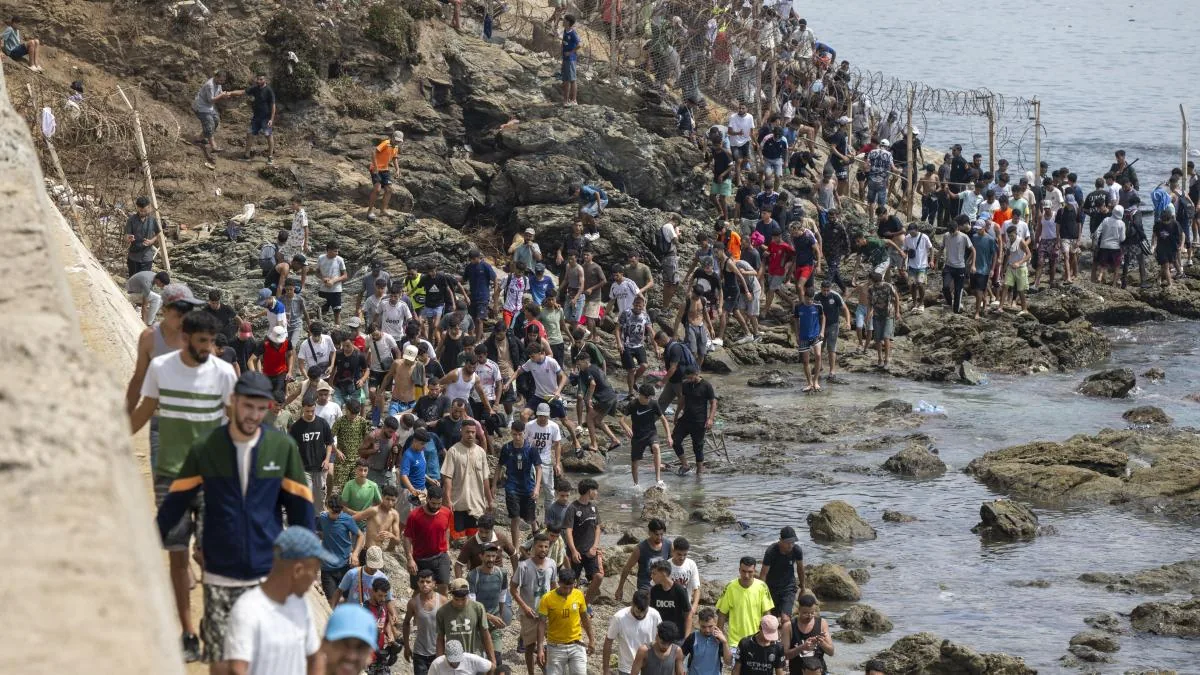
The tide of immigrants that overwhelmed Ceuta, believing that Spain would be a free-for-all of opportunities, went from chants about setting foot on the autonomous city’s soil to faces of resignation, barely 24 hours later, as they embarked on the return journey amid laments over their dream of legally emigrating to Europe fading away. As many had been promised. There was no need to use force; more than 48,300 people, out of the 50,000 who entered massively without Moroccan authorities preventing it, returned voluntarily in a line the way they came, via the border breakwater, after spending a night outdoors, wandering the streets with nothing to eat, and above all, with the widespread feeling of having been deceived. “They lied to us. No one welcomes us. This feels like a prison,” lamented Karim yesterday, just turned 18, barely a hundred meters from Morocco.
Read more The Ceuta crisis pits Sánchez against his European partners over immigration
Who is behind the deception that led tens of thousands of young people, neither studying nor working, from various Moroccan cities to gather this week in Fnideq (Castillejos), as the last stop before trying to cross into Spain, is still unknown. Yesterday, some of the few youngsters who still had battery on their mobile phones showed chains of messages on social networks talking about the opportunity to swim around the breakwater, the possibility of obtaining residence permits in Spain thanks to extraordinary regularization, or the ease of buying tickets to travel to the Peninsula. An Alaouite generation without a future, clinging to any straw of hope. Even if it burns in hoaxes. However, the massive crossing, which the Ceuta Government raised to 60,000 people in a city of 84,000 inhabitants, would not have happened if Moroccan gendarmes had not looked the other way, despite yesterday, from Moncloa, Rabat still being described as a reliable partner. Although this exposes to the whole world the shame of a kingdom where its young people seize the slightest opportunity to flee, with nothing but what they wear, without looking back.
About 50,000 people crossed the border with Morocco’s permissiveness, most of whom returned
Only that desire to leave the country explains the ecstasy with which young people began entering Ceuta by the hundreds from Thursday noon. Swimming, with swimsuits and floaters, or on foot, skirting the breakwater. “Long live Spain,” some shouted. “Long live Pedro Sánchez,” others did, as local media reported, which for weeks have been informing that a Supreme Court ruling, which determined that hot returns of migrants intercepted at sea are not allowed, was causing a surge in arrivals. But such a flood of immigrants heading to the city center arrived that Ceuta locked down, more or less spontaneously, to suffocate them. Fearing looting, after moments of some tension due to people seeking food, shopkeepers and restaurateurs pulled down all shutters, making finding water or food impossible.
Spirits were fading at dawn in a city unrecognizable to its residents. Its streets looked like the outskirts of any music festival, with hundreds of young people, barely clothed, lying on park lawns. But it also looked like a besieged city, with Army vehicles patrolling back and forth, giving a warlike tone to the biggest bilateral migration crisis between Spain and Morocco since 2021.
The autonomous city, with all commerce closed, suffocated immigrants who said they felt “in prison”
Exhausted but not stopping walking, looking in groups for a place to have breakfast, a fountain to drink from, a plug to charge their phone. Everything was in vain. Amina, who stood out among the crowd as one of the few women who crossed the border among thousands of men, accepted at noon that she had to return to her native Fez. So did Mahir, who was born less than 18 years ago in Casablanca, who admitted he thought it would be “easier” to reach the peninsula. In fact, he had planned to “surprise” his family with a video call once he crossed the Strait. With the help of the mobile phone translator, because the Spanish he knows allows him to say little more than in Morocco “no work, no money,” he lamented that they told him “many lies.”
We will have to unravel that tangle of “lies” to find out who is behind them and has caused, by action or omission, more than 57 victims, all young Moroccans who drowned in the sea in the deadliest jump recorded. In some countries, their instigators would be accused of homicide.
Read more The agnosticism of Page, Borràs and Ayuso
Despite the military presence on the breakwater, the trickle of swimming arrivals did not stop all morning
In the last migration crisis, after Spain hosted the leader of the Polisario Front, Mohamed VI’s circle warned that all acts have consequences. Now, Rabat, through its ambassador in Spain, has regretted that the crisis is not “wanted” by their country. For now, more doubts than certainties. Reasons hover such as the rapprochement between Spain and Algeria, staged in Pedro Sánchez’s last trip to Algiers after the national team’s World Cup victory. Also, precisely, the dispute between neighbors to host the 2030 World Cup final, which no country has yet renounced. Or the Spanish thorn in the side of the United States-Israel marriage with Morocco as the favored companion. What is becoming certain is the poor foresight of intelligence services to detect this crisis, as ministerial sources, visibly annoyed, begin to denounce. “Did no one notice the human columns heading to the border?” these sources ask.
The Tarajal breakwater, through which about 10,000 people also entered in 2021 encouraged by Rabat as a response to Spain’s hosting of the Polisario Front leader, became yesterday a continuous gateway into Spain and continuous exit to Morocco, at a huge pace. The Interior Ministry, which until returns began avoided giving any arrival figures (finally estimating 50,000), then updated departure numbers punctually. By 1:00 p.m., about 25,000 people, by 3:15 p.m. more than 37,500, past 6:00 p.m. 48,300. At that hour, the trickle of arrivals decreased. Also as in 2021, Civil Guard agents, supported by military, formed a human barrier on the shore of the border breakwater to stop immigrants trying to reach solid ground.
Encouraged by social networks, they thought they would get proper papers to cross to the Peninsula
According to calculations by the department led by Fernando Grande-Marlaska, who will appear before the media this morning after meeting with the Government delegate in Ceuta and security forces commanders, about two thousand young people would still remain in Ceuta, although a simple walk through its streets, which remained locked down late in the afternoon, suggests higher numbers. Immigrants and military seemed to play cat and mouse through the city’s nooks: the former fled (and mocked) the latter, who tried to direct them to the border crossing. “Water, water,” one group asked. “In Morocco,” the others replied at the end of a day that will be remembered as historic in Ceuta, keeping the whole city on edge.
In other neighborhoods, however, the situation escalated, with stones thrown at officers and residents demanding more police presence. Hours pass, and those who have decided to resist so far remain without water, electricity, or food…
Read more Feijóo speaks with about twenty European leaders and with the United States