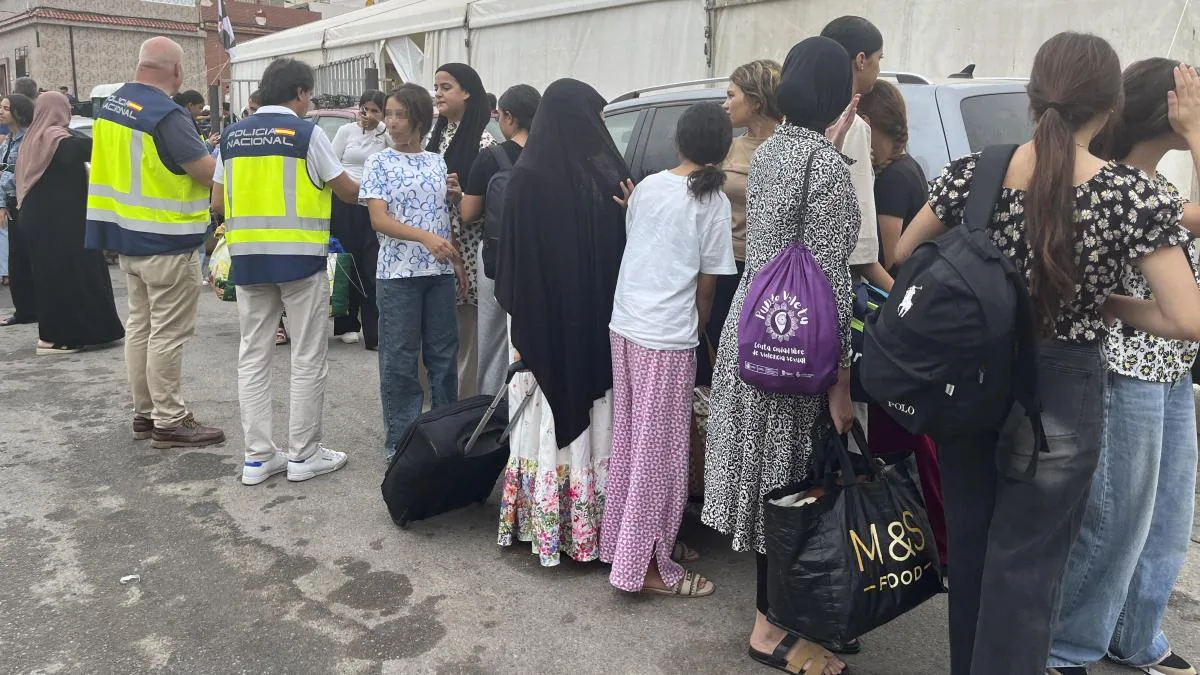
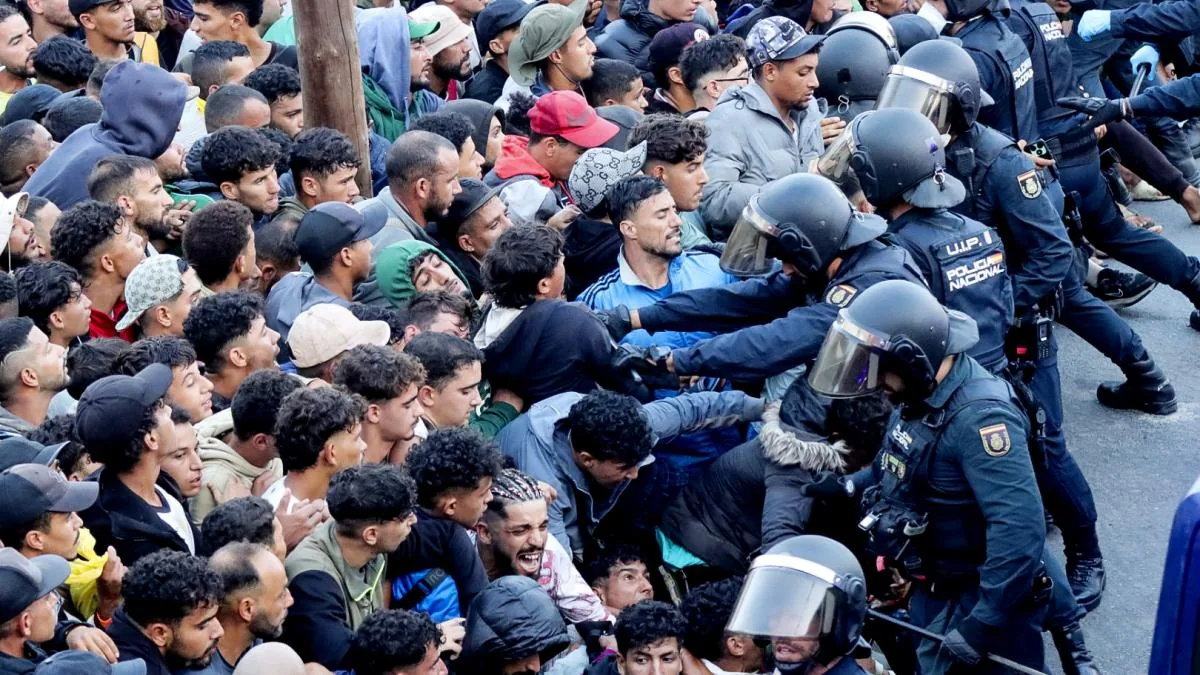
When 40 days have passed since the massive entry into Ceuta, the Ministry of the Interior finally has ready the Temporary Immigrant Care Center (CATE) through which all the people remaining in the autonomous city must pass to be identified in order to determine their future: return or international protection. The opening of this detention center, with a capacity to accommodate 400 people, marks a turning point in the Government’s plan to manage the crisis, since if Morocco continues willing to accept the —non-voluntary— return of its nationals, returns should start to gain momentum. Yesterday, while waiting to open its doors, dozens of immigrants, who were evicted on Sunday, were again erecting makeshift huts near the CATE, set up in some warehouses in the Tarajal industrial estate, just meters from the border with Morocco.
Read more Vivas demands more firmness from Brussels in the European relationship with Morocco
Until now, immigrant identifications, prior to any administrative procedure (return, expulsion, or international protection), have been residual. The registrations have been carried out at the Ceuta National Police Headquarters, which has four work lines, and at the border post, where six stations were set up. According to ministerial sources, this has allowed between ten and twenty daily screenings. With the opening of an adjacent 1,179 square meter warehouse for residential use, the CATE will have 14 police points operational, which will be added to the other ten already operational. Then, the Government expects the identification rate to rise to around one hundred per day, according to the same sources. Police unions such as the SUP, which have been denouncing the lack of human and material resources, doubt these forecasts.

The delay in opening the CATE reflects the Government’s slow reaction in managing the crisis. It is not the first time that the Ministry of the Interior, led by Fernando Grande-Marlaska, has set up a detention center of this nature. During the waves of cayucos on the Atlantic route, one was built in Arrecife (Lanzarote). It is a temporary solution halfway between the Temporary Immigrant Stay Centers (CETI) and the Foreigners’ Internment Centers (CIE), designed for a dual function, both police and humanitarian: to identify foreigners and initiate their administrative procedures, but also to provide them with food, shelter, and medical assistance. The Supreme Court, in line with European jurisprudence, considered that people entering the CATE are deprived of their liberty because the nature of these detention centers is that of police facilities. But the maximum administrative detention time is 72 hours. That timer will start soon with the first admissions.
Initially, it was decided that the first 400 immigrants entering the CATE would be intercepted from the streets, where hundreds of them still spend the night. However, the final plan is to bring people who are in the various reception centers set up by the Government in the city. Upon entering the temporary spaces, they underwent a kind of preregistration without police character, which will help speed up the process. The screenings will consist of a medical examination carried out by the Red Cross, a vulnerability assessment for minors, pregnant women, or people with disabilities or mental disorders, and biometric data collection including photographs, fingerprints, and document scanning. All this will end up in a police database that, as the process gains momentum, will serve to quantify the migrants remaining in Ceuta.
For these tasks, the Interior Ministry will have the help of the European Border and Coast Guard Agency (Frontex) and Europol, after the Government decided to request support from the European Commission. The portfolio led by Marlaska requested to extend the duration of Operation Minerva, which covers the ports of Algeciras, Tarifa, and Ceuta during the Operation Paso del Estrecho, “as long as necessary.” Additionally, the ministry requests the participation of ten additional agents from the General Corps of Frontex for prior identifications for individualized files. Brussels will also be contacted remotely for interpreters needed for interviews.
But the key will come after those first identifications, when each case is studied because not all migrants follow the same procedure. Adults intercepted for irregular entry into the country could be subject to return without the need to open expulsion files. But there are exceptions, which will determine how long the crisis in Ceuta may be prolonged. It is taken for granted that sub-Saharan migrants will all request international protection, so the mere acceptance of the application suspends any return, according to asylum regulations. The Government also considers that a large number of Moroccans, a nationality with minimal asylum grant rates, will claim international protection advised by NGOs, which could delay their return.

But, would it be possible to return to Morocco the adult migrants who pass through the CATE within 72 hours? All consulted sources, police and ministerial, assure that it is feasible if the requirements are met. The main one is that Rabat accepts the returns, so this will be the test to check the cooperation of the Alaouite regime. If a Moroccan citizen is correctly identified, it is determined that the return is legally justified due to irregular entry, they have not formalized an asylum application, and there are no circumstances preventing execution, the return can be carried out even before the maximum three-day period. But Morocco must accept them: one by one. And that is yet to be seen.