







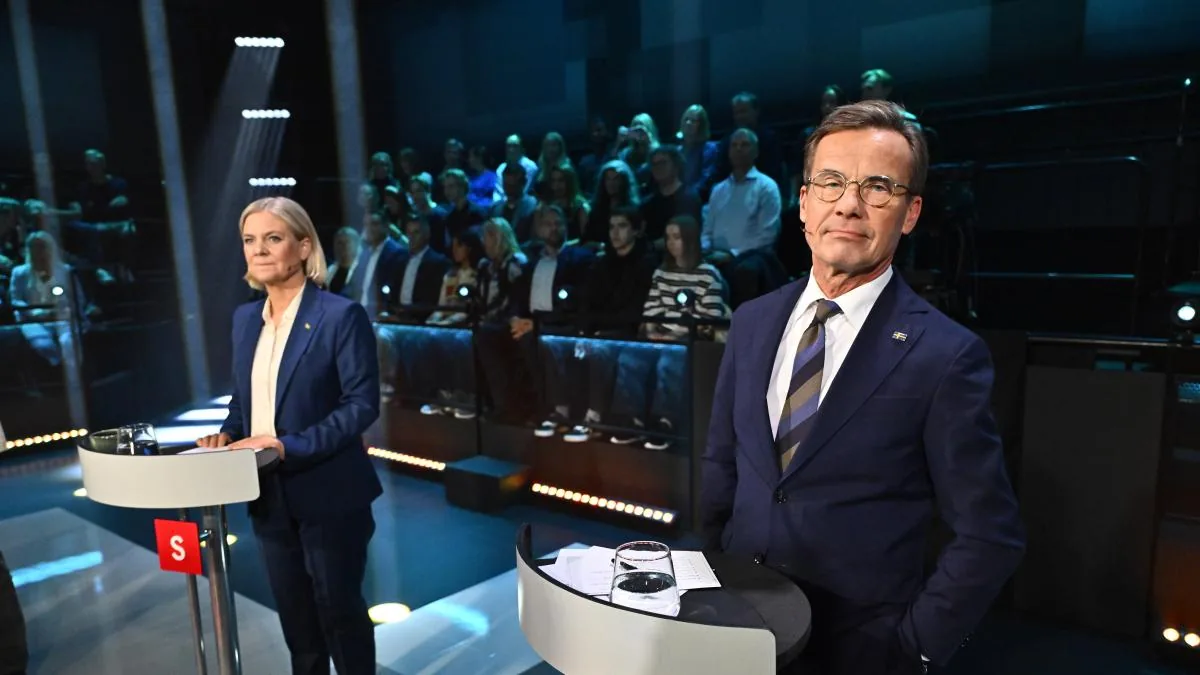
Sweden votes this Sunday from 8:00 a.m. (6:00 GMT) in a general election in which the center-left opposition arrives with a slight favoritism, according to polls, although the right-wing government bloc has significantly closed the gap in recent days.
Read more Felipe VI attends the Spanish GP in Madring with Princess Leonor and Infanta Sofía
Polls place the center-left ahead by between 0.5 and 5.6 points, when just two weeks ago the difference was around ten, which has increased speculation about a possible electoral drama like in the 2018 and 2022 elections, where the external vote count had to be awaited.
More than 3.6 million Swedes out of the 8 million called to the polls have already voted early, 30% more than in 2022 and a record number, according to the Electoral Authority. Around 3.6 million citizens have used early voting before the polls closed, according to data published during election day by The Guardian.
The figure is approximately 44.7% of the 8,046,725 voters eligible to vote in the Riksdag elections, the Swedish Parliament. There have never been so many in a general election in the country.
Postnord, the public postal service company, has referred to this factor to justify that in several places in Stockholm it has not been able to send early votes before the opening of the polling stations, which could cause delays in the count.
The campaign issues
Security, immigration, inflation, healthcare, and education
Issues such as security and order, immigration, measures against the inflation crisis, healthcare, and education have dominated a campaign in which personal attacks have been abundant.
“Nature, the climate… I think people haven’t talked about that, there has been too much silence about the climate in the campaign. There has been too much talk about crime and people coming to Sweden,” explains pensioner Carl Söderberg to EFE, after voting at the Södra Latin school in the Swedish capital.
Söderberg, who voted for the Green Party, criticizes Sweden’s entry into NATO and military support to Ukraine and regrets that the war has not been an electoral issue and “no one talks about peace,” because “it is one of the most important issues.”
The climate and the environment are also relevant issues for Maja, a student who says “it has been difficult to make a choice” and that “I voted for the party I consider the least bad,” although she does not want to reveal her vote.
Read more Tension grows between Alonso and Sainz: “It’s not the first time, at least today he was penalized”
For Sebastián Calero, a Colombian psychologist who also has Swedish nationality, what worries him most is security, in relation to violence associated with criminal gangs — one of the highest in Europe — because although “you won’t perceive that violence here (in the center), it is a reality you cannot ignore.”
The far-right Sweden Democrats (SD)
Could enter government if the conservative bloc wins
A victory for the government bloc would mean the entry into government of the far-right Sweden Democrats (SD), external support this legislature for the coalition of conservatives, liberals, and Christian Democrats, who have promised to include it in a hypothetical new cabinet.
In last night’s final televised debate, opposition leader, Social Democrat Magdalena Andersson, reproached that promise to Prime Minister Ulf Kristersson. “If I am prime minister, I will never let extremist forces direct me, that is something Ulf Kristersson cannot promise,” said Andersson, in whose bloc the Centre Party has assured it will not support any government that includes the Left Party, which in turn refuses to be only external support.
Andersson reiterated that she is willing to collaborate with all forces except the SD and that she has “no red lines.” “That is a kind of delusion of grandeur, believing you can form a government without majorities, without being able to approve your own proposals and budgets; it is a recipe for total chaos,” Kristersson reproached her.
The possible entry of the SD into government — the second force in the previous elections — also does not leave Swedish voters indifferent. “I think it would be very bad for Sweden. Sweden would enter decline. I look back to Sweden in the time of Olof Palme. Sweden was someone in the world, now it is nobody,” laments Söderberg.
Hugo, a film student, is also worried about the SD coming to power, “but, at the same time, if people vote for them, what are you going to do.” Calero, who voted for the Liberal Party, believes the rest of the government bloc forces can “keep the SD at bay,” although he admits his concern.
“Obviously I am worried, in fact we were talking about it this morning with the family. There is a danger, without a doubt, there are extremes that can be incurred, but I am a firm believer in democracy. It is a parliamentary democracy and parliamentary forces will be able to contain the dangers,” he states.
Polling stations close at 8:00 p.m., the same time as in mainland Spain. From that moment, the first exit polls will begin to be known. The Swedish Electoral Authority expects to start publishing the first preliminary count data around 9:00 p.m.
Read more Antonelli reigns in the drowsiness of Madring; Alonso, 17th, Sainz, retired