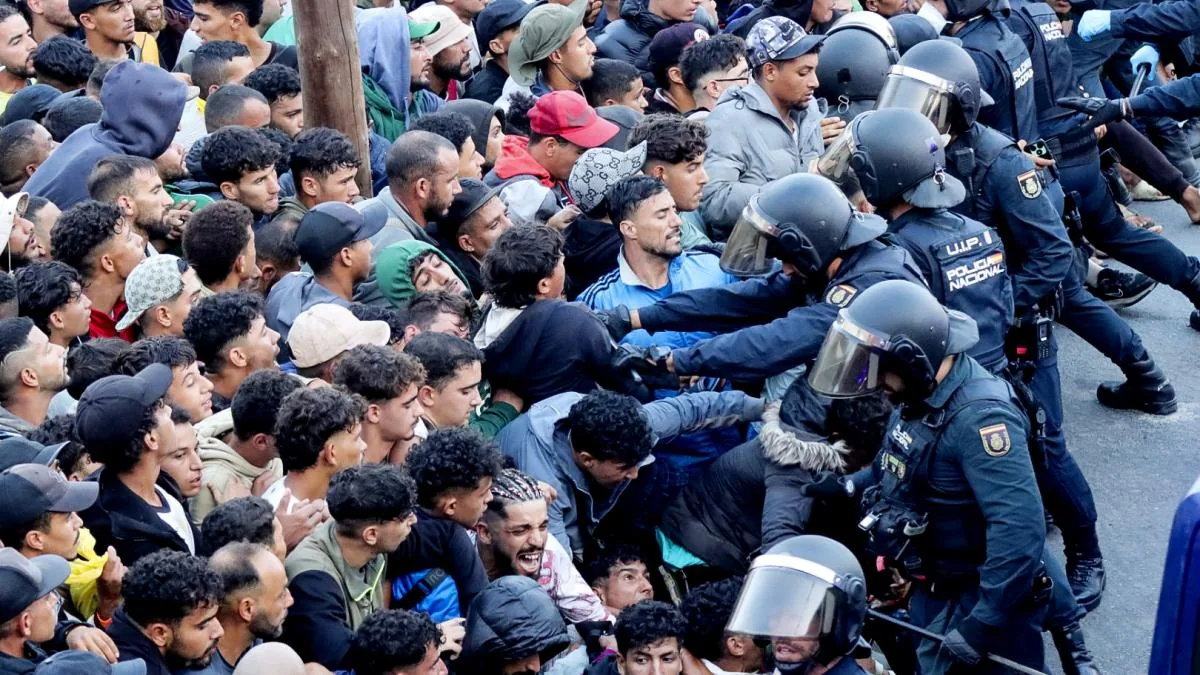
Pedro Sánchez will give explanations next week about Ceuta after a month of silence from the president. The carousel of ministers that preceded him has brought more confusion than anything else. We do not know what happened for almost 80,000 people to storm the Ceuta border in less than two days and, after listening to the statements, the only conclusion is that the Government does not know for sure either.
Read more The CIA director’s visit to Moscow sparks speculation about a Russian attack on NATO
The CNI emphasizes the mafias, which would have taken advantage of a Supreme Court ruling to spread via social networks that the border was open, that no one could be expelled if they arrived by swimming. The intelligence services are not willing to swallow the bitter pill of being responsible for not having detected the avalanche in time. Hence the firmness of its minister, the Defense minister, in assuring that they warned about what was going to happen. For the reputation of the CNI, this is not a minor issue.
But except for Margarita Robles, the rest of the Government maintains that only an increase in migrant arrivals was noticed and, in no case, such an assault. This is not simply another quarrel between the Defense minister and other cabinet colleagues, something already usual, but about the credibility of the secret services and the trust the Executive has in them. Probably only a declassification of the material issued on the matter would clear up the questions raised this week.
The Foreign Minister, José Manuel Albares, has defended Morocco’s cooperation, with whose government he maintains a fluid relationship. But if that is so, the secret services of that country would also have overlooked such a massive mobilization of people at the border. And, if they knew about it, it would mean that the relationship between the Moroccan Executive and its spies is not what it should be. All this framed in the imminence of that country’s legislative elections and the opacity that characterizes the regime.

Immigration will dominate the electoral mobilization despite the PSOE wanting to tone it down
At the same time, Albares pointed out the interests of Trumpism and its allies on social networks, who would seek to install the framework of the “invasion” of migrants through mobile phones as a mobilizing agent of the vote towards the far right. Thus, while young Maghrebis and Sub-Saharan Africans received on their phones the message of an open border to the European paradise, EU citizens saw on their devices images of a human avalanche storming into their territory. However, we do not know if those political agents merely took advantage of the occasion or were the instigators.
Read more Ceuta, facing the fear of breaking apart
This has been one of the few times Sánchez has not gauged the extent of the crisis from the first minute. Or, at least, he has not conveyed it as such. The limited reaction capacity shown is unusual in a president used to managing exceptional situations. The Government suffers daily blows on the judicial front and ended the term exhausted. In Ceuta, it has shown signs of fatigue, and the worst for Sánchez is that it happens in an issue especially damaging to the PSOE, since immigration is a divisive debate for its voters.
Indeed, immigration is and will continue to be the framework of the upcoming European electoral appointments. From the debate on the viability of the welfare state to the rise of parties with a strong identity component, everything will go through the sieve of rejection of immigration. There will be no shortage of material to stir up that flank if we consider that demography indicates a huge gap between Europe and Africa, with rapid aging of the population in the first case and accelerated growth and youth explosion in the second. The PP has joined demonstrations in more than 260 municipalities across Spain next Wednesday. Vox maintains a striking discretion given the circumstances. Even if Sánchez manages to accelerate a good part of the returns of migrants from Ceuta and a distribution by autonomous communities of many minors, immigration will be the great electoral argument and so far the PSOE has insisted on toning it down.
This year the Government has not had a break even in August and the term begins as it ended, with numerous pending judicial cases for alleged corruption accusations. Sánchez maintains his intention to complete the legislature and has accepted bitter pills, such as seeing his wife sit on the bench before a jury. The open cases will fall relentlessly on the Government’s management attempts. For now, one of the few supports would be the approval of the Budgets, although right now that seems a political miracle.
The Constitutional Court plans to greenlight Puigdemont’s return by the end of October
Although with little hope, Sánchez will continue trying to attract Junts. On the horizon is the closer return of Carles Puigdemont. The Constitutional Court plenary calendar has a couple of marked dates. One around September 22 for a plenary session in which the first of the four appeals filed by those convicted for the procés who have not been granted amnesty by the Supreme Court would be addressed. The report is led by magistrate José María Macias, from the conservative sector, and will almost certainly reject the appeal. From there, it may fall to the president of the TC, Cándido Conde-Pumpido. He is in charge of resolving another appeal from one of the convicted politicians and could do so favorably in the next plenary, on October 6. Puigdemont would have to wait for a new plenary, probably at the end of that month, when the appeals of those who were not judged, as in his case, would be addressed. This has fallen to magistrate Laura Díez, from the progressive sector, who would definitely greenlight Puigdemont’s immediate return. To what extent this will ease Sánchez’s parliamentary troubles remains to be seen.
Read more Sánchez’s bad summer